
When to Sell Gold: Exit Strategies & Profit-Taking Guide for 2026
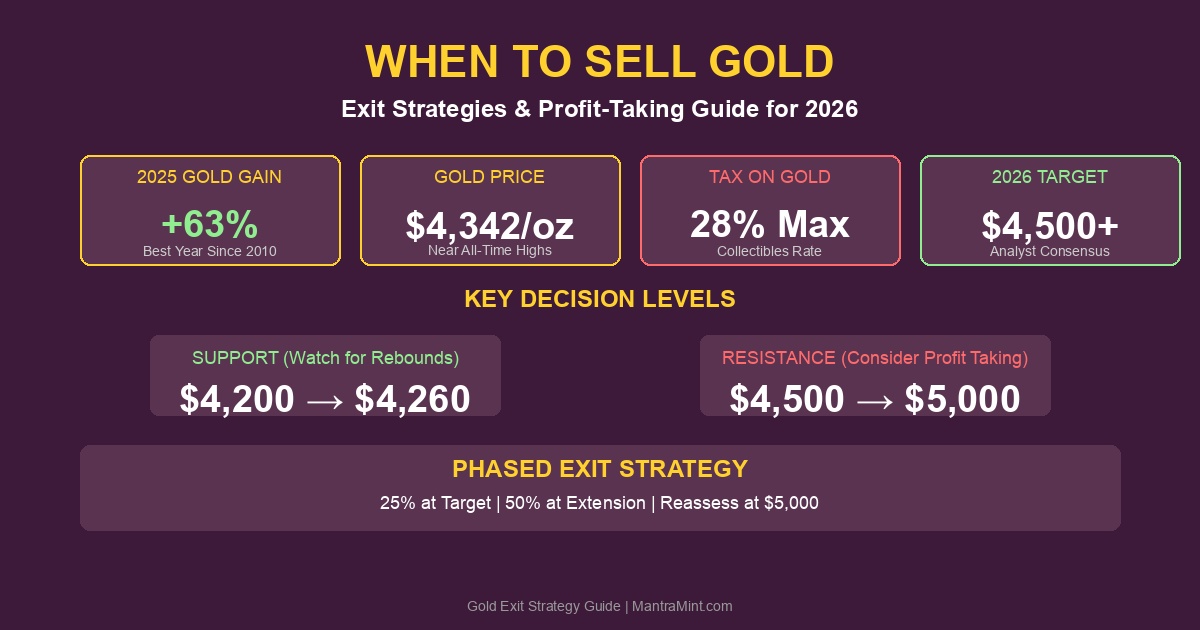
Gold delivered an extraordinary +63% return in 2025—its best year since 2010. With prices hovering near $4,342 per ounce and the all-time high of $4,550 within reach, many investors are asking the question that rarely gets discussed: When should you sell?
According to Investing.com, “Gold prices climbed as much as 55% and surpassed $4,000/oz for the first time in October 2025.” This historic rally has created significant unrealized gains for long-term holders—and with that comes the need for a thoughtful exit strategy.
Whether you’re looking to rebalance, lock in profits, or fund a major life expense, this guide provides a data-driven framework for deciding when and how to sell your gold.
Current Gold Market Snapshot
| Metric | Current Value | Notes | Source |
|---|---|---|---|
| Gold Spot Price | $4,342/oz | +0.4% weekly | Yahoo Finance |
| 2025 YTD Return | +63.3% | Best year since 2010 | Calculated |
| Silver Spot Price | $72.26/oz | +144% YTD | Yahoo Finance |
| Gold/Silver Ratio | 60.1 | Near 5-year low | Calculated |
| All-Time High | $4,549.78 | December 26, 2025 | LiteFinance |
Data via yfinance as of January 2, 2026
Why Most Investors Never Have an Exit Strategy
Most gold investment advice focuses on when to buy, not when to sell. This creates a dangerous situation where investors:
- Hold too long and watch gains evaporate during corrections
- Panic sell at bottoms after sharp pullbacks
- Miss opportunities to rebalance at optimal times
- Ignore tax implications until it’s too late
According to CNBC, “Rebalancing takes the emotion out of it. It puts the client in a position where they have a systematic approach that enables them to unemotionally sell high and buy low.”
The 4-Phase Exit Strategy Framework
Based on research from Discovery Alert and multiple financial advisors, here’s a systematic approach to gold profit-taking:
Phase 1: Initial Profit-Taking (25% Reduction)
When to Execute:
- Gold reaches your initial price target (e.g., +50% from purchase)
- RSI exceeds 70 (overbought territory)
- Portfolio gold allocation exceeds target by 5%+
Rationale:
- Lock in meaningful gains while maintaining 75% exposure
- Reduce concentration risk
- Generate liquidity for other opportunities
Phase 2: Moderate Rebalancing (50% Reduction)
When to Execute:
- Gold reaches major resistance (e.g., $4,500-$5,000)
- Technical indicators show divergence
- Fundamental thesis changes (Fed turns hawkish)
Rationale:
- Balance profit protection with upside participation
- Reduces emotional attachment to positions
- Provides significant capital for redeployment
Phase 3: Substantial Reduction (75% Reduction)
When to Execute:
- Extended overbought conditions (RSI >80 for weeks)
- Major fundamental shift (inflation collapses, yields surge)
- Personal liquidity needs (home purchase, education)
Rationale:
- Preserve the majority of gains
- Maintain minimal gold exposure for hedging
- Prioritize capital preservation over maximum gains
Phase 4: Complete Exit (100% Sold)
When to Execute:
- Compelling alternative opportunities emerge
- Personal financial circumstances require full liquidation
- Gold thesis completely invalidated
Rationale:
- Reserved for exceptional circumstances
- Most advisors recommend never going to 0% gold allocation
- Consider keeping 5-10% as permanent hedge
Key Price Levels to Watch in 2026
According to FX Empire and LiteFinance, here are the critical levels for exit decisions:
Support Levels (Potential Buying Opportunities)
| Level | Significance | Action |
|---|---|---|
| $4,260 | Key technical support | Hold; consider adding |
| $4,200 | Major psychological level | Strong support; don’t panic sell |
| $3,920 | 200-day moving average zone | Major test of trend |
| $3,625 | Previous resistance, now support | Would signal trend change |
Resistance Levels (Profit-Taking Zones)
| Level | Significance | Action |
|---|---|---|
| $4,400 | Near-term resistance | Consider Phase 1 (25% sale) |
| $4,500 | Major psychological barrier | Execute Phase 2 (50% sale) |
| $4,750-$4,850 | Analyst consensus high for 2026 | Consider Phase 3 |
| $5,000 | Major extension target | Significant profit-taking zone |
| $5,050 | 2.618 Fibonacci extension | Expect high volatility |
According to EBC Financial Group, “The $5,050 area (corresponding to the 2.618 Fibonacci extension) and its proximity to the psychological $5,000 level is likely to see higher volatility and increased profit-taking.”
Technical Indicators for Exit Timing
1. Relative Strength Index (RSI)
According to market strategists, “The Relative Strength Index (RSI) serves as a primary momentum oscillator, with readings above 70 typically indicating overbought conditions. For precious metals, sustained RSI readings above 80 have historically preceded significant price corrections.”
| RSI Level | Signal | Recommended Action |
|---|---|---|
| Below 30 | Oversold | Buy opportunity |
| 30-70 | Neutral | Hold position |
| 70-80 | Overbought | Consider partial sale |
| Above 80 | Extremely overbought | Execute profit-taking |
2. Bollinger Bands
“Bollinger Bands are a useful tool for spotting overextensions. When gold touches or exceeds the upper band, it often signals overbought conditions and a potential pullback.”
3. MACD (Moving Average Convergence Divergence)
“When the MACD line crosses below the signal line during uptrends, it may indicate momentum exhaustion and suggest profit-taking opportunities.”
Tax Implications of Selling Gold
The 28% Collectibles Rate
According to JM Bullion and Kiplinger, physical gold is taxed as a collectible:
| Holding Period | Tax Treatment | Rate |
|---|---|---|
| Less than 1 year | Short-term capital gains | Ordinary income rate (up to 37%) |
| More than 1 year | Long-term (collectibles) | Up to 28% (not 20%) |
Key Tax Considerations:
- The 28% Maximum: Unlike stocks (20% max), gold gains are taxed at up to 28% for long-term holdings
- Lower Brackets Pay Less: If your ordinary rate is 15%, you pay 15% on gold gains (not 28%)
- Net Investment Income Tax: High earners may owe an additional 3.8% NIIT on gold gains
- State Taxes: California, New York, and others add state capital gains taxes
Tax-Smart Selling Strategies
| Strategy | Description | Best For |
|---|---|---|
| Tax-Loss Harvesting | Offset gains with losses in other investments | High-gain years |
| Bracket Management | Time sales to stay in lower tax bracket | Pre-retirement |
| Charitable Giving | Donate appreciated gold to charity | Philanthropic investors |
| Installment Sales | Spread gains over multiple tax years | Large positions |
| Opportunity Zones | Reinvest gains in qualified zones | Tax deferral seekers |
According to SmartAsset, “To report your gold sales to the IRS, use Schedule D (Form 1040). If you sold at a loss, you can use that loss to offset gains from other investments.”
Gold ETFs vs Physical Gold: Different Exit Strategies
Physical Gold (Coins, Bars)
Pros for Selling:
- No counterparty risk during sale
- Can sell to local dealers instantly
- Private transactions possible (some limits)
Cons:
- Dealer spreads reduce proceeds (2-5%)
- May need to travel with valuable metals
- Storage costs end immediately
Gold ETFs (GLD, IAU)
Pros for Selling:
- Instant liquidity via brokerage account
- No physical handling required
- Lower transaction costs
Cons:
- Still taxed at 28% collectibles rate (not 20%)
- Must sell through market hours
- No flexibility on buyer selection
According to Investing News, “Gold and silver ETFs that hold physical metals are subject to a 28 percent maximum rate on long-term capital gains because the holdings are considered collectibles.”
Gold Mining Stocks
Tax Advantage: Long-term gains capped at 20% (not 28%) because stocks aren’t collectibles
| Investment Type | Long-Term Cap Gains Rate | Tax Efficiency |
|---|---|---|
| Physical Gold | Up to 28% | Lower |
| Gold ETFs (GLD, IAU) | Up to 28% | Lower |
| Gold Mining Stocks | Up to 20% | Higher |
| Gold IRA | Tax-deferred | Highest |
Portfolio Rebalancing: The Advisor’s Approach
How Much Gold Should You Own?
According to Proactive Advisor Magazine, “Research shows that gold enhanced risk-adjusted returns across a wide range of allocation levels, with an optimal allocation of 18% over the study period.”
| Risk Profile | Traditional Advice | Research-Based | 60/20/20 Model |
|---|---|---|---|
| Conservative | 5-10% | 15-20% | 20% |
| Moderate | 5-10% | 10-15% | 20% |
| Aggressive | 0-5% | 5-10% | 10-15% |
The 60/20/20 Strategy
According to Advisor Perspectives, analysts suggest “a quiet revolution is taking shape within investment portfolios because the traditional 60/40 model doesn’t work anymore.”
The new recommended allocation:
- 60% Equities
- 20% Bonds
- 20% Gold (replacing half of traditional bond allocation)
When to Rebalance
According to Advisor Perspectives:
| Strategy | Trigger | Pros | Cons |
|---|---|---|---|
| Annual | Once per year | Simple, tax-efficient | May miss opportunities |
| Quarterly | Every 3 months | More responsive | Higher transaction costs |
| Drift-Based | 5% deviation from target | Captures extremes | Requires monitoring |
| Tactical | Based on market conditions | Most responsive | Requires expertise |
“Notably, the more frequently you rebalance a portfolio, the more it tends to underperform, all else equal.”
2026 Price Forecasts: When Might You Sell?
Analyst Price Targets
| Institution | 2026 Target | Implied Move | Source |
|---|---|---|---|
| UBS | $4,500 (mid-year) | +3.6% | FX Leaders |
| Metals Focus | $4,560 (avg), $4,850 (peak) | +5% to +12% | LiteFinance |
| ING | $4,100 (average) | -5.6% | EBC |
| TD Securities | $4,400+ (H1) | +1.3% | NAGA |
| Commerzbank | $4,200 (year-end) | -3.3% | EBC |
Scenario Analysis
According to the World Gold Council’s 2026 Outlook:
| Scenario | Price Change | Trigger | Action |
|---|---|---|---|
| Bullish | +15% to +30% | Rate cuts, geopolitical stress | Phased profit-taking |
| Base Case | +5% to +15% | Gradual economic slowdown | Hold with annual rebalance |
| Bearish | -5% to -20% | Rising yields, strong dollar | Review thesis; possibly add |
When NOT to Sell Gold
According to CBS News, there are specific situations where selling may be premature:
Don’t Sell Because:
- “It’s at all-time highs” - New highs don’t predict reversals
- Short-term volatility - Gold can swing 5-10% in days
- Someone else is selling - FOMO works both ways
- You need quick cash - Emergency sales often get poor prices
Do Consider Selling When:
- Portfolio allocation exceeds target by 10%+
- Personal financial goals require capital (home, education)
- Thesis changes (inflation collapses, yields surge above 6%)
- Tax optimization opportunity (bracket management)
- Better opportunity emerges (with clear data supporting it)
The NRI Perspective: Selling Gold in the US vs India
For Indian-Americans, selling gold involves additional considerations:
Selling in the US
| Factor | Consideration |
|---|---|
| Tax Rate | 28% federal + state (CA adds 13.3%) |
| Reporting | Required on Schedule D |
| Currency | USD proceeds |
| Transaction | Bank/dealer/ETF sale |
Selling in India (Gold Held There)
| Factor | Consideration |
|---|---|
| Tax Rate | 12.5% LTCG (after 2 years) + indexation |
| Reporting | May trigger FBAR/FATCA requirements |
| Repatriation | Up to $1M/year allowed for NRIs |
| Currency Risk | INR/USD fluctuations affect USD value |
Gift vs Sale
For family wealth transfer, consider:
- US Annual Gift Exclusion: $18,000 per recipient (2025)
- India: No gift tax (recipient may owe income tax)
- Strategy: Gift appreciated gold instead of selling + gifting cash
Action Plan: Your Personal Exit Strategy
Step 1: Know Your Numbers
Calculate your:
- Cost basis (what you paid)
- Current value (today’s price × quantity)
- Unrealized gain (current - cost)
- Tax liability (gain × your effective rate)
Step 2: Set Price Targets
Based on your goals:
| Target | Price Level | Action | % of Position |
|---|---|---|---|
| Conservative | $4,400 | Phase 1 | 25% |
| Moderate | $4,700 | Phase 2 | 25% (50% total) |
| Aggressive | $5,000 | Phase 3 | 25% (75% total) |
| Final | Your call | Phase 4 | 25% (100%) |
Step 3: Set Alerts
Use tools like:
- Yahoo Finance price alerts
- TradingView notifications
- Broker mobile apps
Step 4: Prepare Logistics
- Know your dealer/broker selling process
- Have tax documentation ready
- Plan for proceeds reinvestment
Step 5: Execute Unemotionally
Stick to your plan regardless of market noise.
Key Takeaways
- Have a plan before you need one - Define exit triggers now, not in the moment
- Phased exits reduce risk - Don’t try to time the exact top
- 28% tax matters - Consider tax-loss harvesting and bracket management
- Rebalancing is selling too - Annual drift correction is a valid strategy
- $4,400-$5,000 is the profit-taking zone - Per analyst consensus
- Never go to 0% - Most advisors recommend 5-10% permanent allocation
Conclusion: Profit-Taking is Part of Investing
After gold’s remarkable +63% rally in 2025, taking some profits isn’t weakness—it’s wisdom. The goal isn’t to sell at the exact top (impossible to predict), but to systematically capture gains while maintaining appropriate exposure.
As Benjamin Offit, CFP notes, “Rebalancing takes the emotion out of it. It puts the client in a position where they have a systematic approach.”
For NRI investors, gold serves multiple purposes—portfolio hedging, cultural significance, and family wealth transfer. A thoughtful exit strategy ensures you benefit from all of them without being forced into panic decisions.
Build your systematic gold investment plan with Mantra Mint—buy, hold, gift, and yes, eventually sell—all on one platform designed for your goals.
Sources
- Yahoo Finance - Gold Futures (GC=F)
- Yahoo Finance - Silver Futures (SI=F)
- Investing.com - Gold 2026 Outlook
- LiteFinance - Gold Price Prediction & Forecast
- EBC Financial Group - Gold Price Forecast 2026
- FX Empire - Gold 2026 Forecast
- FX Leaders - Gold Price Forecast January 2026
- World Gold Council - Gold Outlook 2026
- CNBC - Portfolio Rebalancing
- Advisor Perspectives - Optimal Rebalancing Strategy
- Advisor Perspectives - 60/20/20 Portfolio Strategy
- Proactive Advisor Magazine - Gold Portfolio Allocation
- JM Bullion - Capital Gains on Precious Metals
- Kiplinger - How Collectibles Are Taxed
- SmartAsset - Avoid Capital Gains Tax on Gold
- Investing News - Tax on Gold/Silver Investments
- CBS News - Smart Gold Investing Moves 2026
Ready to start investing in gold?
Join thousands of Indian families building wealth with Mantra Mint.
Get Started Free