
When Stocks Fall, Gold Shines: Understanding the Relationship in 2026
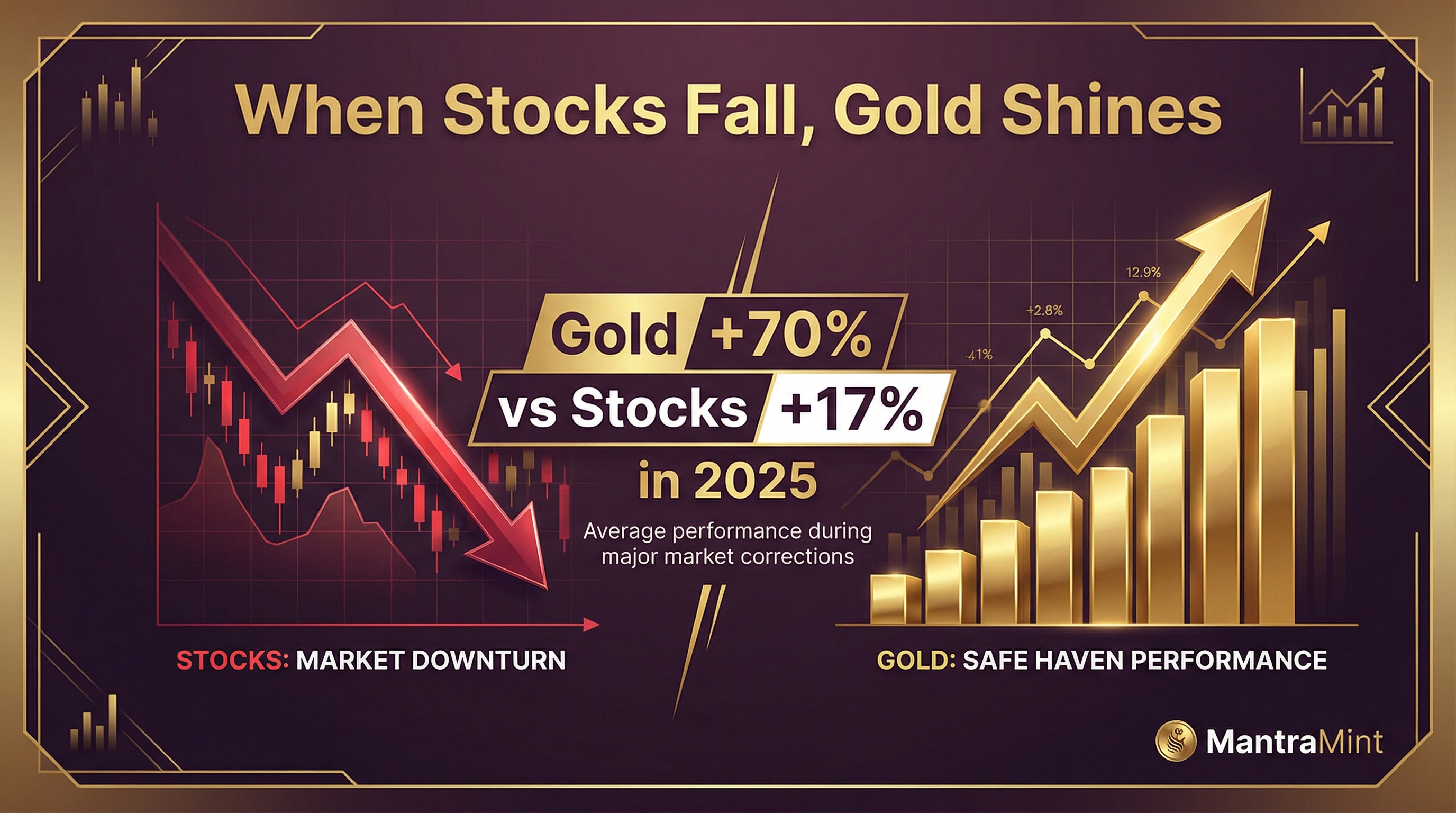
In 2025, gold delivered one of its most remarkable performances in history—surging over 70% while the S&P 500 gained a comparatively modest 17.9%. According to Advisor Perspectives, this performance gap marked one of the widest spreads between gold and stocks in modern market history.
But this isn’t just about comparing returns. It’s about understanding why gold tends to shine brightest when stock markets stumble—and how you can use this relationship to protect your portfolio in 2026.
According to the World Gold Council, gold’s correlation with stocks remains remarkably low at around 0.1-0.3, meaning gold moves largely independently from equity markets. This near-negligible correlation is exactly what makes gold so valuable during times of market stress.
Current Market Snapshot
| Metric | Current | 2025 Return | Source |
|---|---|---|---|
| Gold Spot Price | $4,599/oz | +70% | Yahoo Finance |
| Silver Spot Price | $88.16/oz | +180% | Yahoo Finance |
| S&P 500 | 6,944 | +17.9% | Yahoo Finance |
| Gold/Silver Ratio | 52.2 | Compressing | Calculated |
| Fed Funds Rate | 3.50-3.75% | Holding | Federal Reserve |
2025: The Year Gold Crushed Stocks
The performance gap between gold and stocks in 2025 tells a powerful story. According to The Motley Fool:
“Gold hit $4,000 per ounce in October 2025, up 51.6% year-to-date as of early October. Gold is off to a commanding lead in 2025, clearing the mythical $3,000/oz barrier and hitting fresh all-time highs.”
Head-to-Head: 2025 Performance
| Asset | 2025 Return | Key Driver |
|---|---|---|
| Gold | +70% | Safe haven demand, central bank buying |
| Silver | +180% | Industrial demand + monetary hedge |
| S&P 500 | +17.9% | Earnings growth, but high volatility |
| NASDAQ | +15.2% | Tech sector mixed |
| Bonds (AGG) | +1.8% | Rate uncertainty |
According to First Trust Portfolios, while the S&P 500’s 17.9% return was respectable, the path was anything but smooth:
“The S&P 500 Index experienced significant volatility, including an almost 19% decline during the first half of the year before rebounding to finish well in the green.”
This volatility is precisely where gold demonstrated its value—providing stability when stocks cratered.
Why Gold Outperforms When Stocks Fall
According to Allianz Global Investors, gold provides unique diversification properties:
“Gold provides diversification in a portfolio and is often correlated with the stock market during risk-on periods, while it decouples and becomes inversely correlated during periods of stress. This is unique amongst most hedges in the marketplace.”
Gold’s Crisis Track Record
According to Commons LLC research, gold’s performance during periods of market stress reveals its critical importance:
| Crisis Event | Stock Market | Gold Return | Gold’s Role |
|---|---|---|---|
| 2008 Financial Crisis | -37% | +5% | Crisis hedge |
| 2020 COVID Crash | -34% (peak-trough) | +25% | Safe haven |
| 2022 Rate Shock | -18% | -1% | Wealth preservation |
| 2025 Tariff Wars | -19% (H1) | +35% (H1) | Portfolio stabilizer |
According to Sprott’s 2026 outlook:
“Since 2008, gold has outperformed U.S. stocks and Treasuries during the most notable of market crises. This reflects gold’s role as a hedge against financial risks and safe haven amid uncertainty.”
The Correlation That Matters
The World Gold Council’s correlation data shows:
| Time Period | Gold-Stock Correlation | Implication |
|---|---|---|
| 20-year average | 0.14 | Low correlation |
| Crisis periods | -0.3 to -0.5 | Inverse (protective) |
| Bull markets | 0.2 to 0.4 | Modest positive |
| Current (2026) | Variable | Uncertainty premium |
This low correlation means gold moves largely independently from stock market movements—and often moves in the opposite direction during stress.
2026: Why the Gold-Stock Relationship Matters More Than Ever
The current market environment has elevated gold’s importance as a portfolio hedge. According to State Street Global Advisors:
“US stock/bond correlations soared to 30-year highs during the post-COVID inflation spike and Fed tightening cycle. If stock/bond correlations remain historically elevated, gold’s role as a diversifier and left-tail hedge becomes even more important.”
The 60/40 Portfolio Problem
Traditional 60/40 portfolios (60% stocks, 40% bonds) are facing a structural challenge. According to the World Gold Council’s 2026 outlook:
“Since 2008, gold’s correlation to the global 60/40 portfolio has trended lower, while other alternative asset classes have experienced an increase in their correlation to global 60/40 portfolios, potentially reducing the diversification benefits they provide.”
| Traditional Hedge | 2025 Performance | Correlation to Stocks |
|---|---|---|
| Bonds | +1.8% | Rising (problematic) |
| Gold | +70% | Low/negative in stress |
| REITs | +8% | High correlation |
| Commodities (ex-gold) | Mixed | Moderate correlation |
This is why institutional investors are adding gold to replace some of their bond allocation.
Three Factors Driving Gold’s Structural Strength
1. The Fed Independence Crisis
The Powell investigation has created unprecedented uncertainty about U.S. monetary policy. According to CNBC, the “Sell America” trade emerged as investors questioned Fed independence—driving flows into gold.
2. Central Bank Accumulation
Central banks have purchased over 1,000 tonnes of gold for three consecutive years. According to VanEck:
“Even with three consecutive years of more than 1,000 tonnes of central bank gold purchases, the structural trend of higher central bank buying has further to run in 2026.”
3. The De-Dollarization Shift
According to FXStreet:
“The market is no longer buying gold as a short-term safe-haven tool but rather as a long-term store of value asset. The overall trend has been ascending essentially because the market no longer trusts the dollar-dominated financial system.”
Historical Performance: Gold vs S&P 500
According to Monetary Metals, the long-term comparison reveals interesting patterns:
| Period | Gold CAGR | S&P 500 CAGR | Winner |
|---|---|---|---|
| Last 1 year | +70% | +17.9% | Gold |
| Last 5 years | +85% | +85% | Tie |
| Last 10 years | +8.2% | +11.4% | Stocks |
| Last 25 years | +9.0% | +7.7% | Gold |
| Last 30 years | +7.96% | +10.67% | Stocks |
According to CNBC’s analysis:
“Over a 30-year period through September, the annualized total return for gold is 7.96%. Over the same time frame, the total return of S&P 500 stocks is 10.67%.”
But this long-term comparison misses the key point: gold’s value isn’t in beating stocks consistently—it’s in protecting portfolios when stocks crash.
How Much Gold Should You Own?
Investment professionals recommend a modest allocation to gold. According to Advisor Perspectives:
“Some investment professionals view a modest allocation to gold—often cited in the 5–10% range—as one potential way to enhance diversification by balancing bullion and gold equities for both defensive stability and growth exposure.”
Portfolio Allocation Framework
| Risk Profile | Recommended Gold Allocation | Rationale |
|---|---|---|
| Conservative | 10-15% | Maximum protection |
| Moderate | 7-10% | Balanced approach |
| Aggressive | 5-7% | Diversification |
| High conviction | 15-20% | Structural bull view |
According to J.P. Morgan’s commodity research:
“If sized appropriately in a portfolio, the long-term case is good for gold. Central banks are buying and accumulating gold, there’s geopolitical risk, global debt levels are high. None of that guarantees performance, but it helps reinforce gold’s value as a strategic diversifier.”
What India/NRI Investors Should Know
For Indians in the USA, gold’s role extends beyond pure financial hedging. According to the World Gold Council:
“Both investors and central banks have increased their allocations to gold, seeking diversification and stability. Looking to 2026, the outlook is shaped by ongoing geoeconomic uncertainty.”
India-Specific Considerations
| Factor | Impact for NRIs |
|---|---|
| Rupee weakness (Rs 86.5/USD) | Gold gains amplified in INR terms |
| Cultural significance | Gold is both investment and tradition |
| Portfolio diversification | US stocks + gold provides balance |
| Gifting opportunities | Gold maintains value for family gifts |
The RBI has also been accumulating gold, bringing reserves to 880 tonnes—a vote of confidence from India’s central bank in gold’s strategic value.
2026 Price Forecasts
Major institutions remain bullish on gold’s outlook:
| Institution | 2026 Target | Upside | Key Driver |
|---|---|---|---|
| J.P. Morgan | $5,055/oz | +10% | Central bank buying |
| Goldman Sachs | $4,900/oz | +6.5% | Structural demand |
| Sprott | $4,500 (consolidation) | — | “Higher consolidation” |
| Bull Case | $6,000/oz | +30% | Full Fed crisis |
According to The Motley Fool’s January 2026 analysis:
“While there is potential for gold to set new record-highs in 2026, a performance similar to 2025 could be hard to come by. Although the conditions are perfect for more upside, investors should temper their expectations after its 64% gain in 2025.”
Action Framework for 2026
| Goal | Strategy | Implementation |
|---|---|---|
| Portfolio protection | Add 5-10% gold allocation | Start now, add on dips |
| Dollar-cost average | Monthly purchases | Systematic building |
| Correlation hedge | Increase gold when stocks rally | Rebalance quarterly |
| New Year planning | Set allocation targets | Review by end of January |
Key Takeaways
-
Gold +70% vs S&P +17.9%: 2025 demonstrated gold’s crisis outperformance
-
Low correlation (0.14): Gold moves independently from stocks, especially in crises
-
Crisis protection proven: +7.18% average gold return during stock drawdowns
-
60/40 challenge: Bonds aren’t diversifying—gold is filling the gap
-
Fed crisis continues: Powell investigation driving safe haven flows
-
Central banks accumulating: 1,000+ tonnes purchased for 3 consecutive years
-
5-10% allocation recommended: Professional consensus on gold weighting
-
J.P. Morgan targets $5,055: Major bank sees continued upside
The Bottom Line
The relationship between gold and stocks isn’t about which asset performs better over the long term—it’s about how they behave together during different market conditions.
Gold’s true value emerges during the moments investors need it most: when stocks plunge, when uncertainty spikes, when traditional hedges fail. The 2025 performance gap (gold +70% vs stocks +17.9%) wasn’t an anomaly—it was gold doing exactly what it’s supposed to do.
As we navigate 2026 with Fed independence under fire, central banks accumulating record gold reserves, and geopolitical tensions elevated, the case for holding gold alongside stocks has rarely been stronger.
The question isn’t whether gold will outperform stocks this year. It’s whether you’ll be protected when stocks inevitably face their next downturn.
Build Your Gold Allocation with MantraMint
Ready to add gold’s protective power to your portfolio? MantraMint makes it simple for Indians in the USA to build systematic gold positions.
Why MantraMint?
- Start with $10: Build your allocation gradually, no large commitments needed
- Auto-invest: Set up weekly or monthly purchases to dollar-cost average
- 24K pure gold: Investment-grade quality, fully backed
- Portfolio tracking: Monitor your gold holdings alongside other investments
- Gift gold: Share the wealth with family for any occasion
When stocks fall, you’ll be glad you had gold. Start building your position before the next market correction.
Start Investing Today — Because portfolio protection shouldn’t wait.
Sources
- Advisor Perspectives - S&P 500 Snapshot 2025
- World Gold Council - Gold Correlation Data
- The Motley Fool - Gold vs S&P 500 in 2025
- First Trust Portfolios - S&P 500 Index 2025 Recap
- Allianz Global Investors - Gold: The Portfolio Differentiator
- Commons LLC - Historical Correlation Between Gold and Stock Market
- Sprott - Gold & Silver Outlook 2026
- State Street - Gold 2026 Outlook
- World Gold Council - Gold Outlook 2026
- VanEck - Gold in 2025: Structural Strength
- FXStreet - Gold Price 2026 Forecast
- Monetary Metals - Gold vs S&P 500
- CNBC - Gold vs S&P 500 Returns
- J.P. Morgan - Gold Price Predictions
- Advisor Perspectives - Evolving Role of Gold
- The Motley Fool - SPDR Gold ETF 2026
- Yahoo Finance - Gold Futures (GC=F)
- Yahoo Finance - S&P 500 Index
- Federal Reserve - Interest Rates H.15
Ready to start investing in gold?
Join thousands of Indian families building wealth with Mantra Mint.
Get Started Free