
US National Debt Hits $38.4 Trillion: Why Gold Is Your Best Hedge Against America's Fiscal Crisis
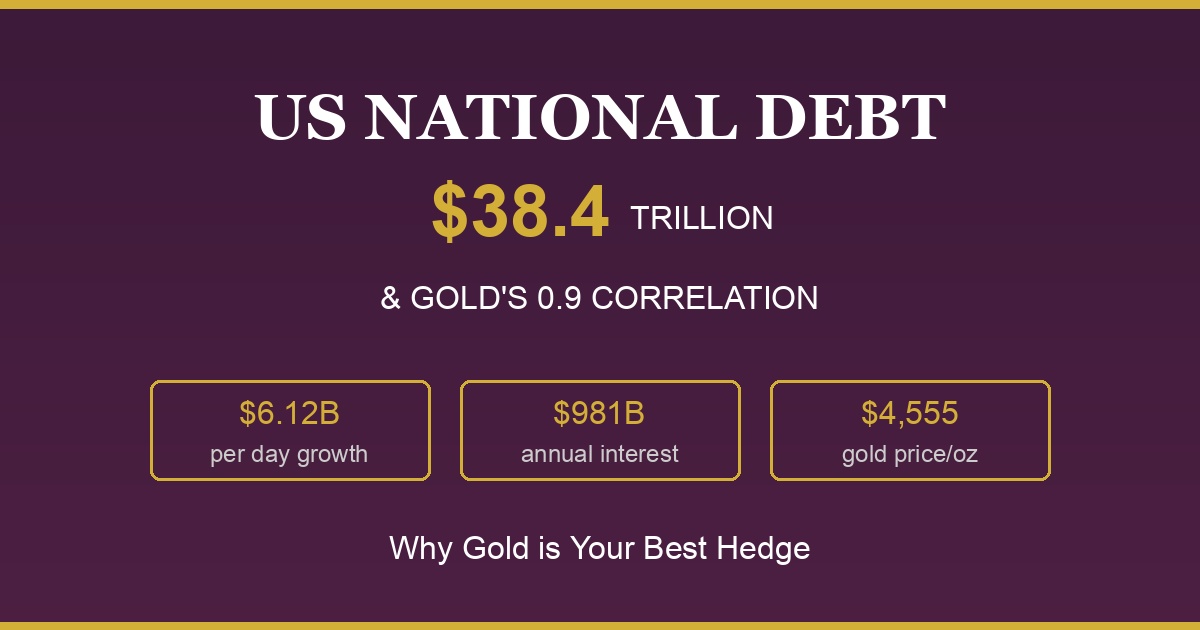
The US national debt just crossed $38.4 trillion—and it’s growing at a staggering $6.12 billion per day. According to the Congressional Joint Economic Committee, debt has increased $2.23 trillion in the past year alone. Meanwhile, gold has rallied to $4,555/oz, continuing a historic correlation that has tracked almost perfectly with US government debt for two decades.
This isn’t coincidence. Since 2000, gold and the national debt have shared a correlation coefficient of 0.9—one of the strongest relationships in financial markets. For every $15 trillion increase in debt, gold has historically risen approximately $1,000 per ounce. With debt now racing toward $40 trillion and beyond, understanding this relationship is crucial for protecting your wealth.
Current Market Snapshot
| Metric | Current | Change | Source |
|---|---|---|---|
| Gold Spot Price | $4,555/oz | +72% YTD | Yahoo Finance |
| Silver Spot Price | $74.59/oz | +150% YTD | Yahoo Finance |
| US National Debt | $38.40 trillion | +$2.23T YoY | JEC |
| Debt Growth Rate | $6.12 billion/day | Accelerating | JEC Data |
| Annual Interest Payments | $981 billion | Nearly 3x 2020 | CRFB |
| Debt-to-GDP | 100% | Historic level | Pew Research |
Gold Prices in India Today
| Metric | Price (₹) | Change | Source |
|---|---|---|---|
| 24K Gold (10g) | ₹1,40,020 | +₹770 | GoodReturns |
| 22K Gold (10g) | ₹1,28,350 | +₹700 | Market data |
| 18K Gold (10g) | ₹1,05,020 | +₹580 | Market data |
| Silver (1kg) | ₹2,40,000+ | Strong gains | Market data |
The Stunning 0.9 Correlation: Gold Tracks US Debt
According to Visual Capitalist and BullionVault, gold and US national debt have maintained a remarkably strong positive correlation since 2000:
The $15 Trillion / $1,000 Pattern
| Debt Level | Year | Gold Price | Pattern |
|---|---|---|---|
| $15 trillion | 2009 | ~$1,000/oz | Baseline |
| $30 trillion | 2020 | ~$2,000/oz | +$15T → +$1,000 |
| $38 trillion | 2025 | ~$4,500/oz | Pattern accelerates |
| $45 trillion | Est. 2028 | ? | Next target |
“Since the start of this century, national debt and gold have shared a strong positive correlation coefficient of 0.9. In simple terms, this means that both have tended to make similar moves day-to-day.” — BullionVault Analysis
Why This Correlation Exists
| Factor | How It Connects Debt to Gold |
|---|---|
| Inflation expectations | More debt → more money printing → higher inflation → gold rises |
| Dollar debasement | Rising debt undermines dollar confidence → gold as alternative |
| Interest rate pressures | High debt limits Fed’s ability to raise rates → gold benefits |
| Safe-haven demand | Fiscal uncertainty → investors seek gold protection |
| Central bank buying | Nations diversify away from US debt → buy gold instead |
The Debt Crisis in Numbers: Why It Matters Now
According to the Committee for a Responsible Federal Budget and Congressional Budget Office:
Debt Growth Timeline
| Milestone | Date | Time to Add |
|---|---|---|
| $0 to $10 trillion | 1776-2008 | 232 years |
| $10 to $20 trillion | 2008-2017 | 9 years |
| $20 to $30 trillion | 2017-2022 | 5 years |
| $30 to $38 trillion | 2022-2025 | 3 years |
| $38 to $45 trillion | Est. 2028 | 3 years |
Interest Payments: The Growing Monster
| Year | Annual Interest | Change |
|---|---|---|
| October 2020 | $345 billion | — |
| October 2025 | $981 billion | +184% |
| FY 2026 (projected) | $1.0+ trillion | First time ever |
| FY 2035 (projected) | $1.8 trillion | +76% from 2026 |
According to the Peter G. Peterson Foundation:
“In fiscal year 2025, the federal government spent $970 billion on interest payments on the national debt—the equivalent of 19 percent of all federal revenue collections and roughly $7,300 per household.”
What $970 Billion in Interest Means
| Comparison | Annual Cost |
|---|---|
| Interest on debt | $970 billion |
| Entire Medicare program | ~$900 billion |
| Defense Department | ~$850 billion |
| All infrastructure spending | ~$150 billion |
Interest payments are now the third-largest federal expenditure, behind only Social Security and Medicare.
Historical Debt Ceiling Crises and Gold Performance
According to Gold Price Forecast and CME Group:
The 2011 Crisis: A Case Study
| Event | Date | Gold Price | Change |
|---|---|---|---|
| Before downgrade | July 2011 | $1,615/oz | — |
| S&P downgrades US | August 5, 2011 | — | AAA → AA+ |
| After crisis | August 31, 2011 | $1,825/oz | +13% |
“Standard & Poor’s downgraded the United States’ credit rating from AAA to AA+ due to concerns over the country’s debt levels and gridlock over the debt ceiling. This led to a jump in market volatility and a surge in gold prices.” — US Gold Bureau
The 2023 Crisis
| Date | Event | Gold Movement |
|---|---|---|
| May 2023 | Debt ceiling standoff | Gold rallied to $2,050+ |
| June 3, 2023 | Ceiling suspended | Prices stabilized |
| June 2023-Dec 2024 | Post-crisis | Gold resumed uptrend |
2025: Another Ceiling Crisis Averted
According to the Bipartisan Policy Center:
| Date | Event |
|---|---|
| January 2, 2025 | Debt limit reinstated at $36.1 trillion |
| January 21, 2025 | Treasury begins extraordinary measures |
| August 2025 (CBO estimate) | X-date without action |
| July 4, 2025 | Congress raises ceiling by $5 trillion |
| New ceiling | $41.1 trillion |
The $5 trillion increase delays the next showdown by 1-2 years—but the underlying fiscal trajectory remains unchanged.
Who Holds America’s Debt?
According to Pew Research:
Breakdown of $38.4 Trillion
| Holder Type | Amount | Percentage |
|---|---|---|
| Debt held by public | $30.84 trillion | 80.3% |
| Intragovernmental debt | $7.56 trillion | 19.7% |
Top Foreign Holders
| Country | Holdings | % of Total Debt |
|---|---|---|
| Japan | $1.1+ trillion | 3.1% |
| United Kingdom | $809.4 billion | 2.2% |
| China | $756.3 billion | 2.1% |
Notable trend: China has been reducing its US Treasury holdings while simultaneously increasing gold reserves—a pattern followed by many central banks.
Central Banks Are Sending a Signal
According to the World Gold Council:
2024-2025 Central Bank Gold Buying
| Year | Tonnes Purchased | Key Buyers |
|---|---|---|
| 2022 | 1,082 tonnes | Record year |
| 2023 | 1,037 tonnes | Near-record |
| 2024 | 1,000+ tonnes | Continued strength |
| 2025 | On pace for record | Poland, China, India |
“Central banks are diversifying reserves away from the US dollar and into gold. This structural shift reflects concerns about US fiscal sustainability and the weaponization of the dollar in geopolitics.” — World Gold Council analysis
Why Gold Protects Against Fiscal Mismanagement
The Debasement Hedge
| Scenario | Impact on Dollar | Impact on Gold |
|---|---|---|
| Debt monetization | Loses purchasing power | Preserves value |
| High inflation | Erodes savings | Maintains real value |
| Currency crisis | Dollar devalues | Gold appreciates |
| Default risk | Treasury volatility | Safe-haven flows |
Historical Protection During Fiscal Crises
| Crisis | Period | Gold Performance |
|---|---|---|
| 1970s stagflation | 1971-1980 | +2,300% |
| 2008 financial crisis | 2008-2011 | +166% |
| COVID fiscal expansion | 2020-2025 | +127% |
| Current fiscal spiral | 2023-2025 | +90%+ |
What the Projections Tell Us
According to the Congressional Budget Office:
Debt Trajectory
| Year | Projected Debt | Debt-to-GDP |
|---|---|---|
| 2025 | $38.4 trillion | 100% |
| 2030 | $44+ trillion | 110%+ |
| 2035 | $50+ trillion | 118%+ |
Interest Payments Trajectory
| Year | Interest Payments | % of Revenue |
|---|---|---|
| 2025 | $970 billion | 19% |
| 2026 | $1.0+ trillion | 20%+ |
| 2035 | $1.8 trillion | 25%+ |
If the gold-debt correlation holds, these projections suggest:
- $44 trillion debt → Gold ~$5,000-5,500/oz
- $50 trillion debt → Gold ~$6,000+/oz
Practical Strategies for Debt-Driven Gold Investing
Portfolio Allocation Framework
| Investor Profile | Gold Allocation | Rationale |
|---|---|---|
| Conservative | 10-15% | Basic inflation hedge |
| Moderate | 15-20% | Fiscal concern hedge |
| Aggressive | 20-25% | Strong conviction in debt thesis |
| Maximum protection | 25-30% | Extreme fiscal concern |
Dollar-Cost Averaging Into Gold
| Frequency | Amount | Annual Investment |
|---|---|---|
| Weekly | $50 | $2,600 |
| Biweekly | $100 | $2,600 |
| Monthly | $200 | $2,400 |
When to Increase Gold Allocation
| Trigger | Action |
|---|---|
| Debt ceiling crisis approaches | Increase by 5% |
| Interest payments exceed $1T | Add to position |
| Credit rating downgrade | Significant increase |
| Debt-to-GDP exceeds 120% | Maximum allocation |
For Indian Investors: The Double Protection
Indian investors face two fiscal concerns:
- US fiscal trajectory - Affects global markets and dollar-denominated assets
- Rupee depreciation - INR weakens when dollar weakens against gold
NRI Advantage
| Scenario | Dollar Impact | Gold in USD | Gold in INR |
|---|---|---|---|
| US debt crisis | Weakens | Rises | Double benefit |
| Global risk-off | Mixed | Rises | Rises |
| Fed prints money | Weakens | Rises | Double benefit |
Gold offers NRIs protection against both US fiscal mismanagement AND rupee volatility.
The Bottom Line: Debt Isn’t Going Away—Neither Is Gold’s Appeal
The numbers are stark:
- $38.4 trillion in debt, growing $6.12 billion daily
- $981 billion in annual interest—nearly 3x 2020 levels
- 100% debt-to-GDP—a level historically associated with fiscal instability
- 0.9 correlation between gold and debt since 2000
- $4,555/oz gold price, up 72% YTD
The fiscal trajectory isn’t changing. Neither party is proposing debt reduction—the debate is only about how fast to increase spending. For investors seeking protection against this structural reality, gold’s track record speaks for itself.
Whether you’re concerned about inflation, currency debasement, or a full-blown fiscal crisis, gold has proven itself as the asset that benefits when governments mismanage their finances. The question isn’t whether the debt will keep growing—it’s whether you’ll be positioned to benefit when it does.
Start Protecting Your Wealth with Mantra Mint
As US debt races toward $40 trillion and beyond, building your gold position has never been more important. Mantra Mint makes it simple for Indians in the USA.
Why Gold, Why Now?
- $38.4 trillion debt and counting
- 0.9 correlation between gold and debt
- 72% gains YTD in 2025
- Central banks are buying record amounts
Why Mantra Mint?
- Start with $10 - Build your hedge gradually
- Auto-invest - Dollar-cost average into protection
- Instant liquidity - Sell anytime if needed
- No storage hassles - We handle the logistics
Don’t wait for the next debt ceiling crisis. Start building your gold position today.
Start Buying Gold Now — Your hedge against fiscal uncertainty.
Sources
- US Congress Joint Economic Committee - National Debt Update December 2025
- Pew Research Center - Key Facts About US National Debt
- Committee for a Responsible Federal Budget - Trillion-Dollar Interest Payments
- Congressional Budget Office - Federal Debt and Statutory Limit
- Visual Capitalist - Gold Price and US Debt 1970-2023
- BullionVault - Gold’s Correlation with US Federal Debt
- Bipartisan Policy Center - Debt Limit 2025
- Peter G. Peterson Foundation - Interest Tracker
- US Gold Bureau - Debt Ceiling Crisis and Gold
- CME Group - Debt Ceiling and Gold Analysis
- Gold Price Forecast - Debt Ceiling Explained
- World Gold Council - Central Bank Statistics
- Yahoo Finance - Gold Futures
- Yahoo Finance - Silver Futures
- GoodReturns - India Gold Rates
Ready to start investing in gold?
Join thousands of Indian families building wealth with Mantra Mint.
Get Started Free