
Temple Gold Donations in India: The Sacred Tradition of Offering Gold to the Gods
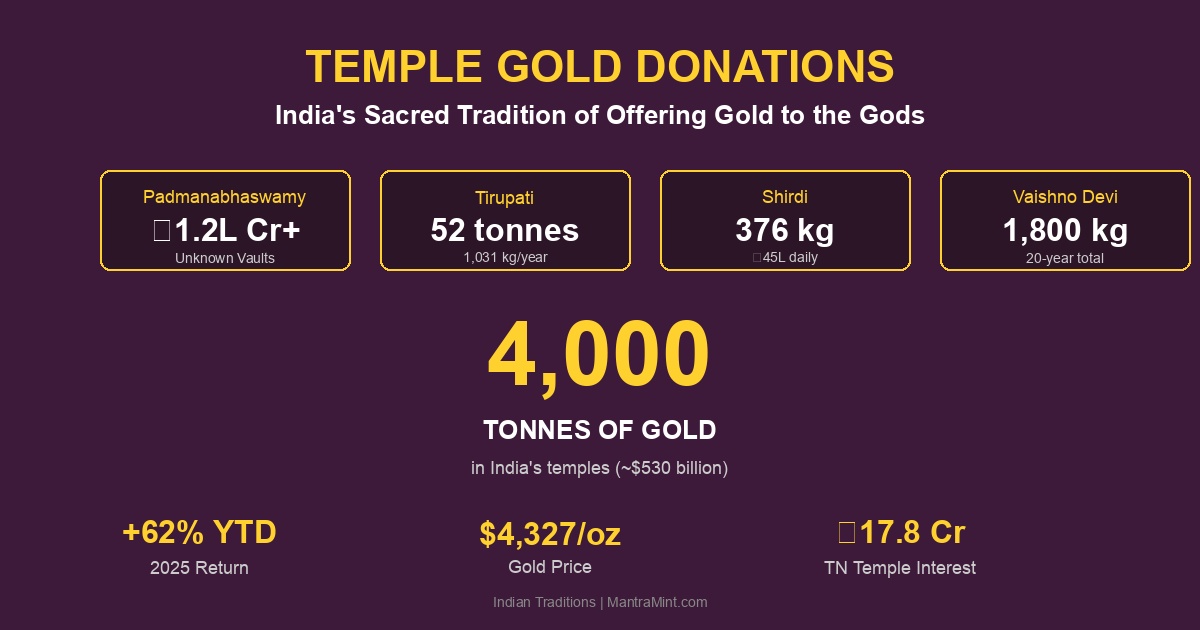
In a country where temples hold an estimated 4,000 tonnes of gold—more than the reserves of most central banks—the tradition of offering gold to deities represents one of humanity’s most enduring acts of devotion and wealth accumulation.
With gold delivering a stunning 62% return in 2025 and currently trading at $4,327 per ounce according to Yahoo Finance, the gold lying in India’s temple vaults has appreciated dramatically. Yet for millions of devotees, the spiritual value of these offerings far exceeds their material worth.
This comprehensive guide explores why Indians have offered gold to temples for millennia, which temples hold the most treasures, and how NRI families can participate in this sacred tradition.
Why Indians Offer Gold to Temples
Spiritual Motivations
According to Al Jazeera’s feature on temple gold, “Most of the temple gold is donated by devotees either seeking blessings or favours of their revered gods and goddesses.”
The tradition encompasses several spiritual beliefs:
| Motivation | Explanation |
|---|---|
| Divine Blessings | Offering precious gold invites deity’s favor |
| Karma Cleansing | Experts say many donate “to wash their sins” |
| Wish Fulfillment | Devotees offer gold when prayers are answered |
| Spiritual Merit | Donations are seen as pathways to dharma |
| Protection | Gold offerings seek divine protection for family |
Historical and Cultural Significance
According to En Route Indian History, “Historically, kings and wealthy patrons endowed temples with gold to seek divine blessings for prosperity and strength. These acts of generosity were seen as pathways to dharma—a righteous way of living aligned with divine principles.”
The tradition of temple jewelry, known as thiruvabharanam in Kerala, traces its origins to the 9th-century Chola kingdom, where highly skilled artisans crafted gold as offerings to adorn temple deities.
Social and Cultural Factors
Beyond spirituality, Arab News reports that donating to temples offers “social and cultural validation” to many. “While an ordinary devotee may pay small amounts out of love for the deity, there are public figures for whom large donations bring social prestige.”
India’s Richest Temples: A Gold Inventory
The Top 10 Wealthiest Temples (2025)
According to Jar App’s 2025 ranking, India’s temples hold staggering amounts of gold:
| Rank | Temple | Location | Estimated Net Worth | Gold Holdings |
|---|---|---|---|---|
| 1 | Padmanabhaswamy | Kerala | ₹1.2 lakh crore+ | Unknown (vaults) |
| 2 | Tirumala Tirupati | Andhra Pradesh | ₹2.5 lakh crore | 52 tonnes jewelry |
| 3 | Shirdi Sai Baba | Maharashtra | ₹2,000+ crore | 376 kg |
| 4 | Golden Temple | Punjab | ~$4 billion | 750 kg (dome) |
| 5 | Vaishno Devi | J&K | ₹500+ crore | 1,800 kg (20 yrs) |
| 6 | Siddhivinayak | Maharashtra | ₹125+ crore | 160 kg |
| 7 | Somnath | Gujarat | Undisclosed | 280 kg |
| 8 | Jagannath | Odisha | ₹150+ crore | Significant |
| 9 | Meenakshi | Tamil Nadu | ~$3 billion | Significant |
| 10 | Kashi Vishwanath | Uttar Pradesh | ₹2,100+ crore | Significant |
Sources: Holidify, MyTicketsToIndia
Padmanabhaswamy Temple: The World’s Richest
The Trillion-Dollar Mystery
Britannica documents that in 2011, “an exploration of its vaults revealed a wealth of jewels, precious metals, and other treasures estimated to be worth 1 trillion rupees, or $22 billion.”
The discovery of what lay in the temple’s underground vaults stunned the world:
| Item Discovered | Description |
|---|---|
| Gold Coins | 800 kilograms |
| Gold Chain | 18-foot pure gold chain |
| Gold Sheaf | 500 kilograms |
| Gold Ornaments | More than 2,000 pieces |
| Golden Throne | Studded with hundreds of diamonds |
| Golden Idols | Several precious statues |
Source: The Archaeologist
The Mysterious Vault B
Five of six vaults have been opened, but Vault B remains sealed under Supreme Court order. According to The Archaeologist, “According to a calculation by the Travancore Royal Family, the treasure in the unopened Vault B alone could be worth at least one trillion dollars in present value.”
Historical Accumulation
The temple’s treasures weren’t accumulated overnight. According to historical accounts, “The artifacts were amassed over the course of many thousand years and were given to the Deity by a number of Indian dynasties, as well as by traders and kings from Mesopotamia, Jerusalem, Greece, Rome, and other places.”
During invasions, smaller temples in Kerala transferred their treasures to Padmanabhaswamy Temple for security, concentrating wealth over centuries.
Tirumala Tirupati: The People’s Temple
Annual Gold Donations
According to Tarakesh, “In 2023, Tirumala temple received a staggering 1,031 kilograms of gold, estimated at ₹773 crore—one of the highest annual gold donations in temple history.”
The scale of devotion at Tirupati is staggering:
| Metric | Data |
|---|---|
| Daily Pilgrims | 60,000+ |
| Annual Gold Donations | 1,000+ kg |
| Total Gold Jewelry | 52 tonnes |
| Gold in Banks (GMS) | 10.25 tonnes (₹5,309 cr) |
| Total Assets | ₹2.5 lakh crore |
| Annual Revenue | ₹4,385 crore |
Sources: Tirumala.org, India Tribune
Why Devotees Choose Tirupati
The temple of Lord Venkateswara (a form of Vishnu) is considered especially powerful for wish fulfillment. Devotees often:
- Offer gold when prayers are answered
- Donate gold equivalents of vows made
- Give jewelry as gratitude for health, wealth, or family blessings
- Make offerings during auspicious occasions
Gold Plating Projects
According to TTD News, the temple continuously undertakes gold plating projects, including the Srivari Nilayam, using donated gold to enhance the sanctum’s divine appearance.
Regional Temple Gold Traditions
Vaishno Devi Shrine (Jammu & Kashmir)
According to India.com, “An RTI revealed that the Hindu shrine received 1,800 kgs of gold, over 4,700 kgs of silver and a whopping Rs 2,000 crore cash from devotees in the last two decades.”
However, the RTI also revealed that 43 kg of the 193.5 kg gold received in one five-year period was found to be fake—highlighting the need for verification.
Shirdi Sai Baba Temple (Maharashtra)
The Sai Baba temple possesses 376 kg of gold and sees donations of ₹45 lakh daily, especially during festivals. Gold and silver bricks, ornaments, and currency from around the world pour in regularly.
Somnath Temple (Gujarat)
Despite being looted and demolished seventeen times throughout history for its gold repository, Somnath Temple still possesses 130 kg of gold in its sanctum and 150 kg on its spire, according to GoDigit.
Golden Temple (Amritsar)
The iconic Harmandir Sahib features approximately 750 kg of gold covering its dome and upper levels, making it one of the most visually stunning religious sites in the world.
The Gold Monetization Scheme: Temples Earning Interest
How Temples Are Monetizing Gold
India’s government launched the Gold Monetization Scheme (GMS) to mobilize idle gold. According to Business Standard, temples have become significant participants.
| Temple/State | Gold Deposited | Annual Interest |
|---|---|---|
| Tirumala Tirupati | 10.25 tonnes | ~₹230 crore |
| Tamil Nadu (21 temples) | 1,074 kg | ₹17.81 crore |
| Ambaji Temple | 168 kg | Earning 2.25-2.5% |
| Somnath Temple | ~32 kg | Earning 2.25-2.5% |
Tamil Nadu’s Model
According to DTNext, “Gold ornaments weighing 1,074 kg, offered as donations to various temples and lying unutilised, were melted into bars and deposited with SBI’s gold investment scheme.”
Gujarat’s Contribution
According to DeshGujarat, “Ambaji Temple and Somnath Temple have collectively deposited close to 200 kg of gold in public sector banks under GMS.”
How Devotees Can Donate Gold
At Major Temples
Most major temples have organized systems for gold donations:
| Temple | Donation Process |
|---|---|
| Tirupati | Dedicated counters, receipts issued, all gold weighed and documented |
| Padmanabhaswamy | Donations accepted through temple trust |
| Shirdi | Daily collection, all denominations accepted |
| Vaishno Devi | Collection boxes and dedicated donation counters |
Types of Gold Donations
| Donation Type | Description | Common Occasions |
|---|---|---|
| Gold Coins | 2g to 100g coins | Prayer fulfillment |
| Jewelry | Chains, bangles, rings | Milestone blessings |
| Gold Ornaments | Deity-specific pieces | Festival donations |
| Gold Bars | Larger donations | Major vows fulfilled |
Tax Implications for Temple Donations
The Reality for Gold Donations
According to Tax2win, gold donations do NOT qualify for Section 80G tax deductions because they are in-kind contributions.
| Donation Type | Tax Deductible? | Conditions |
|---|---|---|
| Gold/Jewelry | ❌ No | In-kind donations not eligible |
| Cash (up to ₹2,000) | ✅ 50% | Temple must have 80G registration |
| Bank Transfer/Digital | ✅ 50% | Temple must have 80G registration |
| For Renovation/Repair | ✅ 50% | Notified temples only |
Source: ClearTax
Important Limitations
According to IndiaFilings:
- Only monetary donations qualify for 80G
- Maximum deduction is 50% of donation amount
- Subject to 10% of adjusted gross total income limit
- Only available under Old Tax Regime
- Temple must be registered under Section 12A and 80G
NRI Considerations for Temple Gold Donations
Participating from Abroad
NRIs can continue this tradition through several methods:
| Method | Pros | Cons |
|---|---|---|
| Visit During Pilgrimage | Direct offering, spiritual experience | Travel required |
| Family Representatives | Gold reaches temple | Trust required |
| Temple Trust Online | Some temples accept online donations | Usually cash only |
| Digital Gold | Easy to accumulate, can gift to family for donation | Conversion needed |
Customs Considerations
When bringing gold to India for temple donation:
| Category | Duty-Free Limit | Notes |
|---|---|---|
| Male Travelers | 20g jewelry (≤₹50,000) | Must be worn |
| Female Travelers | 40g jewelry (≤₹1,00,000) | Must be worn |
| Gold Bars/Coins | No duty-free limit | ~16.25% customs duty |
Source: Muthoot Gold Point
The Spiritual vs. Financial Perspective
Sacred Nature of Temple Gold
According to CoinWeek, “Coins that are offered as an act of religious devotion are considered sacred. This makes the effort to put any of these temples’ gold to use much more complicated due to the sensitivity of the subject.”
This explains why:
- Most temple gold remains unutilized
- Only 37.81 tonnes mobilized under GMS (vs. 4,000 tonnes held)
- Discussions about using temple gold spark controversy
- Many devotees prefer their offerings remain with the deity
The Investment Angle
From a pure financial perspective, gold donated to temples in 2005 (at ~$450/oz) would be worth 860% more today at $4,327/oz. But for devotees, the spiritual return—blessings, peace, karma—is immeasurable.
Alternative Ways to Honor the Tradition
For those who wish to honor the spirit of temple gold donations without physical offerings:
Modern Alternatives
| Alternative | Description | Benefit |
|---|---|---|
| Monthly Gold SIP | Systematic gold investment | Builds wealth for pilgrimage/donation |
| Digital Gold Fund | Accumulate for future temple visit | No storage concerns |
| Temple Trust Donations | Monetary support for temple upkeep | 80G eligible if cash |
| Community Sponsorship | Fund temple events or services | Social impact |
Creating Your Own Tradition
Some families create personal traditions that combine investment with devotion:
- Buying gold on auspicious days (Akshaya Tritiya, Dhanteras)
- Setting aside a portion of gold purchases for eventual donation
- Teaching children about gold’s spiritual significance
- Building a “temple fund” over time
Current Gold Market Context
As of December 31, 2025:
| Metric | Current Value | Source |
|---|---|---|
| Gold Price (USD) | $4,327/oz | Yahoo Finance |
| Gold Price (INR) | ~₹1,36,300/10g | Market rates |
| 2025 YTD Return | +62% | Yahoo Finance |
| India Temple Gold | ~4,000 tonnes | Business Standard |
At current prices, India’s temple gold holdings are worth approximately $530 billion—more than the GDP of many countries.
Conclusion: Faith, Tradition, and Wealth
India’s temple gold tradition represents something remarkable: a system where devotion, cultural identity, and wealth preservation have coexisted for millennia. The gold in Tirupati’s vaults, Padmanabhaswamy’s chambers, and countless other temples across India isn’t just treasure—it’s a testament to the faith of hundreds of millions of people across thousands of years.
For NRI families, continuing this tradition—whether through physical donations during pilgrimages or building gold portfolios for future offerings—connects them to something ancient and meaningful.
After gold’s 62% rally in 2025, the material value of temple gold has never been higher. But for true devotees, the value was never about the price. It was always about the offering.
Looking to build your gold portfolio for future temple pilgrimages or family traditions? Mantra Mint makes it easy for NRIs to buy, accumulate, and gift digital gold—honoring ancient traditions with modern convenience.
Sources
- Yahoo Finance - Gold Futures (GC=F)
- Jar App - Richest Temples in India 2025
- Tirumala.org - Donations
- Tarakesh - Who Donated Most Gold to Tirupati
- The Archaeologist - Padmanabhaswamy Temple Treasure
- Britannica - Padmanabhaswamy Temple
- Al Jazeera - Eyeing God’s Gold in India
- Arab News - India’s Rich Temples
- En Route Indian History - Gods Cast in Gold
- India.com - Vaishno Devi Temple Donations
- GoDigit - Richest Temples in India
- Business Standard - Tamil Nadu Temples Gold Monetisation
- IBEF - Gold Monetization Scheme
- Tax2win - Section 80G Deduction
- ClearTax - Donations Under Section 80G
- Business Standard - Temples Hold 4,000 Tonnes Gold
Ready to start investing in gold?
Join thousands of Indian families building wealth with Mantra Mint.
Get Started Free