
The Nixon Shock: How August 15, 1971 Changed Gold Forever
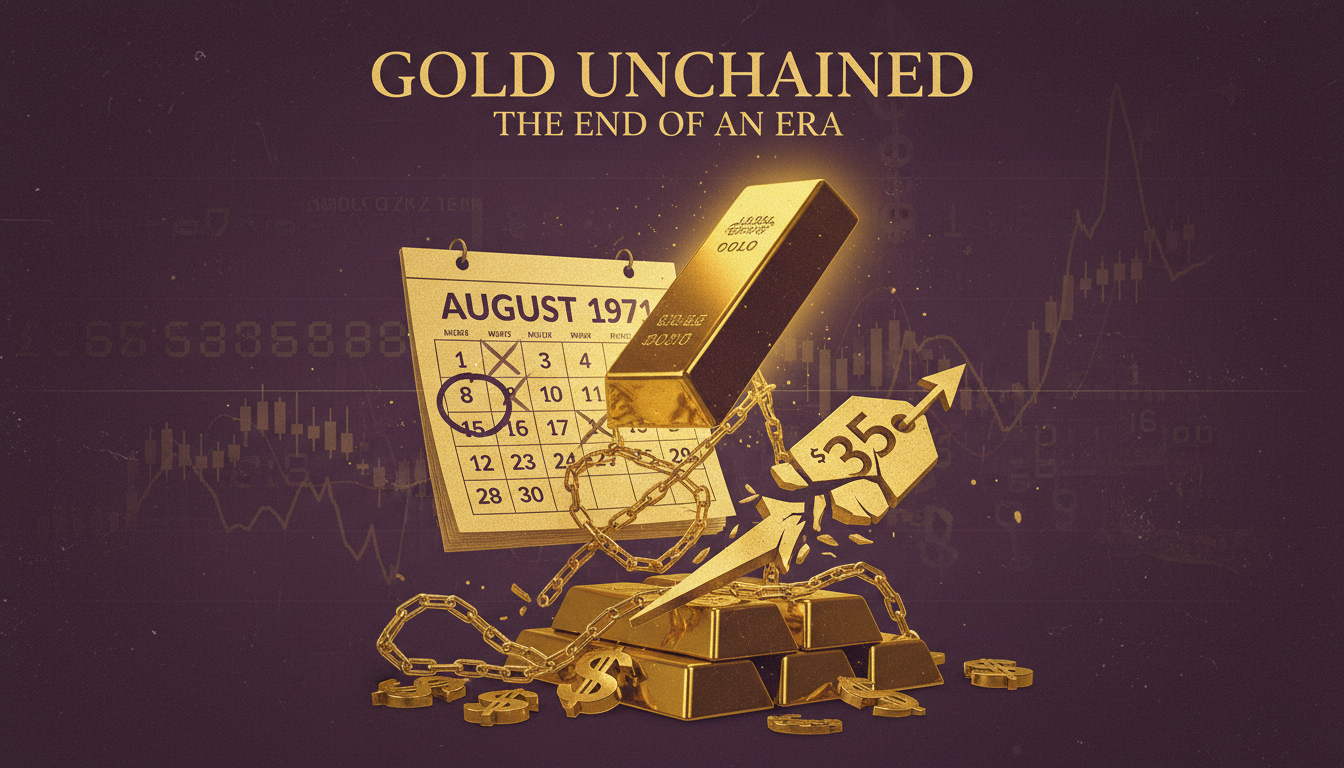
Fifty-five years ago, on a summer Sunday evening, President Richard Nixon addressed the nation from the Oval Office and uttered words that would fundamentally transform the global financial system. In 15 minutes, he ended an arrangement that had governed international money for nearly three decades—and freed gold to find its true market value.
Since that night, gold has risen from $35 per ounce to over $4,600—a gain of more than 13,000%. Understanding what happened on August 15, 1971, and why it happened, provides crucial context for anyone investing in gold today.
The Three Days That Changed Everything
The Secret Camp David Meeting
According to the Federal Reserve History archive, with inflation rising and a gold run looming, Nixon summoned his top economic advisers to Camp David for an emergency weekend meeting from August 13-15, 1971.
The attendees included some of the most influential economic minds of the era:
| Attendee | Role | Later Significance |
|---|---|---|
| John Connally | Treasury Secretary | Architect of the plan |
| Arthur Burns | Federal Reserve Chairman | Reluctant participant |
| Paul Volcker | Undersecretary for International Monetary Affairs | Later Fed Chairman (1979-87) |
| George Shultz | OMB Director | Later Secretary of State |
| Herbert Stein | Council of Economic Advisers | Coined “Nixonomics” |
According to Yale Insights, the State Department and National Security Council were deliberately excluded—they learned about the meeting only after it was underway.
The Crisis They Faced
According to Wikipedia, by August 1971, the U.S. faced a convergence of economic pressures:
| Metric | August 1971 Value | Context |
|---|---|---|
| U.S. Gold Reserves | 10,000 tonnes | Less than half the peak |
| Unemployment Rate | 6.1% | Politically dangerous |
| Annual Inflation | 5.84% | “Stagflation” emerging |
| Gold Window Exposure | Massive | Foreign governments held $30B+ in dollars |
Foreign governments, particularly France under President Pompidou, had begun demanding gold for their dollar holdings. According to the Office of the Historian, France actually sent a battleship to New York to collect its gold reserves. On August 9, Switzerland left the Bretton Woods system entirely.
The system was cracking.
What Was the Bretton Woods System?
The Post-War Monetary Order
According to the Federal Reserve, the Bretton Woods system was established in 1944 when 44 countries met in New Hampshire to create a stable post-war monetary order:
| Feature | How It Worked |
|---|---|
| Dollar-Gold Link | $35 = 1 oz gold (fixed) |
| Currency Pegs | All currencies fixed to dollar |
| Convertibility | Foreign governments could exchange dollars for gold |
| Adjustment Mechanism | IMF supervised, changes required approval |
The system worked brilliantly for two decades. According to Econlib, the gold standard provided “a nearly automatic mechanism for keeping the balance of payments in equilibrium.”
Why It Broke Down
According to CITECO, several factors combined to doom the system:
| Factor | Impact |
|---|---|
| Vietnam War spending | Flooded world with dollars |
| Great Society programs | Increased fiscal deficits |
| European recovery | Competitive exports challenged U.S. |
| ”Triffin Dilemma” | System’s inherent contradiction |
The Triffin Dilemma, named after economist Robert Triffin, highlighted the fundamental problem: the world needed dollars for trade, but producing more dollars meant U.S. gold backing became increasingly inadequate.
Nixon’s Announcement: August 15, 1971
What He Said
According to the Office of the Historian, Nixon addressed the nation at 9 PM on Sunday, August 15, preempting the popular TV show Bonanza:
“I have directed Secretary Connally to suspend temporarily the convertibility of the dollar into gold.”
The word “temporarily” would prove misleading—gold convertibility never returned.
The Complete Package
Nixon’s “New Economic Policy” contained three major components:
| Measure | Purpose |
|---|---|
| Close the “gold window” | End dollar-gold convertibility |
| 90-day wage and price freeze | Combat inflation |
| 10% import surcharge | Pressure trading partners |
According to the Federal Reserve History, this marked “the first time the government enacted wage and price controls outside of wartime.”
Immediate Aftermath
The Smithsonian Agreement of December 1971 attempted to salvage fixed exchange rates:
| Adjustment | Change |
|---|---|
| Gold price | $35 → $38 per ounce |
| Dollar devaluation | 7.9% |
| Trading bands | Widened to ±2.25% |
| Import surcharge | Dropped |
But this bandage wouldn’t hold. By 1973, the Bretton Woods system was completely abandoned, and currencies began floating freely.
Gold’s Journey: From $35 to $4,659
The Price Explosion
According to Macrotrends historical data, gold’s price journey since 1971 has been extraordinary:
| Year | Gold Price | Change from $35 | Key Event |
|---|---|---|---|
| 1971 | $35 | — | Nixon closes gold window |
| 1974 | $183 | +423% | Americans can legally own gold again |
| 1980 | $850 | +2,329% | Stagflation peak, Iran crisis |
| 1990 | $386 | +1,003% | Post-crash stabilization |
| 2000 | $279 | +697% | Tech bubble, gold forgotten |
| 2011 | $1,900 | +5,329% | Post-2008 crisis safe haven |
| 2020 | $2,072 | +5,820% | COVID-19 pandemic |
| 2024 | $2,690 | +7,586% | Central bank buying surge |
| 2026 (Current) | $4,659 | +13,211% | Post-crash recovery |
Why Gold Rose So Dramatically
Several factors drove gold’s appreciation after 1971:
| Factor | Impact |
|---|---|
| Removed price ceiling | Market could finally price gold freely |
| Inflation hedge demand | 1970s stagflation drove buying |
| Central bank reserves | Governments continued holding gold |
| Investor demand | New asset class for portfolios |
| Supply constraints | Mining output relatively stable |
According to JM Bullion, gold increased 659% during just the 2000-2011 bull market alone.
India’s Gold Story: A Parallel History
The Gold Control Era (1962-1990)
While Nixon was ending gold convertibility in the U.S., India was taking the opposite approach.
According to historical records, India’s gold restrictions actually predated the Nixon Shock:
| Year | Indian Gold Policy |
|---|---|
| 1962 | Gold Control Act after China border conflict |
| 1963 | Jewelry above 14 carats banned |
| 1965 | Gold bond scheme launched |
| 1968 | Citizens prohibited from owning gold bars/coins |
| 1990 | Gold Control Act abolished |
| 1992 | Gold imports liberalized |
Under the 1968 Gold (Control) Act:
- Citizens couldn’t own gold bars or coins
- Goldsmiths limited to 100 grams
- Licensed dealers capped at 2 kg
- All existing holdings had to be converted to jewelry
The Unintended Consequences
Finance Minister Morarji Desai believed Indians would stop consuming gold. Instead:
- Massive smuggling networks developed
- Black market premiums soared
- Foreign exchange continued draining through unofficial channels
- The government lost potential tax revenue
Liberalization and the Modern Era
When India liberalized gold imports in 1992:
- Official imports went from nearly zero to 110 tonnes
- Prices aligned with international markets
- Gold became a legitimate investment asset
Today, according to the World Gold Council, India spends approximately $49 billion annually on gold jewelry alone.
The 2026 Context: History Rhymes
January 2026’s Flash Crash
Just as the Nixon Shock represented a dramatic monetary policy shift, January 2026 brought its own shock.
According to CNBC, on January 30, 2026:
| Metal | Drop | Context |
|---|---|---|
| Gold | -11% from ATH | Largest single-day drop in 13 years |
| Silver | -30% | Worst day since 1980 Hunt Brothers collapse |
The catalyst? News that Trump’s administration was preparing to nominate Kevin Warsh as Federal Reserve Chair—perceived as hawkish on monetary policy.
Current Market Snapshot (February 2, 2026)
| Metric | Value | Weekly Change |
|---|---|---|
| Gold | $4,659.80/oz | -12.1% |
| Silver | $76.87/oz | -32.0% |
| Gold/Silver Ratio | 60.6 | — |
According to Finance Magnates, this was the most violent “flash crash” in precious metals in recent history.
What History Teaches Us
The Nixon Shock and the January 2026 crash share common elements:
| Element | 1971 | 2026 |
|---|---|---|
| Policy surprise | Closing gold window | Fed Chair nomination |
| Market dislocation | End of fixed prices | Flash crash |
| Long-term result | Massive gold appreciation | To be determined |
History suggests that policy-driven price dislocations often create opportunities for patient investors.
Why This History Matters for NRI Investors
Gold’s Proven Track Record
For Indians in the USA, understanding gold’s history since 1971 provides perspective:
| Timeframe | Gold Return | S&P 500 Return | Winner |
|---|---|---|---|
| 1971-1980 | +2,329% | +42% | Gold |
| 1980-2000 | -67% | +1,336% | Stocks |
| 2000-2011 | +581% | -0.5% | Gold |
| 2011-2020 | +9% | +200% | Stocks |
| 2020-2026 | +125% | +40% | Gold |
Gold doesn’t always win, but it often wins when you need protection most.
The Cultural Continuity
For NRIs, gold represents more than an investment:
| Aspect | Significance |
|---|---|
| Tradition | Thousands of years of Indian gold culture |
| Family wealth | Passed through generations |
| Financial security | Insurance against uncertainty |
| Celebration | Central to weddings, festivals, milestones |
The Nixon Shock freed gold to reflect its true value. That value includes not just industrial and financial utility, but cultural and emotional significance that transcends price charts.
Key Takeaways
-
August 15, 1971 changed everything: Nixon’s decision to close the gold window ended the fixed $35 price and allowed gold to find its market value
-
Gold has risen 13,200% since: From $35 to over $4,600, demonstrating the metal’s long-term appreciation potential
-
Policy shocks create opportunities: Both 1971 and January 2026 show that dramatic policy shifts can precede significant price moves
-
India’s gold story parallels: While the U.S. freed gold prices, India restricted ownership—both eventually moved toward market-based systems
-
Current prices reflect history: Today’s $4,659/oz price represents five decades of monetary evolution since the Nixon Shock
-
Cultural value persists: For Indians, gold’s significance extends beyond financial returns to family, tradition, and celebration
Build Your Gold Legacy with MantraMint
The Nixon Shock taught us that gold’s value transcends any government’s attempts to fix its price. Fifty-five years later, gold remains the ultimate store of value—and for Indians in the USA, it represents both financial wisdom and cultural heritage.
Why MantraMint?
- Start with just $10 — Begin your gold journey at any budget
- Real gold, real ownership — No paper promises, actual gold backing
- Instant gifting — Send gold to family for weddings, festivals, milestones
- Auto-invest — Build wealth systematically like generations before you
Gold has survived the end of the gold standard, countless crises, and now a flash crash. It will survive whatever comes next.
Current Price: Gold $4,659.80/oz | Silver $76.87/oz
Start Your Gold Journey Today — Where 5,000 years of tradition meets modern investing.
Sources
- Federal Reserve History - Nixon Ends Gold Convertibility
- Office of the Historian - Nixon Shock
- Wikipedia - Nixon Shock
- Yale Insights - How the Nixon Shock Remade the World Economy
- Wikipedia - Gold Standard
- CITECO - End of Gold-Dollar Standard
- Econlib - Gold Standard
- Macrotrends - 100 Year Gold Price Chart
- JM Bullion - History of Gold Prices
- SD Bullion - Gold Prices by Year
- Wikipedia - Gold Control Act, 1968
- World Gold Council - Gold Demand Trends 2025
- CNBC - Silver Gold Crash January 2026
- Finance Magnates - Gold Silver Selloff Analysis
- Vaulted - 100 Years of Gold Price History
- GoldPrice.org - Gold Price History
Ready to start investing in gold?
Join thousands of Indian families building wealth with Mantra Mint.
Get Started Free