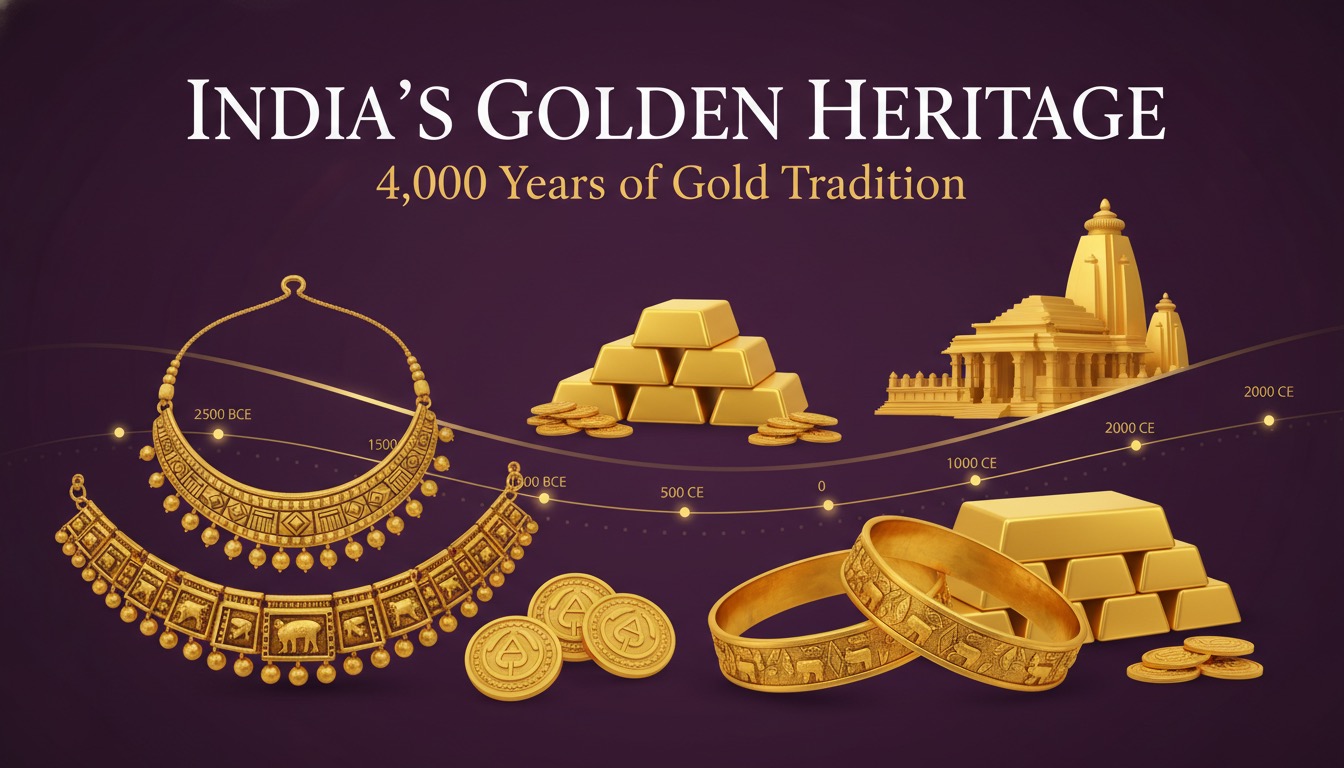
India's Love Affair With Gold: A 4,000-Year History
Indian women own approximately 25,000 tonnes of gold—more than the combined official reserves of the United States, Germany, Italy, France, and Russia. According to Business Today, this staggering private wealth represents 11% of the world’s total gold supply.
But this isn’t a modern phenomenon. India’s relationship with gold stretches back 4,000 years to the Bronze Age Indus Valley civilization, where the first gold jewelry adorned the necks and wrists of ancient Indians. With gold currently trading at $4,317 per ounce according to Yahoo Finance—up over 60% in 2025—understanding this historical relationship reveals why gold remains the cornerstone of Indian wealth.
The Ancient Origins: Indus Valley Civilization (3300-1300 BCE)
The World’s First Jewelers
According to Ancient Origins, the Indian subcontinent boasts the longest history of jewelry making in the world, stemming back 5,000 years. These first jewelers created gold earrings, necklaces, beads, and bangles used in trade and worn primarily by women.
| Period | Era | Gold Significance | Archaeological Evidence |
|---|---|---|---|
| 3300-1300 BCE | Indus Valley | First gold jewelry | Harappa, Mohenjo-daro artifacts |
| 1500-500 BCE | Vedic Period | Religious rituals | Rigveda references |
| 4th Century BCE | Mauryan Empire | Gold refining texts | Kautilya’s Arthashastra |
| 320-550 CE | Gupta Empire | ”Golden Age” of India | Extensive gold coinage |
Archaeological Treasures
As MyJar reports, excavations at Harappa and Mohenjo-daro unearthed extensive gold jewelry from the Indus Valley period (2600-1900 BCE). More than 200 ornaments are displayed at the National Museum in Delhi, including a 5,000-year-old necklace crafted of steatite and gold beads, with pendants of agate and jade.
According to the Mises Institute, “Much of India’s desire to acquire gold dates back to the Bronze Age Indus Valley civilization, in which people wore gold jewelry almost 4,000 years ago.”
The Vedic Period: Gold Becomes Sacred (1500-500 BCE)
Gold in Hindu Scripture
The Vedic period transformed gold from mere adornment to divine substance. According to Pragathi Gold, Kautilya’s famous Arthashastra (4th century BCE) contains detailed references to gold refining in both molten and solid states.
The Sri Sukta, a hymn from the Rig Veda, describes Goddess Lakshmi—the deity of wealth and prosperity—as “shining resplendently with a golden hue and adorned with a brilliant golden necklace.” This divine association permanently embedded gold into India’s spiritual consciousness.
Key Religious Texts Referencing Gold
| Text | Period | Gold Reference |
|---|---|---|
| Rigveda | 1500-1200 BCE | Gold as divine, pure, cosmic power |
| Ramayana | 7th-5th century BCE | Gold as auspicious material |
| Mahabharata | 4th century BCE | Gold in royal ceremonies |
| Arthashastra | 4th century BCE | Gold refining techniques |
According to My Gold Guide, “The word ‘swarna’ means ‘the best,’ showing gold’s sacred value. In these ancient texts, gold stood for purity and cosmic power.”
India’s Gold Holdings Today: The Numbers
Household Gold: A Staggering Wealth
| Entity | Gold Holdings | Value (2025) | % of World Supply |
|---|---|---|---|
| Indian Households | 25,000 tonnes | $3.8+ trillion | 11% |
| Reserve Bank of India | 880 tonnes | $102 billion | 0.4% |
| US Federal Reserve | 8,133 tonnes | $350 billion | 3.5% |
| All Central Banks | 36,000 tonnes | $1.5 trillion | 15% |
Source: Business Today, Trading Economics
According to Khaleej Times, “When combined, India’s households and temples are sitting on an astonishing 27,500 to 29,000 tonnes of gold.”
RBI Gold Reserves: Strategic Accumulation
According to Business Standard, the Reserve Bank of India’s gold reserves crossed 880 metric tonnes by September 2025. The central bank increased its holdings by 7% in FY25, with the total value rising 52% to ₹6.68 lakh crore.
| Year | RBI Gold Holdings | Value | Global Rank |
|---|---|---|---|
| FY24 | 822 tonnes | ₹4.39 lakh crore | 9th |
| FY25 | 880 tonnes | ₹6.68 lakh crore | 9th |
| Growth | +7% | +52% | — |
According to Angel One, the share of gold in India’s total foreign exchange reserves has climbed to 14.7%—its highest proportion since 1996-97.
Wedding Gold: The Cultural Cornerstone
Streedhan: A Woman’s Wealth
The tradition of Streedhan—property given to the bride—makes gold fundamentally different in India than anywhere else in the world. According to Coin Bazaar:
“Streedhan is more than a gift; it’s the bride’s property, symbolizing her identity and security. Soon after female children are born, Indian parents begin saving for her streedhan—a gift of gold that becomes exclusively her property.”
According to the World Gold Council, bridal jewelry dominates the gold jewelry landscape, enjoying 50-55% of market share. Weddings, together with festivals, constitute the two major gold purchase occasions in India.
Gold Consumption in Indian Weddings
| Statistic | Figure | Source |
|---|---|---|
| Wedding share of gold demand | 60% | Provident Metals |
| Bridal jewelry market share | 50-55% | World Gold Council |
| Annual gold consumption | 800-1,000 tonnes | Vocal Media |
| Average wedding gold spending | 15-25% of budget | Industry estimates |
Sacred Ornaments
According to Dhirsons Jewellers, key bridal gold ornaments include:
| Ornament | Significance |
|---|---|
| Mangalsutra | Sacred thread showing marital union |
| Nath (Nose Ring) | Womanhood and marital status |
| Bangles | Marriage and fertility |
| Maang Tikka | Blessing and protection |
| Toe Rings | Married status in Hindu tradition |
| Kamarbandh | Prosperity and fertility |
The Solah Shringar—sixteen traditional adornments—establishes gold jewelry as central to the bride’s identity and beauty.
Regional Traditions: A Diverse Golden Tapestry
Geographic Distribution of Gold
According to Weekend Investing, Southern India dominates gold ownership:
| Region | Share of India’s Gold | Key States |
|---|---|---|
| South India | 40% | Tamil Nadu, Kerala, Karnataka |
| West India | 25% | Maharashtra, Gujarat |
| North India | 20% | Delhi, Punjab, Rajasthan |
| East India | 15% | West Bengal, Odisha |
Tamil Nadu alone accounts for 28% of the nation’s household gold reserves.
State-Specific Traditions
| State | Unique Gold Tradition |
|---|---|
| Kerala | Kasavu sarees with gold border; heavy bridal sets |
| Tamil Nadu | Temple jewelry; Thali (mangalsutra) traditions |
| Gujarat | Kundan and Meenakari work |
| Bengal | Shakha-pola (conch and coral) with gold |
| Punjab | Polki and Jadau jewelry |
| Maharashtra | Kolhapuri saaj and Nath |
Gold in Modern India: Investment Evolution
The 2025 Market Snapshot
| Metric | Current | 2024 Comparison | Source |
|---|---|---|---|
| Gold Price (USD) | $4,317/oz | +60.4% YTD | Yahoo Finance |
| Gold Price (INR) | ₹1,30,510/10g | +63% YTD | GoodReturns |
| India Q3 2025 Demand | 209.4 tonnes | -16% YoY | World Gold Council |
| Gold ETF AUM | ₹1,021 billion | Record high | World Gold Council |
The Investment Shift
According to the World Gold Council, Indian gold investment is evolving:
- Gold ETF inflows in first 10 months of 2025: ₹276 billion ($3.1 billion)—the highest annual inflows on record
- Gold ETF holdings: 83.5 tonnes (nearly one-third added in 2025 alone)
- Share of bar/coin demand increased from 29% (Q2 2024) to 34% (Q2 2025)
According to Upstox, while jewelry demand fell 31% year-over-year in Q3 2025, investment demand surged—indicating Indians are increasingly viewing gold as a financial asset, not just adornment.
Why Gold Remains Central to Indian Identity
Economic Security Through Generations
According to Coin Bazaar, “The tradition of gifting gold stems back to when property laws favored men. Sons would receive the family’s land, home, and other property. If families still had wealth to share with their daughters, it would be in the form of gold.”
This historical context explains why gold jewelry remains a woman’s security—a portable, liquid, and universal store of value that transcends borders and banking systems.
The Wealth Effect
According to Business Today:
“In FY25, gold prices jumped by 35%, from ₹68,420 in April 2024 to ₹92,150 per 10 grams by March 2025. This sharp rise translated into a $400 billion wealth bump in just nine months, and an estimated $750 billion over the full year.”
Indian households gained more wealth from gold appreciation in one year than the entire GDP of countries like Poland or Sweden.
Comparing India’s Gold Culture Globally
| Country | Annual Gold Demand | Primary Use | Cultural Significance |
|---|---|---|---|
| India | 700-800 tonnes | Jewelry (80%) | Religious, marital, investment |
| China | 900-1,000 tonnes | Investment (60%) | Wealth storage, gifting |
| United States | 150-200 tonnes | Investment (70%) | Portfolio diversification |
| Germany | 100-150 tonnes | Investment (80%) | Inflation hedge |
| Middle East | 200-250 tonnes | Jewelry (90%) | Bridal traditions |
Source: World Gold Council
India’s unique position: the second-largest consumer where jewelry dominates demand, yet increasingly sophisticated in investment approaches.
The Future: Ancient Tradition Meets Modern Finance
Digital Gold: The Next Chapter
For NRIs and tech-savvy Indians, digital gold platforms are writing the next chapter of India’s gold story. These platforms allow:
- Fractional gold purchases (as low as $1)
- Instant liquidity without storage concerns
- Gifting across borders
- Integration with festival and wedding traditions
Key Takeaways for Indian Investors
| Lesson from History | Modern Application |
|---|---|
| Gold as security | Emergency fund component |
| Streedhan tradition | Systematic gifting to daughters |
| Festival purchases | DCA strategy aligned with Akshaya Tritiya, Dhanteras |
| Generational wealth | Long-term portfolio allocation |
| Physical ownership | Combination of physical and digital |
Conclusion: 4,000 Years and Counting
From the gold beads of Mohenjo-daro to the digital gold apps of 2025, India’s relationship with gold has evolved in form but never in essence. Gold remains what it has been for 4,000 years: a symbol of divine blessing, a vehicle for generational wealth, and a woman’s security.
With Indian households holding $3.8+ trillion in gold—more than all the world’s central banks combined—this ancient tradition shows no sign of fading. Instead, it’s adapting: younger Indians are embracing gold ETFs and digital platforms while maintaining the cultural practices of their grandparents.
As gold trades above $4,300 per ounce, the wisdom of India’s 4,000-year love affair with gold has never been more evident. The metal that adorned ancient Indus Valley queens continues to secure the futures of millions of Indian families—a golden thread connecting past, present, and future.
Sources
- Business Today - India’s Gold Household Wealth
- Yahoo Finance - Gold Futures
- Ancient Origins - Indus Valley Civilization
- MyJar - History of Gold in India
- Mises Institute - Gold: India’s Capital Asset
- Pragathi Gold - History of Gold in India
- Business Standard - RBI Gold Reserves 2025
- Trading Economics - India Gold Reserves
- Angel One - RBI Gold Holdings FY25
- World Gold Council - India Jewellery Demand
- World Gold Council - India Gold Market Update
- Coin Bazaar - Gold and Weddings
- Khaleej Times - India’s Hidden Gold Empire
- Weekend Investing - Power of Gold in Indian Households
- My Gold Guide - Golden Symbols of Indian Marriage
- Provident Metals - Indian Wedding Gold Tradition
- Upstox - Gold Investment Trends 2025
- Vocal Media - Gold Jewellery in Indian Weddings
Ready to start investing in gold?
Join thousands of Indian families building wealth with Mantra Mint.
Get Started Free