
Gold vs I Bonds vs TIPS: Which Inflation Hedge Is Right for You in 2026?
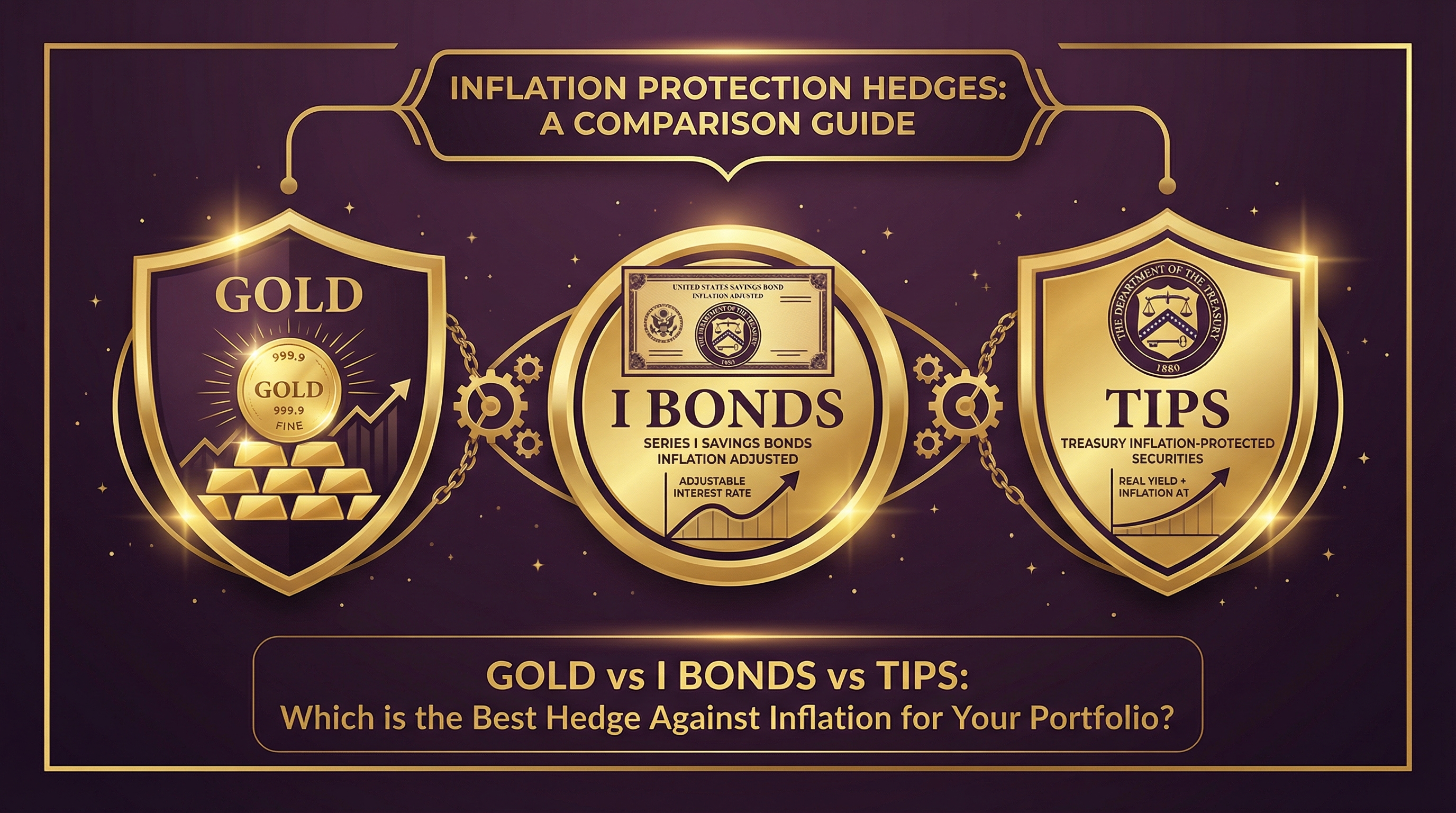
Inflation remains on every investor’s mind in 2026, and the debate over the best inflation hedge continues. With gold trading at approximately $4,516 per ounce—up 4.4% this week according to Yahoo Finance—I Bonds paying 4.03%, and TIPS offering real yields near 2%, investors face a genuine choice between three fundamentally different approaches to protecting purchasing power.
For NRI investors balancing US and Indian financial goals, understanding these options is crucial. Let’s break down how each works, their historical performance, and which might fit your situation best.
Current Rates Snapshot
| Investment | Current Rate/Price | Key Feature | Source |
|---|---|---|---|
| Gold Spot | $4,516/oz | +4.4% weekly | Yahoo Finance |
| Silver Spot | $78.67/oz | +12.2% weekly | Yahoo Finance |
| I Bonds | 4.03% composite | Through April 2026 | TreasuryDirect |
| 5-Year TIPS | 1.44% real yield | + CPI adjustment | Treasury.gov |
| 10-Year TIPS | 1.90% real yield | + CPI adjustment | Treasury.gov |
Understanding Each Inflation Hedge
Gold: The Ancient Hedge
Gold has served as a store of value for millennia. Its appeal as an inflation hedge rests on several pillars:
How it works:
- Gold has no yield—returns come purely from price appreciation
- Historically maintains purchasing power over very long periods
- Acts as a crisis hedge during geopolitical uncertainty
- Negatively correlated with the US dollar
2025-2026 Performance: According to Trading Economics, gold returned 64% in 2025—its strongest annual performance since 1979. This followed central bank buying, geopolitical tensions, and Fed rate cuts.
Advantages:
- No credit risk (physical asset)
- Global liquidity
- Cultural and emotional value (especially for Indian families)
- Crisis protection beyond just inflation
Disadvantages:
- No yield or income
- Storage costs (physical) or expense ratios (ETFs)
- Volatile in the short term
- Taxed as collectibles (28% max) if held physically or via ETFs
I Bonds: The Government Guarantee
Series I Savings Bonds are US government bonds designed specifically for inflation protection.
How it works:
- Composite rate = Fixed rate + Inflation rate (adjusted every 6 months)
- Current rate: 4.03% (0.90% fixed + 1.56% semiannual inflation rate x 2)
- Purchased directly from TreasuryDirect.gov
- $10,000 annual purchase limit per person ($15,000 with tax refund)
Current I Bond Rates (November 2025 - April 2026):
| Component | Rate |
|---|---|
| Fixed Rate | 0.90% |
| Semiannual Inflation Rate | 1.56% |
| Composite Rate | 4.03% |
Source: TreasuryDirect
Advantages:
- Zero credit risk (US government backing)
- Guaranteed inflation protection
- Tax-deferred; state tax exempt
- No market price volatility
Disadvantages:
- $10,000 annual limit
- 1-year lockup period
- 3-month interest penalty if redeemed before 5 years
- Must be held to maturity for full benefit
- No liquidity in secondary markets
TIPS: The Tradeable Treasury
Treasury Inflation-Protected Securities are marketable Treasury bonds with principal adjusted for inflation.
How it works:
- Principal adjusts with CPI-U (Consumer Price Index)
- Pays a fixed coupon on the adjusted principal
- Trades in secondary markets like regular bonds
- Available in 5, 10, and 30-year maturities
Current TIPS Yields:
| Maturity | Real Yield | Breakeven Inflation |
|---|---|---|
| 5-Year | 1.44% | 2.25-2.44% |
| 10-Year | 1.90% | 2.30-2.50% |
| 30-Year | 2.15% | 2.35-2.55% |
Sources: Treasury.gov, market data
The “breakeven inflation rate” is the inflation rate at which TIPS and nominal Treasuries would produce equal returns. If actual inflation exceeds breakeven, TIPS outperform.
Advantages:
- No purchase limits
- Full market liquidity
- Various maturities available
- Can buy through brokers or Treasury auctions
Disadvantages:
- Subject to interest rate risk (prices fall when rates rise)
- Taxed on inflation adjustment (“phantom income”)
- More complex than I Bonds
- Deflation protection limited to original principal
Head-to-Head Comparison
Inflation Protection Mechanism
| Feature | Gold | I Bonds | TIPS |
|---|---|---|---|
| Protection type | Indirect (market-based) | Direct (formula-based) | Direct (CPI-adjusted) |
| Lag to inflation | None (real-time) | 6-month adjustment cycle | Monthly CPI adjustment |
| Deflation risk | Can decline significantly | Rate floor at 0% | Principal floor at par |
| Certainty level | Uncertain | High certainty | High certainty |
Liquidity and Access
| Feature | Gold | I Bonds | TIPS |
|---|---|---|---|
| Purchase limit | None | $10,000/year | None |
| Lockup period | None | 1 year minimum | None |
| Early withdrawal | Anytime | 3-month penalty (years 1-5) | Market price |
| Secondary market | Yes (highly liquid) | No | Yes |
Tax Treatment
| Feature | Gold | I Bonds | TIPS |
|---|---|---|---|
| Federal tax | Collectibles rate (28% max) | Ordinary income (deferrable) | Ordinary income |
| State tax | Usually taxable | Exempt | Exempt |
| Tax timing | On sale | On redemption or 30 years | Annual (phantom income) |
Historical Correlation
According to financial research, gold and TIPS have shown a strong negative correlation historically—approximately -0.93 over certain periods. This means when TIPS underperform, gold often outperforms, and vice versa.
This negative correlation makes them potentially complementary holdings rather than substitutes.
Performance in Different Scenarios
Scenario 1: High Inflation (Above 5%)
| Asset | Expected Performance | Why |
|---|---|---|
| Gold | Strong | Historical inflation hedge, crisis asset |
| I Bonds | Good | Direct CPI link, but capped returns |
| TIPS | Good | Direct CPI link, but interest rate risk |
Winner: Gold (in 2025, gold returned 64% while I Bonds paid ~5%)
Scenario 2: Moderate Inflation (2-4%)
| Asset | Expected Performance | Why |
|---|---|---|
| Gold | Variable | Depends on other factors (rates, dollar, geopolitics) |
| I Bonds | Steady | Reliable 4-5% returns |
| TIPS | Steady | Real yield + inflation adjustment |
Winner: Depends on real yields (currently favoring TIPS/I Bonds for guaranteed returns)
Scenario 3: Deflation or Low Inflation (Below 2%)
| Asset | Expected Performance | Why |
|---|---|---|
| Gold | Mixed | May rise on economic fears, fall on rate hikes |
| I Bonds | Floor at fixed rate | Currently 0.90% minimum |
| TIPS | Interest rate sensitive | Principal protected at par minimum |
Winner: Nominal bonds (but I Bonds provide a floor)
Scenario 4: Geopolitical Crisis
| Asset | Expected Performance | Why |
|---|---|---|
| Gold | Very strong | Ultimate safe haven |
| I Bonds | Stable | Government backing |
| TIPS | Stable | Government backing |
Winner: Gold (as seen in 2022 Ukraine crisis, 2025 Venezuela tensions)
The Math: 10-Year Projections
Let’s compare a $10,000 investment in each, assuming different inflation scenarios:
Assumption Set 1: 3% Annual Inflation
| Investment | Year 1 | Year 5 | Year 10 | Assumptions |
|---|---|---|---|---|
| Gold | $10,800 | $14,693 | $21,589 | 8% annual return (historical average) |
| I Bonds | $10,403 | $12,184 | $14,849 | 4.03% composite (3% inflation + 0.9% fixed) |
| TIPS (10yr) | $10,490 | $12,703 | $16,137 | 1.9% real + 3% inflation |
Assumption Set 2: 5% Annual Inflation
| Investment | Year 1 | Year 5 | Year 10 | Assumptions |
|---|---|---|---|---|
| Gold | $11,200 | $17,623 | $31,058 | 12% annual return (inflation-adjusted) |
| I Bonds | $10,590 | $13,310 | $17,722 | 5.9% composite |
| TIPS (10yr) | $10,690 | $13,916 | $19,368 | 1.9% real + 5% inflation |
Note: Gold returns are highly variable. Historical average is ~8%, but 2025 returned 64%.
Strategic Allocation Frameworks
Conservative Investor (Preservation Focus)
| Allocation | Percentage | Rationale |
|---|---|---|
| I Bonds | 40% | Guaranteed protection, safe |
| TIPS | 40% | Additional protection, liquidity |
| Gold | 20% | Crisis hedge, diversification |
Moderate Investor (Balanced Approach)
| Allocation | Percentage | Rationale |
|---|---|---|
| Gold | 35% | Growth potential + crisis hedge |
| TIPS | 35% | Guaranteed real returns |
| I Bonds | 30% | Stable foundation (to annual limit) |
Growth-Oriented Investor (Return Focus)
| Allocation | Percentage | Rationale |
|---|---|---|
| Gold | 50% | Higher return potential |
| TIPS | 30% | Some guaranteed protection |
| I Bonds | 20% | Safe allocation (to annual limit) |
Special Considerations for NRI Investors
Currency Dynamics
For Indians in the USA, the USD/INR exchange rate adds another dimension:
| Investment | USD Return | Rupee Benefit |
|---|---|---|
| Gold | Market-based | Strong when rupee weakens |
| I Bonds | Fixed formula | No rupee correlation |
| TIPS | CPI-adjusted | No rupee correlation |
Gold tends to perform well in rupee terms during times of rupee weakness, providing a natural hedge for those with Indian financial obligations.
Cultural Considerations
For many Indian families, gold carries significance beyond investment returns:
- Wedding planning: Gold’s tangibility matters for gifting
- Intergenerational wealth: Physical gold transfers easily
- Cultural occasions: Festivals like Akshaya Tritiya, Dhanteras favor gold
- Family expectations: Some wealth in gold is culturally expected
Neither I Bonds nor TIPS can fulfill these cultural roles—only gold can serve both investment and cultural purposes.
Tax Residency Implications
| Consideration | US Tax | India Tax |
|---|---|---|
| I Bonds | Taxable on redemption | N/A (US-only investment) |
| TIPS | Annual phantom income | May create complications |
| Gold | Collectibles rate (28%) | Varies by holding period |
Consult a cross-border tax professional for your specific situation.
Practical Implementation
How to Buy I Bonds
- Create account at TreasuryDirect.gov
- Link bank account
- Purchase up to $10,000/year electronically
- Hold minimum 1 year, ideally 5+ years
How to Buy TIPS
- Through TreasuryDirect (auction purchases)
- Via brokerage accounts (secondary market)
- Through TIPS ETFs (TIP, SCHP, VTIP)
- Through TIPS mutual funds
How to Buy Gold
- Physical: Coins, bars from dealers
- ETFs: GLD, IAU, SGOL
- Digital gold: Platforms like MantraMint
- Mining stocks: Indirect exposure with leverage
Key Takeaways
- Gold provides crisis protection that I Bonds and TIPS cannot—it’s the ultimate safe haven during geopolitical turmoil
- I Bonds offer guaranteed inflation protection with zero credit risk, but the $10,000 annual limit constrains large allocations
- TIPS provide unlimited, liquid inflation protection but carry interest rate risk and phantom income tax complications
- The three are complementary, not competitive—their negative correlation makes combining them potentially beneficial
- Cultural value matters for Indian families—gold serves purposes beyond pure investment that government bonds cannot
- 2026 context favors diversification: With Fed policy uncertain, geopolitical tensions elevated, and inflation moderating, all three have a role
Build Your Inflation-Protected Portfolio with MantraMint
Whether you’re allocating 20% or 50% of your inflation hedge to gold, MantraMint makes building that position simple for Indians in the USA.
Why Gold Through MantraMint?
- Start small: Invest as little as $10 in 24K gold
- No storage hassles: Secure, insured digital gold
- Auto-invest: Dollar-cost average weekly or monthly
- Cultural flexibility: Gift gold for festivals, weddings, milestones
- Instant access: Buy at live market prices
While I Bonds and TIPS protect against measured inflation, gold protects against the unexpected—the scenarios that CPI doesn’t capture. Build your complete inflation defense with all three.
Start Your Gold Position Today — Because the best inflation hedge is the one you actually own.
Sources
Ready to start investing in gold?
Join thousands of Indian families building wealth with Mantra Mint.
Get Started Free