
Gold-Silver Ratio at 57:1 After the Crash: What This Signals for 2026
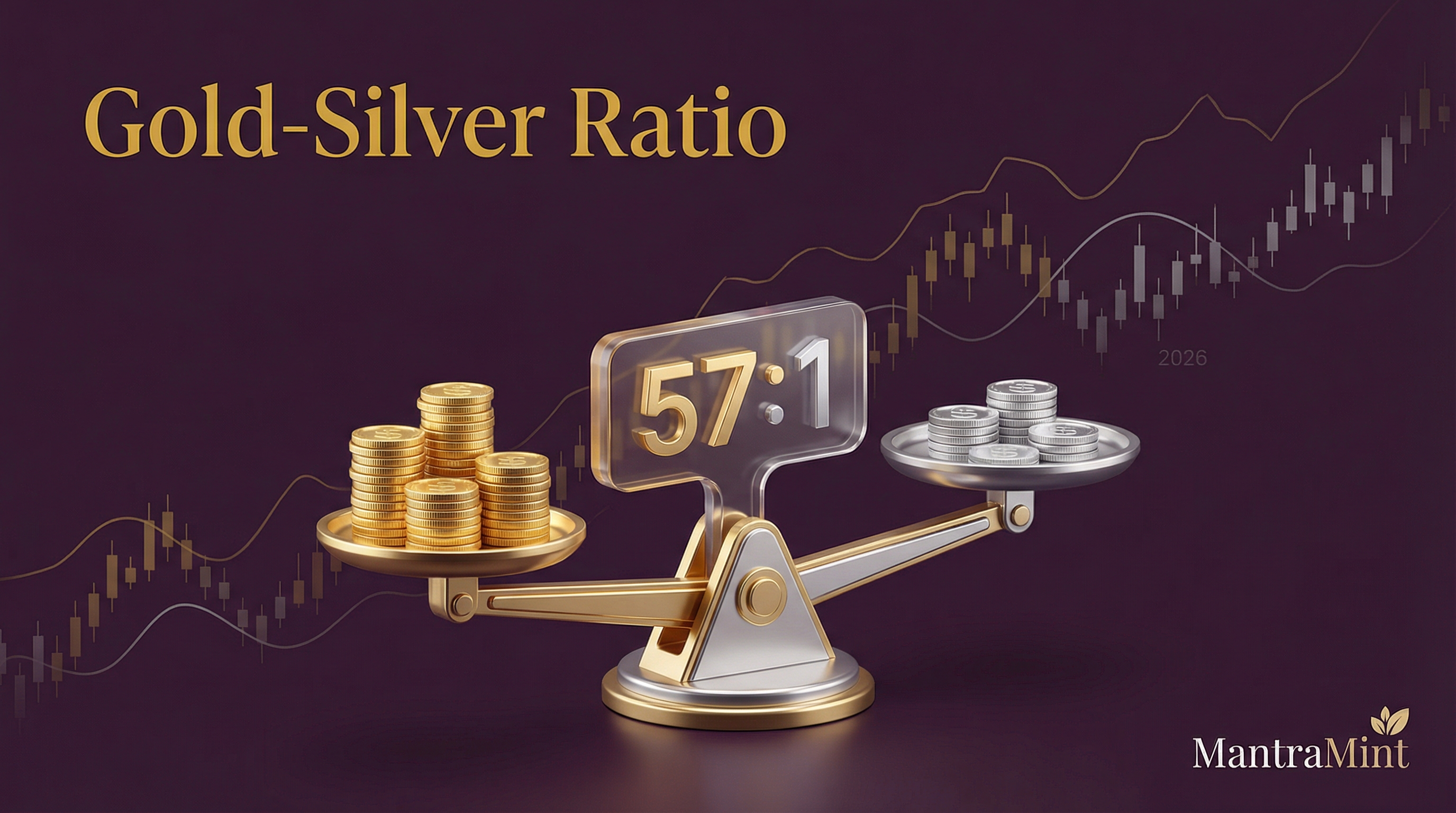
After one of the most dramatic weeks in precious metals history, the gold-silver ratio has settled at a noteworthy level: 57:1. This means it currently takes 57 ounces of silver to buy one ounce of gold—a ratio that sits below the long-term historical average of 60:1, according to JM Bullion.
With gold at $4,943/oz (down 2.6% this week) and silver at $86.52/oz (down 19.1% this week) following January’s flash crash, this compression in the ratio tells a story about relative value, market sentiment, and what may come next.
Current Market Snapshot (February 3, 2026)
| Metric | Value | Weekly Change | Source |
|---|---|---|---|
| Gold Spot Price | $4,943/oz | -2.6% | Yahoo Finance |
| Silver Spot Price | $86.52/oz | -19.1% | Yahoo Finance |
| Gold-Silver Ratio | 57.1:1 | — | Calculated |
| Gold Futures (GC=F) | $4,948.90 | — | Yahoo Finance |
| Silver Futures (SI=F) | $88.31 | — | Yahoo Finance |
What Is the Gold-Silver Ratio and Why Does It Matter?
The Basics
The gold-silver ratio measures how many ounces of silver it takes to purchase one ounce of gold. According to MacroTrends, which tracks this ratio back to 1915, it’s one of the oldest metrics investors use to gauge relative value between the two precious metals.
Simple formula: Gold Price ÷ Silver Price = Ratio
At today’s prices: $4,943 ÷ $86.52 = 57.1:1
Historical Context
According to SD Bullion, the ratio has varied dramatically throughout history:
| Era | Typical Ratio | Context |
|---|---|---|
| Ancient Rome | 12:1 | Fixed by law |
| US Coinage Act (1792) | 15:1 | Legal tender ratio |
| 1980 (Hunt Brothers) | 17:1 | Silver squeeze peak |
| 1991 (Gulf War) | 100:1 | Flight to gold safety |
| 2011 | 32:1 | Post-2008 silver rally |
| April 2020 (COVID) | 125:1 | Extreme flight to gold |
| April 2025 | 105:1 | Pre-crash extreme |
| February 2026 | 57:1 | Post-crash compression |
According to Visual Capitalist, between 1920 and the present, the ratio has fluctuated between 25 and 125, with an average hovering around 60.
The January 2026 Flash Crash: What Happened
The Historic Drop
According to BullionVault, on January 30, 2026, precious metals experienced their most violent single-day decline in decades:
| Metal | Peak (Jan 29) | Crash Low (Jan 30) | Drop | Recovery (Feb 3) |
|---|---|---|---|---|
| Gold | $5,600/oz | under $5,000/oz | -12% | $4,943/oz |
| Silver | $122/oz | under $84/oz | -31% | $86.52/oz |
According to CNBC, this was the largest single-day precious metals decline since 1980.
What Triggered the Crash
According to The Conversation, several factors converged:
| Trigger | Impact |
|---|---|
| Kevin Warsh Fed nomination | Perceived hawkish Fed policy ahead |
| CME margin increases | Forced liquidations by leveraged traders |
| Overbought technicals | RSI above 90 for both metals |
| Tech stock selloff | Risk-off sentiment spreading |
Why Silver Fell Harder
Silver dropped nearly three times as much as gold during the crash. According to Finance Magnates, this is typical behavior:
- Silver is more volatile than gold
- Smaller market means larger price swings
- Industrial demand component adds economic sensitivity
- More speculative positioning in silver futures
This differential decline compressed the ratio from approximately 100:1 before the crash to 57:1 now—silver lost more but has also rebounded more strongly.
What a 57:1 Ratio Signals for Investors
Below the Historical Average
At 57:1, the ratio is currently below its long-term average of 60:1. According to USAGOLD, this positioning tells us several things:
| Signal | Interpretation |
|---|---|
| Silver is relatively expensive | Silver has outperformed gold on a relative basis |
| Mean reversion possible | Ratio could rise back toward 60-65 |
| Industrial demand strong | Silver’s dual role supporting prices |
| Recovery favored silver | Post-crash bounce stronger in silver |
The 80/50 Rule Framework
According to GoldSilver.com, many investors follow the “80/50 rule” (or 80/60 rule):
| Ratio Level | Action | Rationale |
|---|---|---|
| Above 80:1 | Favor silver | Silver undervalued, buy silver |
| Below 50:1 | Favor gold | Gold undervalued, buy gold |
| 50-80:1 | Balanced | Both fairly valued |
At 57:1, we’re in the middle zone—neither extreme. However, the rapid compression from 100:1 to 57:1 in just months suggests silver’s outperformance may be moderating.
2025’s Silver Outperformance: The Numbers
Record-Breaking Returns
According to GoldBroker, silver’s 2025 performance was historic:
| Metal | 2025 Return | Context |
|---|---|---|
| Silver | +147% | Best year since 1979 |
| Gold | +67% | Strong but half of silver’s gain |
| S&P 500 | ~25% | Equity market comparison |
This explains why the ratio compressed from 100:1 (April 2025) to below 60 by year-end—silver more than doubled gold’s percentage gains.
Ratio Compression Timeline 2025-2026
| Date | Ratio | Event |
|---|---|---|
| January 2025 | ~100:1 | Year start |
| April 2025 | 105:1 | Extreme peak |
| September 2025 | 75:1 | Compression accelerates |
| December 2025 | under 60:1 | Silver outperformance |
| January 30, 2026 | ~46:1 | Intraday crash low |
| February 3, 2026 | 57:1 | Post-crash stabilization |
What’s Driving Silver’s Relative Strength?
Industrial Demand Fundamentals
According to the Silver Institute, silver’s industrial demand profile is strengthening:
| Sector | 2025 Demand | 2026 Forecast | Source |
|---|---|---|---|
| Solar/PV | 261M oz | +5.5% growth | Silver Institute |
| Electric Vehicles | 90M+ oz | Growing rapidly | Industry data |
| Data Centers/AI | Rising | New demand driver | Tech reports |
| Total Industrial | 680M oz | Near record | World Silver Survey |
According to ScienceDirect, by 2030, silver supply may meet only 62-70% of demand—a structural deficit supporting prices.
Supply Deficit
According to industry analysis, the silver market faces a fifth consecutive year of deficit:
| Year | Supply-Demand Balance |
|---|---|
| 2022 | Deficit |
| 2023 | Deficit |
| 2024 | Deficit |
| 2025 | Deficit (~149M oz) |
| 2026 (forecast) | Deficit continuing |
This structural imbalance—demand exceeding mine supply—provides fundamental support for silver prices.
Ratio Trading Strategies: What Works in 2026
Strategy 1: Mean Reversion Approach
According to LendEDU, the mean reversion strategy assumes the ratio will return to its historical average:
Current situation: At 57:1, the ratio is slightly below the 60:1 average.
Potential trade: If you believe the ratio will rise back toward 60-70, favor gold over silver for new purchases.
Risk: The “new normal” might be a lower ratio due to silver’s industrial demand growth.
Strategy 2: Contrarian Positioning
According to AInvest, contrarian investors use extreme ratio readings as signals:
| Ratio Zone | Contrarian Action |
|---|---|
| Above 90:1 | Aggressively buy silver |
| Below 50:1 | Aggressively buy gold |
| 50-80:1 | Normal allocation |
At 57:1, we’re closer to “favor gold” territory than “favor silver”—the easy money in silver’s 2025 rally may have been made.
Strategy 3: Balanced Portfolio Approach
For most investors, according to CBS News, a balanced approach makes sense:
| Allocation | Rationale |
|---|---|
| 70% Gold / 30% Silver | Traditional wealth preservation focus |
| 50% Gold / 50% Silver | Balanced approach, capture silver upside |
| 30% Gold / 70% Silver | Aggressive silver bet (higher risk) |
Expert Forecasts for the Ratio in 2026
Analyst Projections
According to Money Made, analysts have varying expectations:
| Scenario | Ratio Forecast | Assumption |
|---|---|---|
| Base case | 65-70:1 by year-end | Normal recovery, gold outperforms |
| Bull case for silver | 50:1 or lower | Industrial surge, supply crunch |
| Bear case for silver | 80:1+ | Economic slowdown hurts industrial demand |
Price Targets Supporting These Ratios
| Institution | Gold Target | Silver Target | Implied Ratio | Source |
|---|---|---|---|---|
| UBS | $6,200/oz | — | — | UBS |
| Bank of America | — | $65/oz | — | Market analysis |
| Deutsche Bank | — | $45/oz | — | Research notes |
NRI Considerations: Gold vs. Silver Allocation
Cultural and Investment Balance
For Indians in the USA, both gold and silver hold cultural significance. According to World Gold Council data, India remains one of the world’s largest gold consumers, while silver plays important roles in:
- Puja items and religious ceremonies
- Baby gifts and naming ceremonies
- Jewelry for daily wear
- Investment diversification
Recommended Framework for NRIs
| Goal | Suggested Allocation | Rationale |
|---|---|---|
| Wealth preservation | 80% gold / 20% silver | Gold’s stability |
| Balanced growth | 60% gold / 40% silver | Both metals’ strengths |
| Maximum growth potential | 50% gold / 50% silver | Capture silver’s industrial upside |
| Cultural gifts | 70% gold / 30% silver | Traditional preference |
Key Takeaways: What the 57:1 Ratio Means for You
1. Silver Has Already Outperformed
After gaining 147% in 2025 versus gold’s 67%, silver’s easy outperformance phase may be complete. The ratio’s compression from 100:1 to 57:1 reflects this.
2. Mean Reversion Favors Gold
At 57:1, we’re below the 60:1 historical average. Statistical probability suggests the ratio could rise—which would mean gold outperforming silver from here.
3. Silver’s Fundamentals Remain Strong
Industrial demand from solar, EVs, and AI continues growing. Supply deficits persist. Silver isn’t “overvalued”—it’s just no longer as undervalued as it was at 100:1.
4. The Post-Crash Recovery Continues
Both metals are recovering from January’s flash crash. Gold at $4,943/oz remains well below its $5,600 peak, suggesting room for continued recovery.
5. Balanced Allocation Makes Sense
Rather than betting everything on one metal, a 60-70% gold / 30-40% silver allocation captures the benefits of both while managing risk.
Action Framework: What to Do Now
| If You… | Consider… | Rationale |
|---|---|---|
| Own mostly gold | Add some silver | Capture potential upside if ratio compresses further |
| Own mostly silver | Take some profits, add gold | Lock in 2025 gains, balance portfolio |
| Own neither | Start with 60/40 gold/silver | Balanced entry point |
| Regular investor | Continue dollar-cost averaging | Don’t time the market |
Build Your Precious Metals Portfolio with MantraMint
Whether you’re bullish on gold, silver, or both, MantraMint makes it simple for Indians in the USA to build a precious metals position that honors tradition while building wealth.
Why MantraMint?
- Start with just $10 — Build your position at any budget
- Buy gold AND silver — Maintain your ideal allocation
- Auto-invest — Dollar-cost average through market volatility
- Gift to family — Send precious metals for any occasion
- No storage hassles — Secure digital ownership
After January’s crash, precious metals are recovering. Whether you favor gold’s stability or silver’s growth potential, MantraMint connects your cultural heritage with modern investing.
Current Prices: Gold $4,943/oz | Silver $86.52/oz | Ratio 57:1
Start Building Your Precious Metals Portfolio Today — Gold and silver, simplified.
Sources
- JM Bullion - Gold-to-Silver Ratio Price Charts
- MacroTrends - Gold to Silver Ratio 100 Year Chart
- SD Bullion - Gold Silver Ratio History
- Visual Capitalist - Gold-to-Silver Ratio Since 1869
- USAGOLD - Gold-Silver Ratio Guide
- GoldSilver.com - The 80/60 Gold-Silver Rule
- Silver Institute - Silver Demand Forecast
- BullionVault - Gold Silver Crash January 2026
- CNBC - Silver Gold Fall January 2026
- The Conversation - Gold Silver Crash Analysis
- Finance Magnates - Gold Silver Selloff Analysis
- GoldBroker - Silver Outlook 2026
- CBS News - Gold vs Silver 2026
- AInvest - Gold Silver Ratio Contrarian Indicator
- LendEDU - Gold Silver Ratio Guide
- Money Made - Trading Gold Silver Ratio
- Equiti - Strong Industrial Demand Supports Silver 2026
- World Gold Council - Gold Demand Trends 2025
- Yahoo Finance - Gold Futures
- Yahoo Finance - Silver Futures
Ready to start investing in gold?
Join thousands of Indian families building wealth with Mantra Mint.
Get Started Free