
Gold Seasonality: Best and Worst Months to Buy Gold in 2025
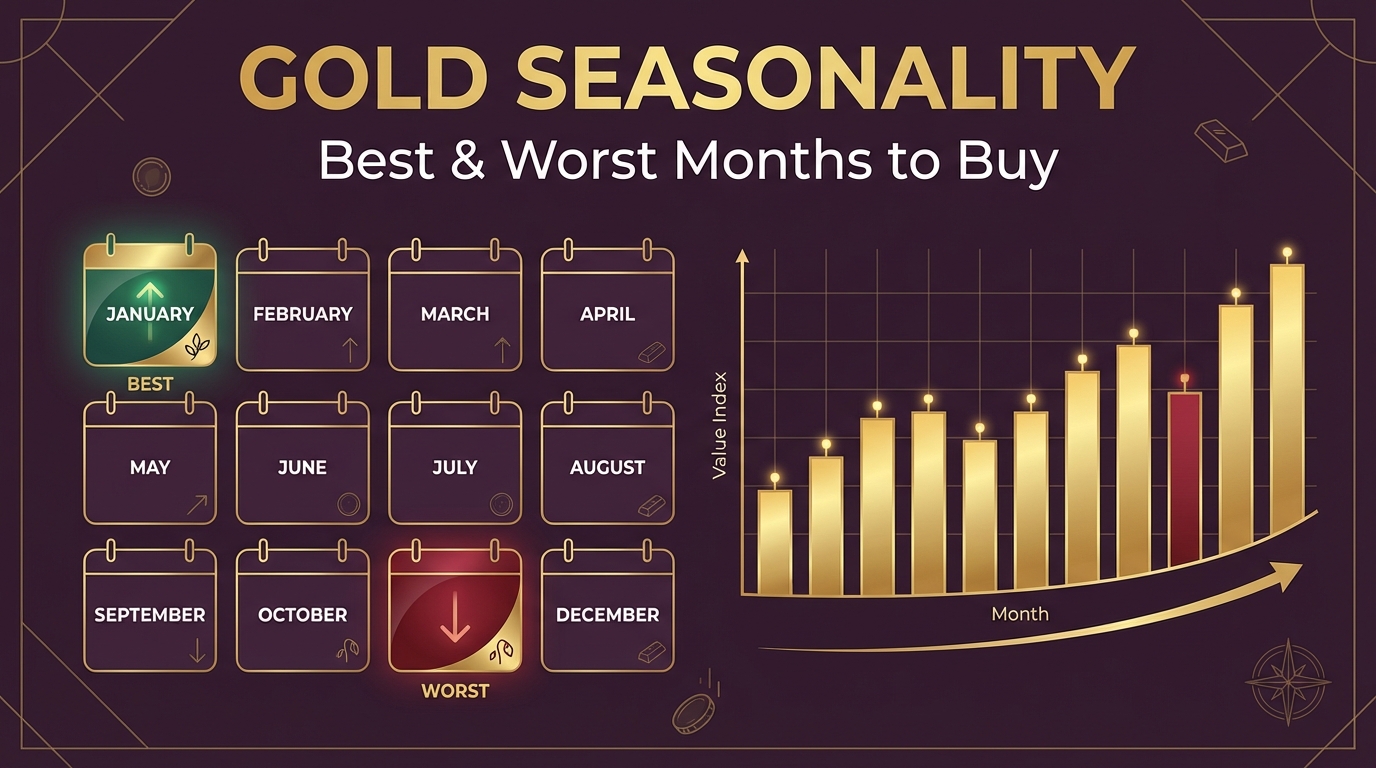
Is there really a “best time” to buy gold? The data says yes. While gold’s long-term trajectory depends on macroeconomic factors like inflation, interest rates, and geopolitical risk, seasonal patterns have proven remarkably consistent over decades of market history.
As of December 23, 2025, gold trades at $4,495 per ounce (+4.0% this week), while silver commands $69.83 per ounce (+10.4% weekly gain). Understanding when gold typically rises and falls can help you optimize entry points and maximize returns.
The Science Behind Gold Seasonality
Gold seasonality isn’t random—it’s driven by predictable cultural and economic events that create recurring demand patterns throughout the year.
Key Demand Drivers by Season
| Season | Demand Driver | Impact on Gold |
|---|---|---|
| Late Summer-Fall | Indian wedding season (Oct-Dec) | Strong buying pressure |
| Winter | Christmas jewelry demand | Elevated prices |
| January-February | Chinese New Year buying | Price surge |
| Spring | Post-holiday lull | Price consolidation |
| Summer | Seasonal low point | Buying opportunity |
According to Seasonax, gold exhibits one of the strongest seasonal patterns among major commodities, with certain months showing statistically significant tendencies over 50+ years of data.
Best Months to Buy Gold
January: The Gold Champion
According to research from BullionVault and InvestingHaven:
| Metric | January Performance |
|---|---|
| Average Return | +5% |
| Positive Years | 70-80% |
| Ranking | Best month for gold |
Why January performs so well:
- Chinese New Year effect: Massive gold buying in Asia
- New Year portfolio rebalancing: Institutional buying
- Momentum from holiday demand: Carries into new year
- Safe-haven positioning: Beginning-of-year risk assessment
The Summer Buying Window
According to Vaulted:
“The seasonal rise in gold prices typically begins around July 6 each year. Smart investors position before this inflection point.”
| Period | Strategy |
|---|---|
| May-June | Accumulation window (prices often soft) |
| Before July 6 | Last chance before seasonal rise |
| July-August | Prices begin climbing toward fall demand |
Monthly Performance Rankings (1970-2024)
Based on analysis from Seasonax and BullionVault:
| Rank | Month | Avg. Return | Win Rate |
|---|---|---|---|
| 1 | January | +5.0% | 75% |
| 2 | August | +2.8% | 65% |
| 3 | September | +2.5% | 55% |
| 4 | November | +2.3% | 62% |
| 5 | December | +1.8% | 60% |
Note: September’s average return is skewed by a few exceptional years; see “Worst Months” section below.
Worst Months to Buy Gold
September: The Paradox Month
Here’s where seasonality gets interesting. According to InvestingHaven:
“September has posted negative returns in 9 out of 10 years over the last decade—a stunning 90% failure rate.”
| Metric | September Performance |
|---|---|
| Negative Years (2014-2024) | 90% |
| Historical Pattern | Post-summer profit-taking |
| Typical Behavior | Sharp corrections |
Why September struggles:
- End of summer doldrums: Low trading volumes
- Profit-taking: Traders liquidate before Q4
- Dollar strength: Seasonal USD rallies hurt gold
- Pre-Fed positioning: Uncertainty before fall Fed meetings
March: The Forgotten Slump
| Metric | March Performance |
|---|---|
| Average Return | -0.5% to +0.5% |
| Win Rate | ~50% |
| Pattern | Post-Chinese New Year hangover |
After the January-February surge driven by Asian demand, March often sees consolidation or pullbacks as buying pressure subsides.
Worst Months Summary
| Month | Why It Underperforms | Strategy |
|---|---|---|
| September | Profit-taking, dollar strength | Wait for October dip |
| March | Post-CNY demand lull | Accumulate on weakness |
| June | Pre-summer quiet period | Build positions gradually |
The Indian Wedding Season Effect
For Indian families—and the global gold market—the October-December period is crucial.
Wedding Season Timeline
| Month | Event | Gold Demand |
|---|---|---|
| October | Navratri, Dussehra | Rising |
| November | Dhanteras, Diwali | Peak |
| December | Wedding season continues | Elevated |
| January | Makar Sankranti weddings | Strong |
According to the World Gold Council, India accounts for approximately 25% of global gold jewelry demand, with wedding and festival purchases concentrated in Q4.
Dhanteras: The Single Biggest Gold-Buying Day
Dhanteras (the first day of Diwali celebrations) sees more gold purchased in India than any other single day worldwide. In 2024, Indian gold demand during Dhanteras exceeded 40 tonnes in a single day.
| Year | Dhanteras Gold Demand | Source |
|---|---|---|
| 2024 | ~40+ tonnes | World Gold Council |
| 2023 | ~35 tonnes | Industry estimates |
| 2022 | ~30 tonnes | Industry estimates |
Chinese New Year: The January Catalyst
The Lunar New Year (late January to mid-February) drives massive gold buying across China, Hong Kong, Taiwan, and overseas Chinese communities.
Why Gold Surges for CNY
| Factor | Impact |
|---|---|
| Gift-giving tradition | Gold jewelry for family |
| Red envelope gold | Small gold items as gifts |
| Auspicious purchases | Starting year with prosperity |
| Central bank buying | PBOC often accumulates in Q1 |
China is the world’s largest gold consumer, and CNY buying alone can move global prices by 2-5% in favorable years.
Putting It All Together: The Seasonal Calendar
Gold Seasonality Calendar 2025-2026
| Month | Seasonal Tendency | Recommended Action |
|---|---|---|
| January | Strong (+5% avg) | Hold/enjoy gains |
| February | Moderate | Monitor CNY impact |
| March | Weak | Accumulate on dips |
| April | Mixed | Continue accumulating |
| May | Soft | Build positions |
| June | Quiet | Last buying window |
| July | Rising begins (~July 6) | Position established |
| August | Moderate strength | Hold positions |
| September | Often negative (90%) | Don’t panic sell |
| October | Recovery begins | Indian demand kicks in |
| November | Strong (Diwali) | Enjoy momentum |
| December | Moderate to strong | Holiday demand |
Does Seasonality Still Work in 2025?
With gold up 67% year-to-date and silver surging 140%, some wonder if traditional patterns still apply in this extraordinary market.
2025’s Unique Factors
| Factor | Impact on Seasonality |
|---|---|
| Central bank buying | Consistent demand regardless of season |
| De-dollarization | Structural bid under gold |
| Geopolitical risk | Safe-haven flows override patterns |
| Fed rate cuts | Monetary tailwind all year |
The verdict: Seasonality provides an edge, not a guarantee. In strong bull markets like 2025, seasonal dips may be shallower, but the relative patterns often persist.
According to Kitco:
“Even in bull markets, gold tends to consolidate in the same seasonal windows—the dips are just smaller and shorter-lived.”
How to Use Seasonality in Your Strategy
For Regular Investors (SIP/Auto-Invest)
If you’re dollar-cost averaging into gold:
| Strategy | Implementation |
|---|---|
| Increase allocation | May-June (before July 6 rise) |
| Maintain steady | Year-round consistency |
| Don’t pause | September dips are temporary |
For Lump-Sum Investors
If you have a significant amount to invest:
| Scenario | Recommended Timing |
|---|---|
| Best entry | May-June or September dip |
| Acceptable entry | March, October |
| Higher-risk entry | January (after run-up) |
For Indian Jewelry Buyers
| Purchase Timing | Price Impact |
|---|---|
| Akshaya Tritiya (April/May) | Often promotional pricing |
| Before Dhanteras | Prices already elevated |
| Off-season (June-July) | Potentially lower premiums |
Current Market Snapshot
| Metric | Value | Weekly Change |
|---|---|---|
| Gold Spot | $4,495/oz | +4.0% |
| Silver Spot | $69.83/oz | +10.4% |
| Gold-Silver Ratio | 64.4:1 | Compressing |
| Gold YTD Return | +67% | — |
Source: Yahoo Finance
The Bottom Line
Gold seasonality is real, measurable, and actionable—but it’s not a crystal ball.
Key takeaways:
- January is gold’s best month (+5% average, 75% win rate)
- September is the worst (90% negative over the last decade)
- The seasonal rise begins around July 6—position before then
- Indian wedding season (Oct-Dec) and Chinese New Year (Jan-Feb) are the primary demand drivers
- In bull markets like 2025, seasonal patterns persist but with shallower dips
For Indian Americans building generational wealth through gold, seasonality offers one more tool in your investment toolkit. Combine it with consistent accumulation, and you’re positioned to benefit from both the long-term bull case and short-term tactical opportunities.
Whether you’re buying for a wedding, building your portfolio, or gifting through platforms like Mantra Mint, understanding when gold moves can help you get more ounces for your dollars.
Sources
Ready to start investing in gold?
Join thousands of Indian families building wealth with Mantra Mint.
Get Started Free