
Gold Purity Guide: 24K vs 22K vs 18K - Which Karat Should You Buy in 2025?
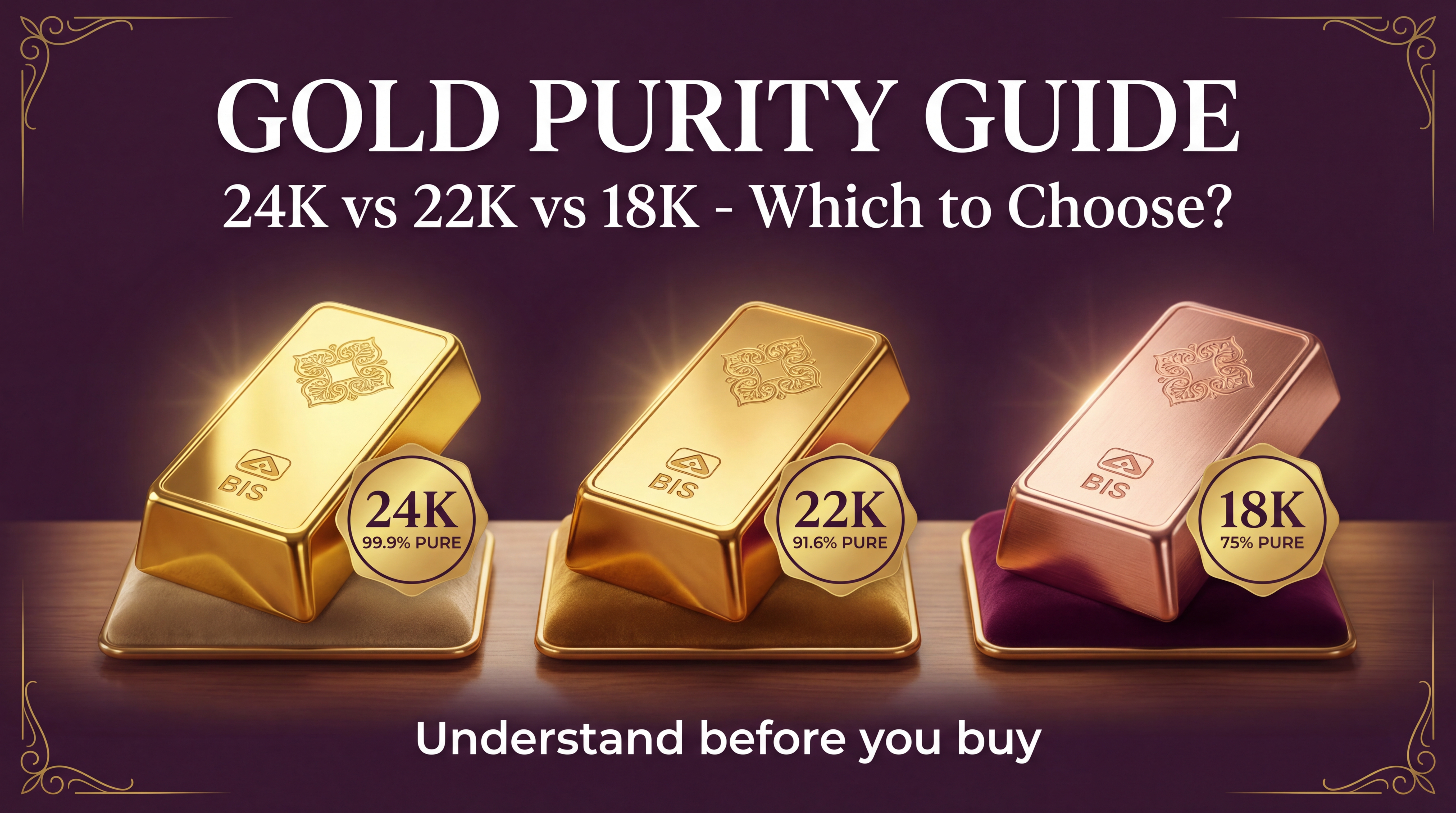
When buying gold—whether for investment, a wedding, or a special gift—one question always arises: Which karat should you choose? With gold trading at $4,517 per ounce and Indian gold prices at approximately ₹78,000 per 10 grams for 24K, understanding purity levels isn’t just academic—it directly impacts what you pay and what you get.
This comprehensive guide breaks down everything Indian Americans and NRIs need to know about gold purity, from the science of karats to India’s mandatory BIS hallmarking system.
Understanding Gold Purity: The Karat System
The karat system measures gold purity on a scale of 24, where 24 karats represents 100% pure gold.
Purity Comparison Table
| Karat | Purity | Gold Content | Fineness Mark | Common Uses |
|---|---|---|---|---|
| 24K | 99.9% | 24/24 parts gold | 999 | Investment bars, coins |
| 22K | 91.67% | 22/24 parts gold | 916 | Traditional Indian jewelry |
| 18K | 75% | 18/24 parts gold | 750 | Designer/Western jewelry |
| 14K | 58.3% | 14/24 parts gold | 585 | Daily wear, US market |
Source: World Gold Council, MMTC-PAMP
24 Karat Gold: The Purest Form
Characteristics
According to MMTC-PAMP:
“24K gold is the purest form of gold, containing 99.9% gold with no other metals. It is bright yellow and primarily used for investment purposes.”
| Feature | Details |
|---|---|
| Purity | 99.9% (999 fineness) |
| Color | Bright, rich yellow |
| Hardness | Softest (scratches easily) |
| Malleability | Most malleable |
| Best For | Investment, coins, bars |
| Resale Value | Highest |
Pros and Cons
Advantages:
- Highest purity and intrinsic value
- Best resale value
- No allergy concerns (hypoallergenic)
- Ideal for investment
Disadvantages:
- Too soft for daily-wear jewelry
- Scratches and bends easily
- Not suitable for intricate designs
- Higher price per gram
Current Prices (December 2025)
| Market | 24K Price |
|---|---|
| International | $4,517/oz |
| India | ~₹78,000/10g |
22 Karat Gold: The Indian Standard
Why Indians Prefer 22K
According to Jupiter Money:
“22K gold has a composition of 91.6% pure gold, with the other 8.4% being other metals, such as copper, silver, or zinc. This combination gives it strength and keeps a bright yellow colour.”
22K gold dominates the Indian market because it strikes the perfect balance between purity and durability.
| Feature | Details |
|---|---|
| Purity | 91.67% (916 fineness) |
| Alloy Metals | Copper, silver, zinc (8.33%) |
| Color | Deep golden yellow |
| Hardness | More durable than 24K |
| Best For | Wedding jewelry, heirlooms |
| Resale Value | Excellent in India |
Where 22K Shines
- Wedding jewelry: Mangalsutras, necklaces, bangles
- Traditional pieces: Temple jewelry, antique designs
- Heirloom jewelry: Pieces meant to pass through generations
- Investment jewelry: Combines wearability with store of value
Price Difference from 24K
According to Good Returns:
| Karat | Price per Gram (India) | Difference |
|---|---|---|
| 24K | ~₹7,800 | Baseline |
| 22K | ~₹7,150 | -8.3% |
The ~8% lower price reflects the 8.33% alloy content—you’re paying for actual gold content.
18 Karat Gold: The Durability Champion
Characteristics
According to Brinker’s Jewelers:
“18K gold consists of 75% gold and 25% alloyed metals, offering a good balance between purity and durability.”
| Feature | Details |
|---|---|
| Purity | 75% (750 fineness) |
| Alloy Metals | 25% (copper, silver, palladium, nickel) |
| Color | Can vary (yellow, white, rose) |
| Hardness | Significantly harder than 22K/24K |
| Best For | Daily wear, engagement rings |
| Color Options | Yellow, white, rose gold |
Why Choose 18K
- Daily wear: Strong enough for everyday use
- Designer jewelry: Holds intricate designs well
- Engagement rings: Industry standard in Western markets
- Color variety: White gold and rose gold options
- Active lifestyles: Resists scratches better
The Trade-Off
| Aspect | 18K vs 22K |
|---|---|
| Gold Content | 75% vs 91.67% |
| Durability | Higher |
| Resale in India | Lower premium |
| Western Market | More common |
| Price | ~25% less than 24K |
BIS Hallmarking: India’s Gold Guarantee
Mandatory Hallmarking in 2025
According to the Bureau of Indian Standards:
“The sale of un-hallmarked jewellery is illegal and punishable under Indian law.”
In 2025, BIS hallmarking is mandatory for all gold jewelry sold in India. The consequences of selling non-hallmarked gold include:
| Penalty | Details |
|---|---|
| Imprisonment | Up to 1 year |
| Fine | ₹1,00,000 or more |
| Seizure | Item confiscated |
Source: Public Mitra
What to Look For on Hallmarked Gold
According to Gullak, every hallmarked piece must have:
| Mark | Description |
|---|---|
| BIS Logo | Triangle with “Standard Mark” |
| Purity Mark | 999/916/750 for 24K/22K/18K |
| HUID | 6-digit Hallmark Unique ID |
How to Verify HUID
- Download the BIS CARE app (official)
- Select “Verify HUID” option
- Enter the 6-digit alphanumeric code
- App shows: carat, fineness, jeweler, hallmarking centre
According to Mehniya Jewelry:
“If HUID codes don’t verify through the BIS Care app, treat the jewelry as non-hallmarked regardless of visual symbols present.”
Making Charges and Wastage: The Hidden Costs
Understanding Making Charges
According to Gullak and ClearTax:
“Across major jewellers in India, gold making charges range between 3%-30% depending on the design complexity.”
| Jewelry Type | Making Charges | Reason |
|---|---|---|
| Machine-made (plain) | 3-8% | Mass production efficiency |
| Light handwork | 8-15% | Some manual labor |
| Heavy handwork | 15-25% | Skilled craftsmanship |
| Designer/Antique | 25-35% | Extensive manual work |
Source: IIFL Finance
Wastage Charges
When gold is shaped, cut, and polished, some material is lost. According to BankBazaar:
| Design Type | Wastage Range |
|---|---|
| Simple designs | 2-5% |
| Medium complexity | 5-8% |
| Intricate/handcrafted | 8-12% |
GST on Gold Jewelry
| Component | GST Rate |
|---|---|
| Gold value | 3% |
| Making charges | 5% |
Source: Razorpay
Total Cost Example
For a 22K gold necklace weighing 20 grams at ₹7,150/gram:
| Component | Calculation | Amount |
|---|---|---|
| Gold value | 20g × ₹7,150 | ₹1,43,000 |
| Making charges (15%) | ₹1,43,000 × 15% | ₹21,450 |
| Wastage (5%) | ₹1,43,000 × 5% | ₹7,150 |
| Subtotal | — | ₹1,71,600 |
| GST on gold (3%) | ₹1,43,000 × 3% | ₹4,290 |
| GST on making (5%) | ₹21,450 × 5% | ₹1,072 |
| Final Price | — | ₹1,76,962 |
The gold content cost ₹1,43,000, but the final price is ₹1,76,962—a 24% premium over spot gold value.
Which Karat Should You Choose?
Decision Framework
| Purpose | Recommended Karat | Why |
|---|---|---|
| Investment | 24K | Highest purity, best resale |
| Wedding jewelry | 22K | Traditional, excellent value |
| Daily wear | 18K or 14K | Durability for regular use |
| Engagement ring | 18K | Industry standard, holds stones well |
| Children’s jewelry | 18K | Withstands active wear |
| Heirloom pieces | 22K | Balances value and durability |
For NRIs Buying in India
If you’re an NRI purchasing gold in India:
- Always verify BIS hallmark and HUID
- Get itemized invoice showing gold weight, purity, making charges
- Compare making charges across jewelers (can vary 10-20%)
- Understand customs rules for carrying gold back
- Consider 22K for gifts—it’s the Indian standard
For Investment Purposes
According to Pimbex:
“24K gold generally offers the best resale value because it is the purest form of gold, containing 99.9% gold.”
| Investment Option | Purity | Making Charges | Resale Value |
|---|---|---|---|
| Digital gold | 24K | None | Face value |
| Gold bars/coins | 24K | 2-5% | Near spot |
| 22K jewelry | 91.67% | 8-25% | 70-85% of MRP |
| 18K jewelry | 75% | 10-30% | 60-75% of MRP |
Digital gold platforms like Mantra Mint offer 24K gold without making charges, maximizing your investment value.
Silver Hallmarking: New 2025 Rules
As of September 2025, silver hallmarking has also moved to the HUID system. According to Retail Jeweller India:
“The Bureau of Indian Standards has shifted silver hallmarking to the HUID system, starting from September 1, 2025.”
| Metal | Hallmarking Status | HUID Required |
|---|---|---|
| Gold | Mandatory | Yes |
| Silver | HUID from Sep 2025 | Yes |
Common Myths Debunked
Myth 1: “Higher karat is always better”
Reality: It depends on use. 24K is too soft for jewelry worn daily. 22K is optimal for Indian jewelry traditions.
Myth 2: “You lose money buying 22K vs 24K”
Reality: You pay for gold content. 22K jewelry costs ~8% less because it has ~8% less gold. The value is proportional.
Myth 3: “Making charges are a rip-off”
Reality: Craftsmanship has value. Machine-made jewelry has low making charges (3-8%). Intricate handwork costs more but produces unique pieces.
Myth 4: “All hallmarked gold is the same”
Reality: Hallmarking verifies purity, not design quality or making charges. Always compare across jewelers.
Current Market Snapshot
| Metric | Value | Source |
|---|---|---|
| Gold (USD) | $4,517/oz | Yahoo Finance |
| Gold 24K (India) | ~₹78,000/10g | Good Returns |
| Gold 22K (India) | ~₹71,500/10g | Good Returns |
| Gold 18K (India) | ~₹58,500/10g | Calculated |
| Silver (USD) | $69.61/oz | Yahoo Finance |
| Gold-Silver Ratio | 64.9:1 | Calculated |
The Bottom Line
Choosing between 24K, 22K, and 18K gold comes down to purpose:
- Investing? Choose 24K (or digital gold) for maximum purity and resale value
- Wedding jewelry? 22K is the Indian standard—pure enough for value, durable enough for generations
- Daily wear? 18K offers the durability needed for regular use
- Designer pieces? 18K holds intricate designs and gemstones better
Whatever karat you choose, always:
- Verify the BIS hallmark and HUID
- Get an itemized invoice
- Compare making charges across jewelers
- Understand the total cost including GST
Gold’s value transcends its karat rating—it’s what the metal represents for Indian families: tradition, security, and love passed through generations.
Sources
- World Gold Council - Gold Jewellery Purity
- MMTC-PAMP - Difference Between 14K, 18K, 22K, 24K Gold
- Jupiter Money - Karat Meaning Explained
- Brinker’s Jewelers - Gold Karat Guide
- Bureau of Indian Standards - Hallmarking Overview
- Mehniya Jewelry - BIS Hallmark Rules 2025
- Gullak - How to Check Hallmark on Gold
- Gullak - Gold Making Charges
- ClearTax - Gold Making Charges
- BankBazaar - Making and Wastage Charges
- IIFL Finance - Gold Making Charges
- Razorpay - GST on Gold
- Good Returns - Gold Rates India
- Pimbex - 24K vs 22K vs 18K Gold
Ready to start investing in gold?
Join thousands of Indian families building wealth with Mantra Mint.
Get Started Free