
Gold's January Effect: Why the New Year Is Historically Gold's Best Month
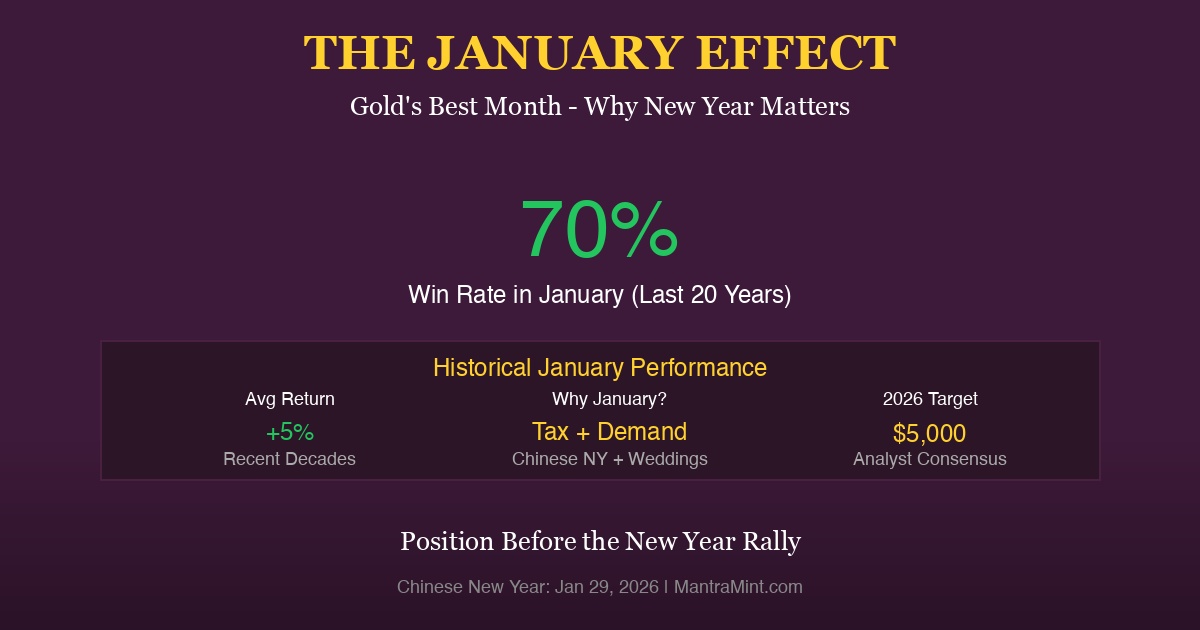
As 2025 closes with gold at $4,348/oz and up 71% year-to-date, investors are looking ahead to January 2026. History suggests they should be optimistic: according to the World Gold Council, January is gold’s strongest month, with an average return of 1.79%—nearly three times the long-term monthly average.
But in recent decades, the January Effect has been even more powerful. Let’s explore why January consistently outperforms for gold and how to position your portfolio for the new year.
The January Effect: By the Numbers
Historical January Performance
According to Forecaster.biz and seasonax:
| Timeframe | Positive Januarys | Average Return |
|---|---|---|
| Since 1971 | 60% | +1.79% |
| Since 2000 | 70% | +3.2% |
| Last 10 years | 70% | ~5% |
| Last 15 years | 73% | ~5% |
| Last 20 years | 70% | ~5% |
Source: World Gold Council
Gold’s Best Months (Historical Average)
According to BullionVault:
| Month | Average Return | Win Rate |
|---|---|---|
| January | +1.79% | 70% |
| August | +1.5% | 65% |
| September | +1.3% | 62% |
| February | +0.9% | 58% |
| November | +0.7% | 55% |
| December | +0.5% | 52% |
The New Year Rally
According to BullionVault:
“Gold has risen 14 times at New Year in US Dollar terms since 2004. Silver rose 13 times and platinum has risen more repeatedly still.”
| Metal | Positive New Years (2004-2024) | Win Rate |
|---|---|---|
| Gold | 14 of 20 | 70% |
| Silver | 13 of 20 | 65% |
| Platinum | 15 of 20 | 75% |
Why Does the January Effect Occur?
1. Tax-Loss Selling Reversal
According to American Standard Gold:
“It stems from tax-loss selling in December, where investors sell assets to offset capital gains or lock in profits. When the new year begins, investors re-enter the market and buy assets with their year-end bonuses.”
| December | January |
|---|---|
| Tax-loss selling | Re-buying begins |
| Portfolio rebalancing | New allocations |
| Profit-taking | Fresh capital deployed |
| Reduced demand | Demand surge |
2. Chinese New Year Demand
According to Vaulted:
“Chinese gold demand tends to pick up in December and January in preparation for the New Year, which usually falls in late January/early February.”
| Factor | Impact |
|---|---|
| Chinese New Year gift buying | High demand |
| Cultural symbolism | Gold = prosperity |
| Jewelry purchases | Peak season |
| Government stimulus | Often deployed in Q1 |
Chinese New Year 2026 falls on January 29, making January demand particularly strong.
3. Indian Wedding Season
According to Discovery Alert:
“Cultural factors underlying the Indian wedding season are what make December and January bullish months for gold. Around 10 million weddings are celebrated in India every year.”
| Period | Wedding Volume | Gold Demand |
|---|---|---|
| October-November | Very high | Peak |
| December-January | High | Strong |
| February-March | Moderate | Elevated |
| Monsoon (June-August) | Low | Weak |
4. Portfolio Rebalancing
According to Capital.com:
| Institutional Activity | Timing |
|---|---|
| New year allocations | January 1-15 |
| Pension fund rebalancing | Early January |
| Fresh investment mandates | Q1 start |
| Hedge fund positioning | New year |
January 2026: What’s Different This Time?
Starting Point: Gold at $4,348/oz
| Factor | 2025 | Typical Year |
|---|---|---|
| YTD performance | +71% | +8% average |
| All-time highs | 50+ in 2025 | 5-10 typical |
| ETF inflows | $57.1B record | $10-15B average |
| Central bank buying | 900+ tonnes | 500-600 tonnes |
The Setup for January 2026
According to FXLeaders:
| Factor | Bullish/Bearish | Weight |
|---|---|---|
| January seasonality | Bullish | Strong |
| Chinese New Year timing | Bullish | Strong |
| Fed rate path | Bullish | Moderate |
| Dollar weakness | Bullish | Strong |
| Overbought conditions | Bearish | Moderate |
| Profit-taking risk | Bearish | Moderate |
Analyst Price Targets for January 2026
| Institution | Q1 2026 Target | Full Year 2026 |
|---|---|---|
| Goldman Sachs | $4,500/oz | $4,900/oz |
| J.P. Morgan | $4,600/oz | $5,000/oz |
| Morgan Stanley | $4,400/oz | $4,800/oz |
Source: Various analyst reports via Yahoo Finance
Technical Levels to Watch
According to FXEmpire:
| Level | Type | Significance |
|---|---|---|
| $4,200 | Support | 0.618 Fibonacci |
| $4,350 | Current | Trading level |
| $4,500 | Resistance | Near-term target |
| $4,620 | Resistance | 1.618 Fibonacci |
| $5,000 | Target | Psychological level |
RSI and Momentum
According to technical analysts:
“Short-term RSI shows overbought conditions. These overbought conditions may form the catalyst for a short-term pullback. If this pullback develops, it will be viewed as an attractive buying opportunity.”
Potential Risks to the January Rally
Why This January Could Be Different
| Risk | Probability | Impact |
|---|---|---|
| Profit-taking after 71% rally | High | Pullback to $4,000-4,200 |
| Dollar recovery | Low-Moderate | 5-10% correction |
| Fed hawkish surprise | Low | 10%+ correction |
| Geopolitical calm | Low | Reduced safe-haven demand |
| Liquidity vacuum | Moderate | Whipsaw volatility |
According to Real Investment Advice:
“Seasonal patterns and low liquidity during holiday trading often distort technical signals, increasing the probability of false breakouts and whipsaw price action.”
How to Position for January 2026
Entry Strategies
| Strategy | Best For | Approach |
|---|---|---|
| Buy now | Long-term holders | Add before January strength |
| Wait for pullback | Value-focused | Target $4,200-4,300 support |
| DCA | Risk-averse | Weekly purchases through Q1 |
| Hybrid | Balanced | 50% now, 50% on dips |
Allocation Recommendations
| Investor Type | Current Gold % | January Action |
|---|---|---|
| No exposure | 0% | Start with 10% allocation |
| Under-allocated | 5% | Increase to 10-15% |
| Appropriately allocated | 10-15% | Hold, rebalance if >20% |
| Over-allocated | 20%+ | Consider taking some profits |
For Indian Investors: Perfect Timing
Why January Matters for NRIs
| Factor | Impact |
|---|---|
| Wedding season continuation | Strong demand |
| Chinese New Year (Jan 29) | Global demand boost |
| Rupee seasonality | Often weakens Q1 |
| Festival gifting | Makar Sankranti (Jan 14) |
| Tax planning | New financial year preparation |
Gold Price in India Context
According to GoodReturns, with gold at approximately ₹14,200/gram (24K), January demand typically pushes prices higher:
| Historical January | INR Change |
|---|---|
| January 2024 | +3.2% |
| January 2023 | +4.1% |
| January 2022 | +2.8% |
Historical Cautionary Tales
When January Disappointed
According to World Gold Council:
| Year | January Return | Context |
|---|---|---|
| 2021 | -2.7% | Post-COVID rebalancing |
| 2013 | -0.8% | Fed tapering fears |
| 2011 | -5.6% | European debt crisis |
“It should be noted that countless factors influence the price of gold. Past seasonal trends may or may not continue in the future.”
The Bottom Line
The January Effect is real—gold has a 70% win rate in January with average gains of 5% in recent decades. But 2026 is unique:
Bullish factors:
- January seasonality (historically strongest month)
- Chinese New Year demand (January 29)
- Continued central bank buying
- Dollar weakness expected to persist
- Indian wedding season in full swing
Bearish factors:
- Gold already up 71% in 2025
- Some profit-taking inevitable
- RSI showing overbought conditions
- Potential for false breakouts
According to Discovery Alert:
“Gold’s strongest seasonal period now generally spans mid-December to mid-April, with additional momentum often observed between August and October.”
The window is open. History suggests January rewards gold investors more often than not.
Position for the January Effect with Mantra Mint
Whether you’re buying for the January rally or building long-term wealth, the time to act is before the new year begins.
Why Mantra Mint:
- Start with $10 — No minimum investment
- Real gold backing — Not paper promises
- Instant purchase — Position before January 1
- Perfect for NRIs — Bridge USA and India seamlessly
January Action Plan:
- Build or increase gold allocation now
- Set up recurring purchases for Q1 2026
- Gift gold for Makar Sankranti (Jan 14) or Chinese New Year (Jan 29)
The January Effect waits for no one. Start your position today.
Start Your Gold Position — Capture the January Effect.
Sources
- World Gold Council - Is There a January Effect for Gold?
- Seasonax - Seasonal Gold Price Trends
- BullionVault - Annual Gold Price Pattern
- Forecaster.biz - Gold Seasonality
- American Standard Gold - Best Months for Investing
- Vaulted - Seasonal Gold Demand
- Capital.com - Gold vs US Dollar Seasonality
- Discovery Alert - Gold Seasonality 2025
- Real Investment Advice - Santa Claus Rally
- FXLeaders - Gold 2026 Outlook
Ready to start investing in gold?
Join thousands of Indian families building wealth with Mantra Mint.
Get Started Free