
Gold and the FIRE Movement: How Precious Metals Fit Into Early Retirement
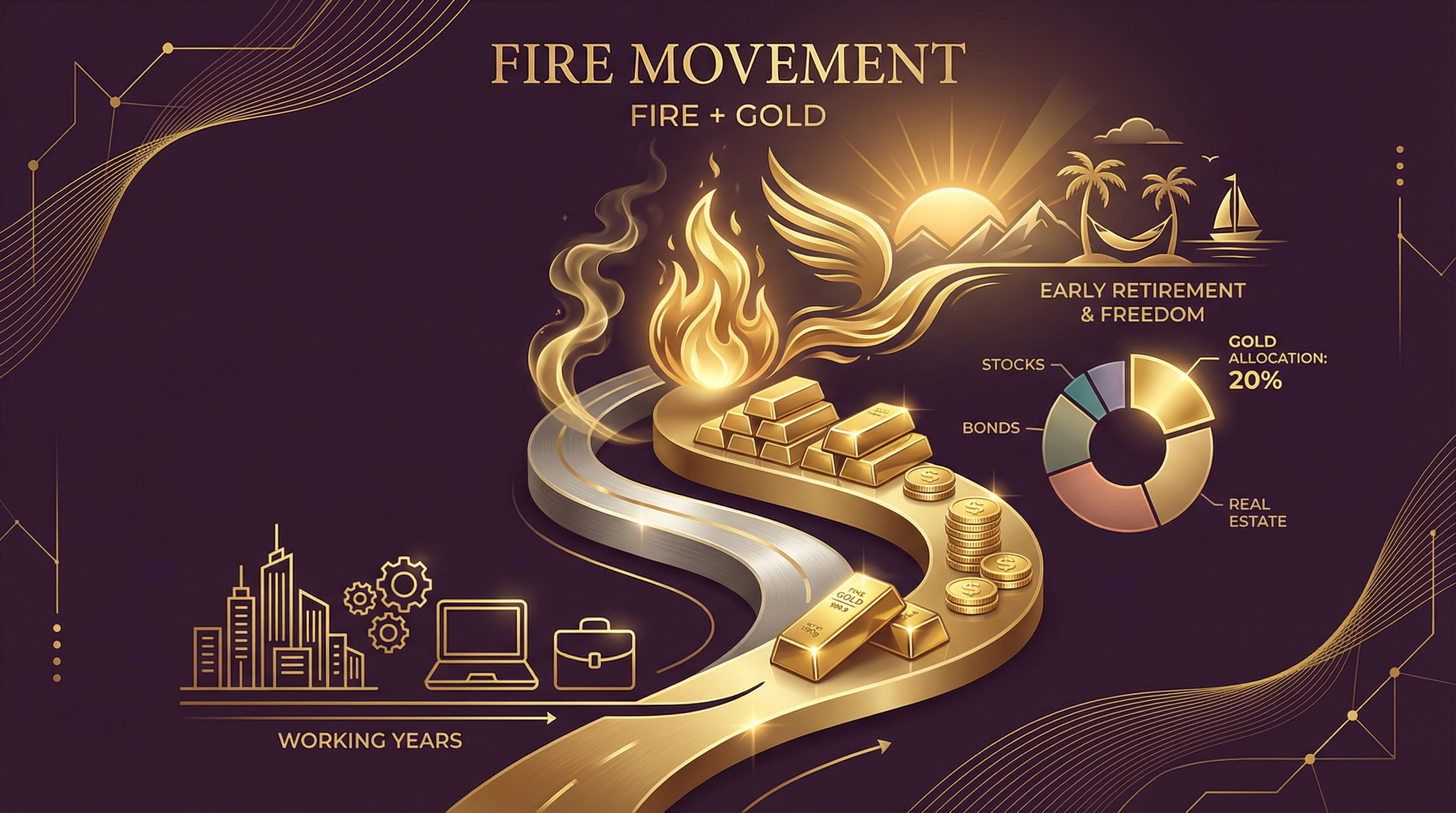
The FIRE movement—Financial Independence, Retire Early—has captivated a generation of high-income earners seeking to escape the 9-to-5 decades ahead of schedule. But as gold trades at $5,414 per ounce in January 2026, a crucial question emerges: does the precious metal have a place in FIRE portfolios?
The answer, backed by rigorous research, is a resounding yes—but not for the reasons most people think.
According to Early Retirement Now’s Safe Withdrawal Rate research, gold “shines when all the other asset classes are hurting. And that’s a huge benefit!” The research shows that gold allocation “alleviates Sequence Risk, precisely during the bad historical bear markets (1929, the 1970s).”
For Indian Americans pursuing FIRE, gold offers something even more profound: a bridge between modern financial optimization and generational wisdom.
What Is the FIRE Movement?
FIRE stands for Financial Independence, Retire Early. According to NerdWallet, it’s “a personal finance phenomenon characterized by high savings rates—often exceeding the 10–15% typically recommended by financial planners—and aggressive investment, with the goal of accumulating sufficient assets to cover living expenses without traditional employment.”
The Core Principles
| FIRE Concept | Definition | Target |
|---|---|---|
| FIRE Number | Portfolio size needed to retire | 25x annual expenses |
| 4% Rule | Annual safe withdrawal rate | 4% of portfolio |
| Savings Rate | Income saved toward FIRE | 50-70%+ |
| Investment Strategy | Asset allocation | Low-cost index funds |
The math is elegant: if you need $40,000/year to live, your FIRE number is $1,000,000 (25 × $40,000). At a 4% withdrawal rate, this portfolio should theoretically last 30+ years.
Types of FIRE
| Type | Description | Target Corpus | Source |
|---|---|---|---|
| Lean FIRE | Minimalist lifestyle | 25x expenses | Mintos |
| Regular FIRE | Comfortable living | 25x expenses | NerdWallet |
| Fat FIRE | Luxurious retirement | 50x expenses | PNB MetLife |
| Barista FIRE | Part-time work in retirement | 20x expenses | Motley Fool |
The Problem: Sequence of Returns Risk
Here’s where most FIRE planning falls short: the 4% rule assumes average market returns. But early retirees face a unique danger called sequence of returns risk.
According to CNBC: “Your first five years of retirement are the ‘danger zone’ for tapping accounts during a downturn.”
Fidelity Investments research confirms: “Negative returns are more harmful early in retirement than later. That’s because retirees miss more years of potential compound growth.”
The Math of Sequence Risk
Consider two scenarios for a $1,000,000 FIRE portfolio withdrawing $40,000/year:
Scenario A: Good Returns First
| Year | Return | Portfolio Start | Withdrawal | Portfolio End |
|---|---|---|---|---|
| 1 | +20% | $1,000,000 | $40,000 | $1,160,000 |
| 2 | +15% | $1,160,000 | $40,000 | $1,294,000 |
| 3 | -30% | $1,294,000 | $40,000 | $877,800 |
Scenario B: Bad Returns First
| Year | Return | Portfolio Start | Withdrawal | Portfolio End |
|---|---|---|---|---|
| 1 | -30% | $1,000,000 | $40,000 | $660,000 |
| 2 | +15% | $660,000 | $40,000 | $719,000 |
| 3 | +20% | $719,000 | $40,000 | $822,800 |
Same average returns. Same withdrawals. But Scenario B leaves you $55,000 poorer—a gap that compounds over 30+ years.
For early retirees with 40-50 year horizons, this risk is existential.
Why Gold Protects FIRE Portfolios
According to the Early Retirement Now research, gold’s value in FIRE portfolios isn’t about maximizing returns—it’s about providing protection precisely when you need it most.
Gold’s Unique Characteristics for Early Retirees
1. Non-Correlation During Crises
U.S. Money Reserve explains: “A 10-15% gold allocation provides meaningful downside protection during equity bear markets while maintaining upside participation during crisis-driven rallies. The metal’s non-correlation with traditional financial assets means it reliably zigs when stocks and bonds zag.”
2. No Counterparty Risk
According to IRA Financial: “Gold requires no revenue growth, pricing power, or economic expansion to maintain value—it simply represents stored purchasing power that governments cannot dilute through monetary expansion.”
3. Self-Liquidating During Bear Markets
When stocks crash, gold often rises. This means early retirees can sell gold (at a premium) instead of stocks (at a loss) during downturns—the exact moment when sequence risk is most dangerous.
Research-Backed Gold Allocations for FIRE
The 4% Rule Creator’s Update
Bill Bengen, who created the original 4% rule, recently updated his guidance. According to CNBC: “Bengen’s new default safe withdrawal rate for a 30-year retirement is 4.7%.”
Morningstar’s 2026 Research
Morningstar’s latest analysis found: “For the typical person retiring in 2026, the safest starting withdrawal rate is actually 3.9%, not 4%.”
Gold Allocation Research
White Coat Investor’s analysis notes: “While it generates a lot of controversy, a modest allocation to gold (10-20%) has historically been quite beneficial to portfolios that were otherwise heavily weighted to stocks and bonds.”
Ray Dalio of Bridgewater Associates, the world’s largest hedge fund, recommends holding as much as 15% of portfolios in gold, according to his October 2025 guidance.
Recommended FIRE Gold Allocations
| FIRE Type | Gold Allocation | Rationale | Source |
|---|---|---|---|
| Lean FIRE | 10-15% | Maximum sequence protection needed | Early Retirement Now |
| Regular FIRE | 10-15% | Balanced protection | White Coat Investor |
| Fat FIRE | 5-10% | More cushion, less hedge needed | Portfolio theory |
| Early Retirees (under 50) | 10-15% | Longer horizon = more sequence risk | Early Retirement Now |
The Golden Butterfly: A FIRE-Optimized Portfolio
One portfolio specifically designed for early retirees is the Golden Butterfly, which includes a substantial gold allocation.
According to Portfolio Charts, the Golden Butterfly consists of:
| Asset | Allocation | Purpose |
|---|---|---|
| Total US Stock Market | 20% | Growth |
| Small Cap Value | 20% | Growth tilt |
| Long-Term Treasuries | 20% | Deflation hedge |
| Short-Term Treasuries | 20% | Stability |
| Gold | 20% | Inflation/crisis hedge |
2025 Performance
According to PortfoliosLab: “As of December 30, 2025, the Golden Butterfly Portfolio returned 19.25% Year-To-Date and 8.77% of annualized return in the last 10 years.”
Portfolio Charts reports: “Gold achieved an attention-grabbing 63% real return in 2025.”
Long-Term Safe Withdrawal Rate
The Golden Butterfly’s expected permanent safe withdrawal rate is 5.3% according to Portfolio Charts—significantly higher than the standard 4% rule.
For Indian Americans: FIRE Meets Tradition
For NRIs pursuing FIRE, gold isn’t just a portfolio optimization—it’s a connection to ancestral wisdom.
The Cultural Advantage
Indian households hold an estimated 25,000-34,000 tonnes of gold according to the World Gold Council—approximately 11% of all gold ever mined. This isn’t superstition; it’s generational wealth preservation validated by history.
NRI-Specific FIRE Considerations
According to WiseNRI, many young NRIs are building investments around the FIRE strategy. GoiNRI research found that 65% of NRIs expressed desire to retire in India.
| Consideration | Impact on FIRE | Gold’s Role |
|---|---|---|
| Return to India option | Lower FIRE number possible | Portable, globally liquid |
| Rupee depreciation risk | Affects spending power | Dollar-denominated hedge |
| Family obligations | Cultural wealth transfers | Traditional gifting vehicle |
| Healthcare costs | Variable by location | Liquidatable emergency reserve |
The Dual Currency Advantage
Gold provides NRIs a unique benefit: protection against both dollar weakness AND rupee depreciation. With gold at $5,414/oz (about ₹1,67,000 per 10 grams), holding gold hedges currency risk regardless of which country you ultimately retire in.
Building Gold Into Your FIRE Portfolio
Strategy 1: The Sequence Risk Buffer
Allocate 10-15% of your portfolio to gold, specifically as “dry powder” for bear markets:
| Portfolio Size | Gold Allocation | Purpose |
|---|---|---|
| Under $250k | 10% ($25k) | Foundation building |
| $250k-$500k | 12% ($30-60k) | Meaningful buffer |
| $500k-$1M | 15% ($75-150k) | Full sequence protection |
| $1M+ | 10-15% ($100-150k+) | Wealth preservation |
Strategy 2: Dollar-Cost Averaging
Rather than timing gold purchases, use systematic buying:
| Monthly Investment | Annual Gold | 5-Year Accumulation (at $174/g) |
|---|---|---|
| $200 | ~13.8g | ~69g ($12,000) |
| $500 | ~34.5g | ~172g ($30,000) |
| $1,000 | ~68.9g | ~345g ($60,000) |
Strategy 3: The Glide Path Approach
Increase gold allocation as you approach your FIRE date:
| Years to FIRE | Stock Allocation | Bond Allocation | Gold Allocation |
|---|---|---|---|
| 10+ years | 90% | 5% | 5% |
| 5-10 years | 80% | 10% | 10% |
| 2-5 years | 70% | 15% | 15% |
| At FIRE | 60% | 25% | 15% |
Common FIRE + Gold Mistakes to Avoid
1. Too Much Gold
Early Retirement Now warns: “Some of the other heavily hyped, ‘sexy’ asset allocation flavors like the ‘Permanent Portfolio,’ ‘Risk Parity/All-Weather Portfolio,’ and ‘Golden Butterfly Portfolio’ not only don’t add value but sometimes even lower your sustainable withdrawal rate.”
The key insight: shift some of the equity portion into gold—don’t add gold on top of an already-conservative allocation.
2. Ignoring Gold in Tax-Advantaged Accounts
Gold can be held in IRAs through Gold ETFs (GLD, IAU) or physical gold via self-directed IRAs. For FIRE portfolios, consider keeping gold in taxable accounts for easier rebalancing access.
3. Treating Gold as a Growth Investment
Gold isn’t meant to grow your FIRE portfolio—it’s meant to protect it during the danger zone. Expect gold to underperform stocks during bull markets while providing insurance during bears.
Current Market Context: January 2026
With gold at record highs, is now the time to add it to your FIRE portfolio?
| Metric | Current | Context | Source |
|---|---|---|---|
| Gold Price | $5,414/oz | Record high | Yahoo Finance |
| Silver Price | $114.87/oz | 14-year high | Yahoo Finance |
| Gold/Silver Ratio | 47.1 | 14-year low | Calculated |
| Fed Rate | 3.50-3.75% | On hold | Federal Reserve |
| 2025 Gold Return | +67% | Best year since 1980 | Market data |
The research suggests that gold’s value comes from its crisis protection, not its price level. Whether gold is at $2,000 or $5,000, its role in protecting against sequence risk remains the same.
For FIRE pursuers, the question isn’t “Is gold expensive?” but “Can I afford to face a 2008-style crash without protection?”
Action Plan: Gold for Your FIRE Journey
If You’re 10+ Years From FIRE
- Target 5% gold allocation as foundation
- Use dollar-cost averaging ($100-500/month)
- Focus primarily on equity accumulation
- Increase gold as you approach FIRE date
If You’re 5-10 Years From FIRE
- Target 10% gold allocation
- Begin building sequence risk buffer
- Consider the Golden Butterfly allocation
- Rebalance annually
If You’re Under 5 Years From FIRE
- Target 15% gold allocation
- Prioritize sequence risk protection
- Keep gold liquid for bear market flexibility
- Don’t sell gold to buy stocks during crashes
If You’ve Already FIREd
- Maintain 10-15% gold allocation
- Use gold as your “sell-first” asset during downturns
- Rebalance into stocks after crashes
- Consider gold for intergenerational wealth transfer
The Bottom Line: FIRE + Gold = Resilience
The FIRE movement’s strength is its mathematical rigor. But math alone can’t protect against the psychological and financial devastation of watching your portfolio drop 40% in year one of retirement.
Gold doesn’t make FIRE portfolios grow faster—it makes them more resilient. And for early retirees facing 40-50 year horizons, resilience may be the most important factor of all.
As White Coat Investor summarizes: “For retirees, gold functions as portfolio insurance that doesn’t require paying ongoing premiums. Unlike put options that decay or insurance policies that demand annual renewals, gold maintains its value and purchasing power across generations.”
For Indian Americans, this is simply validation of what families have known for generations: gold endures.
Build Your FIRE Portfolio’s Gold Allocation with Mantra Mint
Whether you’re 10 years from FIRE or already living the dream, Mantra Mint makes adding gold to your portfolio simple:
For FIRE Seekers:
- Start with $10 — Begin building your gold allocation at any budget
- Auto-invest weekly — Dollar-cost average into gold systematically
- 24K pure gold — Investment-grade, not jewelry markup
- Track your progress — Watch your gold holdings grow alongside your FIRE journey
The FIRE + Gold Strategy:
- Set up auto-invest to match your savings rate
- Build your 10-15% gold allocation over time
- Use your gold as sequence risk protection
- Maintain liquidity for crisis rebalancing
Your FIRE portfolio needs protection, not just growth. Gold provides the resilience that makes early retirement truly sustainable.
Current Gold Price: $5,414/oz | Per Gram: ~$174
Start Building Your Gold Position — Because financial independence requires resilience.
Sources
- Early Retirement Now - Gold as Hedge Against Sequence Risk
- NerdWallet - FIRE Movement Guide
- Morningstar - 4% Withdrawal Rule Research
- CNBC - 4% Rule Creator Update
- CNBC - Sequence of Returns Risk
- White Coat Investor - Safe Withdrawal Rates
- Portfolio Charts - Golden Butterfly Portfolio
- PortfoliosLab - Golden Butterfly Performance
- Motley Fool - FIRE Movement Guide
- U.S. Money Reserve - Sequence Risk
- IRA Financial - Gold in Retirement Funds
- WiseNRI - FIRE Method for NRIs
- GoiNRI - NRI FIRE Number
- Mintos - How to Achieve FIRE
- World Gold Council - Gold Demand Data
- Yahoo Finance - Gold Futures
- Federal Reserve - Interest Rates
Ready to start investing in gold?
Join thousands of Indian families building wealth with Mantra Mint.
Get Started Free