
Gold in Every Economic Cycle: Why It Outperforms in Stagflation, Recession & Beyond
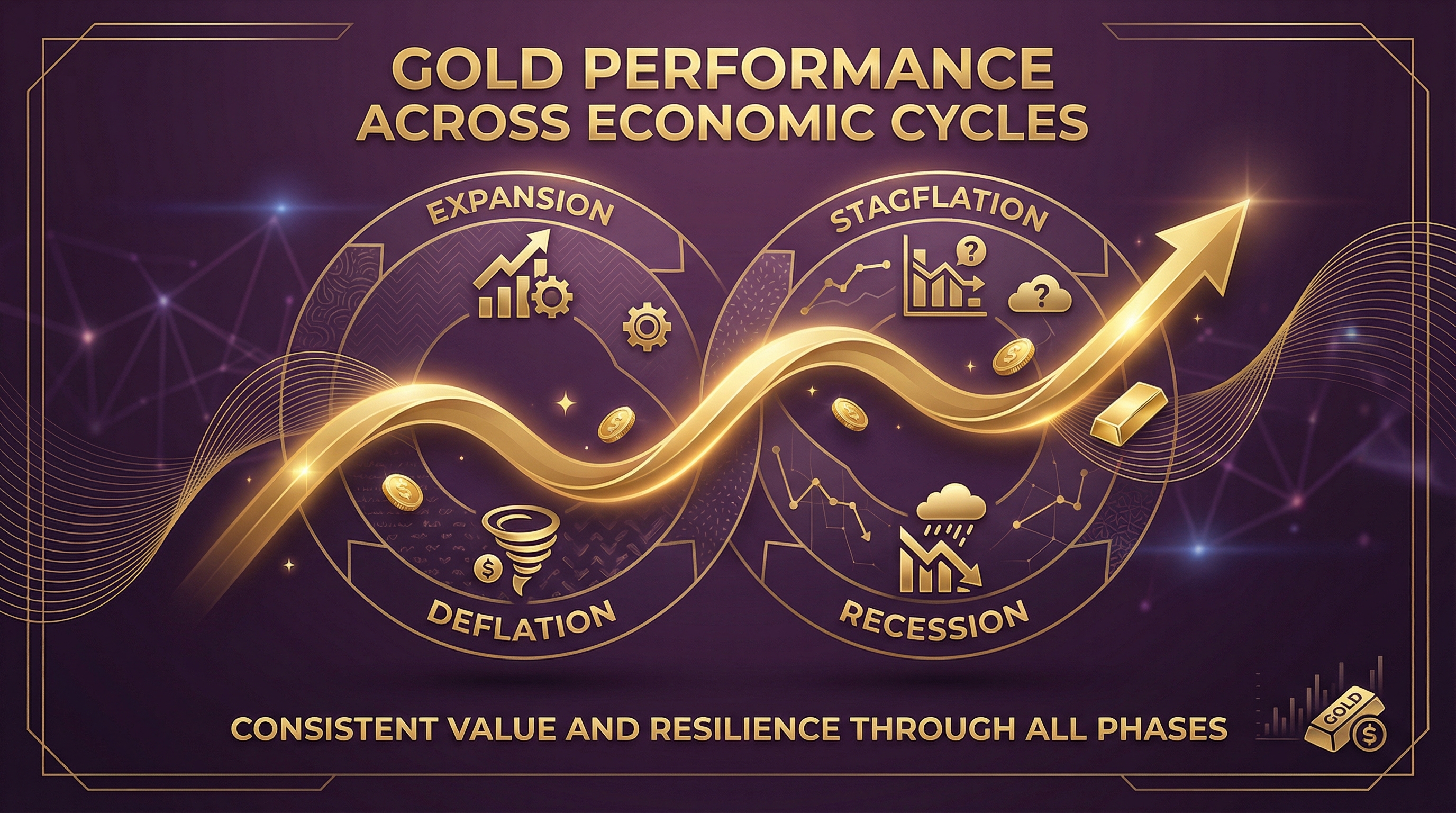
What if there was an asset that performed well regardless of economic conditions—whether the economy is booming, stagnating, deflating, or crashing? According to research from Proactive Advisor Magazine, gold ranked in the top three performers in every economic regime, a consistency no other asset class matches.
With gold trading at approximately $4,525 per ounce—up 4.6% this week according to Yahoo Finance—and economic uncertainty dominating 2026’s outlook, understanding how gold behaves across different economic cycles has never been more important.
Current Market Snapshot
| Metric | Current Value | Weekly Change | Source |
|---|---|---|---|
| Gold Spot Price | $4,525/oz | +4.6% | Yahoo Finance |
| Silver Spot Price | $79.79/oz | +12.2% | Yahoo Finance |
| Gold/Silver Ratio | 56.7 | Compressing | Calculated |
| S&P 500 (SPY) | $694.07 | +1.8% | Yahoo Finance |
| Treasury Bonds (TLT) | $87.93 | Flat | Yahoo Finance |
| TIPS ETF (TIP) | $110.18 | +0.3% | Yahoo Finance |
The Four Economic Regimes
Economic conditions can be classified into four primary regimes based on growth and inflation dynamics:
| Regime | Definition | Frequency | Gold’s Role |
|---|---|---|---|
| Normal/Expansion | Positive growth, moderate inflation | 74.64% of quarters | Wealth building |
| Stagflation | Stagnant growth, high inflation | 33.8% of quarters | Top performer |
| Recession | Negative growth, falling inflation | Variable | Safe haven |
| Deflation | Negative growth, falling prices | 1.44% of quarters | Store of value |
Source: Proactive Advisor Magazine
Let’s examine gold’s performance in each environment.
Stagflation: Gold’s Greatest Triumph
Stagflation—the toxic combination of stagnant growth, high inflation, and rising unemployment—is the economic condition most investors fear. It’s also where gold shines brightest.
The 1970s Stagflation Era
According to CME Group, during the stagflationary period of 1973-1979:
| Metric | Performance |
|---|---|
| Gold Annual Return | +35% average |
| Inflation (CPI) | 8.8% average |
| Real Return | +26% annually |
| Total Decade Gain | +2,300% |
Source: CME Group Research
As documented by Bankrate’s gold price history, gold went from about $35/oz in 1970 to around $850/oz by January 1980—a 2,329% explosion that far outpaced inflation.
Why Gold Excels in Stagflation
According to research cited by Gold Price Forecast:
- Inflation hedge: Gold preserves purchasing power when currencies devalue
- Low opportunity cost: Stagnant growth means fewer attractive alternatives
- Crisis hedge: Economic uncertainty drives safe-haven demand
- Real asset: Physical asset when paper assets underperform
Gold had an annualized return of 19.16% during stagflation periods, outpacing its nearest competitor by a substantial margin, according to Proactive Advisor Magazine.
Comparison to Other Assets During Stagflation
| Asset Class | Annual Real Return | Notes |
|---|---|---|
| Gold | +19.16% | Top performer |
| US Treasuries | +9.6% | Second best |
| Cash | Negative | Lost purchasing power |
| Stocks (S&P 500) | +1.16% | Barely positive |
| Bonds | -3% | Lost value after inflation |
Source: Proactive Advisor Magazine
During stagflation, gold outperformed equities by 18 percentage points—a substantial cushion against equity weakness.
Could Stagflation Return?
According to the World Gold Council, stagflationary periods have occurred more often and lasted longer than many expect. US economic history since 1971 reveals:
- Stagflation appeared in 68 of 201 quarters (33.8%)
- It has twice lasted 8 consecutive quarters
- Current conditions (elevated inflation, slowing growth) echo historical patterns
Recession: Gold’s Safe-Haven Function
While stagflation is gold’s highlight reel, recessions demonstrate gold’s core value proposition as a safe haven.
Historical Recession Performance
According to Hero Bullion’s analysis, gold has outperformed the S&P 500 in six out of eight recessions between 1973 and 2020:
| Recession | Gold Performance | S&P 500 Performance | Gold Advantage |
|---|---|---|---|
| 1973-1975 | +145% | -42% | +187% |
| 1980 | +15% | +10% | +5% |
| 1981-1982 | -12% | -23% | +11% |
| 1990-1991 | +6% | -8% | +14% |
| 2001 | +5% | -27% | +32% |
| 2007-2009 | +25% | -38.5% | +63.5% |
| 2020 (COVID) | +24% | -34% (Mar low) | +58% |
Sources: BLS, Hero Bullion
The 2008 Financial Crisis Deep Dive
According to Bureau of Labor Statistics data:
| Metric | 2008 | 2009 | 2008-2012 |
|---|---|---|---|
| Gold PPI Change | +2.6% | +12.8% | +93% |
| S&P 500 Return | -38.5% | +23% | Flat |
| Gold Peak | $1,788/oz (2012) | - | From $924 |
While gold experienced a brief 28% drawdown during the initial Lehman Brothers panic as funds liquidated all assets for cash, according to Gainesville Coins, it quickly recovered and ended 2008 up 5.5% while stocks crashed.
Why Gold Works in Recessions
According to Metals Mint:
- Flight to safety: Investors flee risky assets
- Rate cuts: Fed cuts rates, reducing opportunity cost of gold
- Currency debasement: Monetary stimulus weakens currency
- Counter-cyclical demand: Fear drives gold buying
Gold prices rallied almost 50% during the 2008-2009 rate cutting period as the Fed brought rates from 4.75% to essentially 0%.
Deflation: The Overlooked Scenario
Deflation—falling prices and economic contraction—is relatively rare but devastating. How does gold perform?
Historical Deflation Performance
According to Proactive Advisor Magazine:
| Asset | Annualized Return in Deflation |
|---|---|
| US Treasuries | +11.2% (best) |
| Gold | Top 3 performer |
| Stocks | Negative |
| Real Estate | Severely negative |
Note: Deflation occurred in only 1.44% of quarters since 1971
Gold’s Dual Role
According to the World Gold Council’s research:
“Gold’s dual role as an inflation hedge and deflation safeguard makes it uniquely resilient.”
In deflation:
- Nominal prices may fall slightly as everything deflates
- Purchasing power increases as gold buys more goods
- Credit risk rises favoring physical assets without counterparty risk
- Central bank response (QE, rate cuts) eventually supports gold
Normal/Expansion: Gold Still Delivers
Even in “normal” economic times (positive growth, moderate inflation), gold has historically delivered positive returns:
Long-Term Performance
| Period | Gold CAGR | S&P 500 CAGR | Notes |
|---|---|---|---|
| 1971-2025 | 8.2% | 10.4% | Gold’s modern era |
| 2000-2025 | 9.8% | 7.2% | 21st century |
| 2015-2025 | 12.4% | 11.8% | Recent decade |
| 2020-2025 | 18.2% | 14.6% | Post-COVID |
Sources: World Gold Council, market data
Role in Normal Times
During economic expansion, gold serves as:
- Portfolio diversifier: Low correlation to other assets
- Insurance policy: Protection against unexpected shocks
- Wealth preservation: Maintains purchasing power
- Rebalancing anchor: Steady allocation regardless of market conditions
The Comprehensive Performance Matrix
Here’s how gold compares across all regimes:
| Regime | Gold Return | Stock Return | Bond Return | Gold Rank |
|---|---|---|---|---|
| Stagflation | +19.16% | +1.16% | Negative | 1st |
| Recession | +28% avg | Negative | Positive | Top 2 |
| Deflation | Positive | Negative | +11.2% | Top 3 |
| Normal | +8.2% | +10.4% | +5% | Top 3 |
Source: Compiled from CME Group, Proactive Advisor Magazine
The key insight: Gold ranks in the top three in every regime—a consistency no other asset class matches.
Practical Application: All-Weather Portfolio
The Gold Allocation Framework
Based on economic regime analysis, consider these allocation frameworks:
| Economic Outlook | Suggested Gold Allocation | Rationale |
|---|---|---|
| Expansion likely | 5-10% | Insurance, diversification |
| Stagflation risk | 15-20% | Proven outperformer |
| Recession signals | 10-15% | Safe haven activation |
| Deflation concerns | 10-15% | Store of value |
| Uncertain/Mixed | 10-15% | Covers all scenarios |
Ray Dalio’s All-Weather Approach
Bridgewater’s Ray Dalio famously recommends 7.5% in gold and 7.5% in commodities as part of an “all-weather” portfolio designed to perform in any economic environment.
Implementation Strategy
| Approach | Method | Best For |
|---|---|---|
| Core holding | Maintain steady allocation | Long-term investors |
| Tactical overlay | Increase on recession signals | Active investors |
| Dollar-cost average | Regular purchases regardless of cycle | Most investors |
| Rebalance trigger | Adjust when allocation drifts 5%+ | Disciplined portfolios |
What About 2026?
Current economic indicators suggest a mixed environment:
| Indicator | Current Status | Historical Parallel |
|---|---|---|
| Inflation | Moderating but sticky | Post-1970s |
| Growth | Slowing from peak | Pre-recession signals |
| Rates | Elevated, easing expected | 2007-2008 pattern |
| Geopolitics | Elevated tensions | Supports gold |
| Central Banks | Net buyers | 2022-2025 trend |
According to multiple analysts cited in our research:
- Stagflation risk remains elevated
- Recession probability has increased
- Deflation is unlikely but possible in a severe downturn
- All scenarios favor maintaining gold exposure
NRI Considerations: Economic Cycles and Currency
For Indians in the USA, economic cycles add another dimension:
USD-INR Dynamics
| US Economic Condition | Typical USD Impact | INR Gold Effect |
|---|---|---|
| US Recession | Dollar weakens | Gold gains in both currencies |
| US Stagflation | Dollar pressure | Strong INR gold returns |
| Global Crisis | Dollar strengthens | Mixed, but gold rises |
| US Expansion | Dollar stable | Normal gold returns |
Strategic Advantage
Holding gold in USD provides:
- Dual protection: Against both US and Indian economic downturns
- Currency hedge: Gold often rises when rupee weakens
- Flexibility: Can benefit from whichever economy struggles
- Family security: Provides real asset regardless of economic conditions
Key Takeaways
- Gold ranks top 3 in every economic regime—a unique consistency no other asset matches
- Stagflation is gold’s sweet spot: +19% annual returns vs. +1% for stocks
- Recessions favor gold: Outperformed S&P 500 in 6 of 8 recessions since 1973
- Even in deflation, gold maintains value better than stocks or real estate
- Normal times still work: 8%+ CAGR provides solid long-term returns
- 10-15% allocation covers most economic scenarios
- For NRIs: Gold hedges both US and Indian economic risks
Prepare for Any Economic Cycle with MantraMint
Nobody knows which economic cycle comes next—but gold has proven itself in all of them. MantraMint makes it simple for Indians in the USA to build gold positions that protect your wealth regardless of economic conditions.
Why MantraMint for Economic Uncertainty?
- Auto-invest: Build your position systematically regardless of headlines
- Dollar-cost averaging: Smooth out your entry across market conditions
- Start small: Begin with as little as $10 in 24K gold
- No timing required: Regular purchases work in any economic environment
- Cultural flexibility: Gift gold for occasions while building protection
Whether stagflation, recession, or unexpected deflation lies ahead, gold has consistently delivered. MantraMint helps you build that protection today.
Start Your All-Weather Gold Position — Because the best time to prepare is before you need it.
Sources
- Yahoo Finance - Gold Futures (GC=F)
- Yahoo Finance - Silver Futures (SI=F)
- CME Group - Gold Performance in Inflation, Stagflation and Recession
- Proactive Advisor Magazine - Gold’s Performance Under Economic Regimes
- World Gold Council - Stagflation Investment Update
- Bureau of Labor Statistics - Gold Prices During the Great Recession
- Hero Bullion - Recessions and Gold Prices Analysis
- Bankrate - Gold Price History
- Gainesville Coins - Gold Price 2008 Lessons
- Gold Price Forecast - Stagflation and Gold
- Metals Mint - Gold in Recessions
- World Gold Council - Inflation and Deflation Impact on Gold
Ready to start investing in gold?
Join thousands of Indian families building wealth with Mantra Mint.
Get Started Free