
Gold ETF vs Physical Gold 2026: Complete Comparison Guide
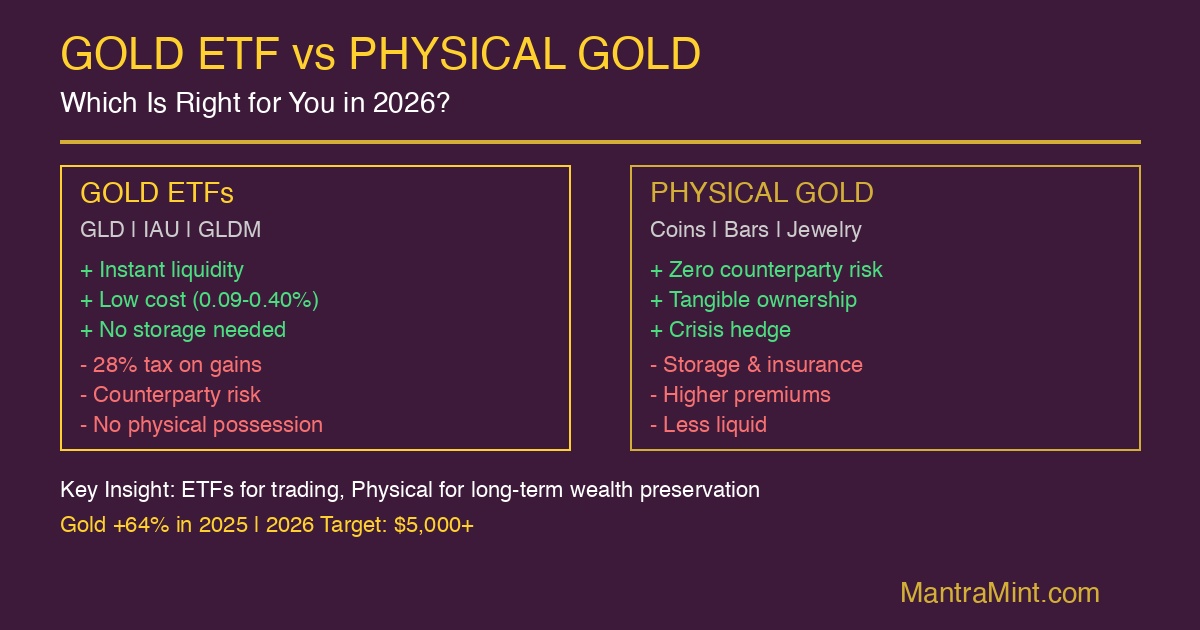
Gold surged 64% in 2025—its best year since 1979. Now comes the important question: How should you own it?
According to The Motley Fool, gold’s performance makes 2026 a critical year for choosing the right format. The difference between ETFs and physical gold isn’t just about convenience—it affects your taxes, risks, and long-term returns.
This guide breaks down everything you need to know to make the right choice.
Quick Comparison: ETF vs Physical Gold
| Factor | Gold ETFs | Physical Gold |
|---|---|---|
| Liquidity | Instant (market hours) | Days to weeks |
| Storage | None needed | Required |
| Insurance | Included in expense ratio | Your responsibility |
| Minimum Investment | ~$180 (1 share GLD) | ~$200 (small coin) |
| Tax Rate (Long-Term) | 28% max (collectibles) | 28% max (collectibles) |
| Counterparty Risk | Yes (custodian, fund) | None |
| Physical Possession | No | Yes |
| Annual Cost | 0.09-0.40% | Storage + insurance |
Understanding Gold ETFs
What Are Gold ETFs?
Gold ETFs (Exchange-Traded Funds) are securities that track the price of gold and trade on stock exchanges like regular stocks. Most hold physical gold in vaults to back their shares.
According to SmartAsset:
“ETFs offer superior liquidity for most investors. Shares trade continuously during market hours with tight bid-ask spreads and minimal premiums over the spot price of gold.”
Top Gold ETFs for 2026
| ETF | Ticker | Expense Ratio | Assets | Best For |
|---|---|---|---|---|
| SPDR Gold Trust | GLD | 0.40% | $75B+ | Highest liquidity |
| iShares Gold Trust | IAU | 0.25% | $30B+ | Lower cost |
| SPDR Gold MiniShares | GLDM | 0.10% | $8B+ | Cost-conscious |
| iShares Gold Micro | IAUM | 0.09% | $1B+ | Lowest expense |
Source: The Motley Fool
According to The Motley Fool:
“The iShares Gold Trust Micro (IAUM) invests in physical gold but charges only 0.09%, making it the cheapest for investors to own.”
Gold ETF Advantages
1. Instant Liquidity
According to The Entrust Group:
“Unlike physical gold, ETF shares can be bought or sold instantly during market hours at prices that closely mirror the current gold spot price. The transaction costs are generally lower than buying physical gold.”
You can:
- Buy/sell in seconds during market hours
- Get exact market price (no haggling)
- Trade through any brokerage account
- Set limit orders, stop losses
2. No Storage Hassles
Gold ETFs eliminate:
- Safe or vault rental
- Insurance premiums
- Security concerns
- Authentication worries
The fund handles everything for a small annual fee.
3. Lower Entry Point
| Investment | Minimum |
|---|---|
| GLDM (1 share) | ~$50 |
| IAU (1 share) | ~$50 |
| GLD (1 share) | ~$180 |
| 1 oz Gold Coin | ~$4,500+ |
| 1 oz Gold Bar | ~$4,400+ |
Prices approximate based on January 2026 levels
Gold ETF Disadvantages
1. The 28% Tax Trap
According to CNBC:
“Investors in popular gold funds — including SPDR Gold Shares (GLD), iShares Gold Trust (IAU), and abrdn Physical Gold Shares ETF (SGOL) — may be surprised to learn they face a 28% top tax rate on long-term capital gains.”
The IRS classifies gold ETFs as collectibles, not securities:
| Tax Category | Long-Term Rate | Applies To |
|---|---|---|
| Stocks/Mutual Funds | 0/15/20% | Most investments |
| Gold ETFs | Up to 28% | GLD, IAU, GLDM, SGOL |
| Gold Mining ETFs | 0/15/20% | GDX, GDXJ |
According to etf.com:
“The IRS treats such ETFs the same as an investment in the metal itself, which would be considered an investment in collectibles.”
2. Counterparty Risk
According to GoldSilver.com:
“Gold ETFs carry structural risks. They offer easy price exposure until counterparty risk materializes. They track gold prices until administrative failures or custody issues break that connection.”
Risks include:
- Custodian failure
- Fund mismanagement
- Tracking errors
- Market disruptions (halted trading)
3. No Physical Possession
According to JM Bullion:
“Investors do not have the option to take possession of the gold held by the ETF, limiting its appeal for those seeking tangible assets.”
You own shares in a fund, not actual gold.
Understanding Physical Gold
Types of Physical Gold
| Type | Premium Over Spot | Liquidity | Best For |
|---|---|---|---|
| Gold Bars (1 oz+) | 2-5% | Medium | Large investments |
| Gold Coins (Eagles, Maples) | 5-8% | High | Recognized worldwide |
| Fractional Coins | 8-15% | Medium | Smaller purchases |
| Gold Jewelry | 20-50%+ | Low | Personal use, gifting |
Physical Gold Advantages
1. Zero Counterparty Risk
According to US Gold Bureau:
“With physical bullion, you have both full ownership and full control of actual pieces of gold. With an ETF, you only have an ownership position in a fund that owns gold, rather than owning gold yourself.”
Physical gold in your possession:
- Can’t be frozen by governments
- Doesn’t depend on financial institutions
- Exists independently of digital systems
- Provides ultimate crisis hedge
2. Tangible Asset
According to Kinesis:
“Physical gold provides something ETFs cannot—actual possession of the precious metal. When you hold physical gold, you own a tangible asset that exists independently of financial systems.”
This matters for:
- Cultural significance (weddings, ceremonies)
- Psychological security
- Intergenerational wealth transfer
- Potential barter value in extreme scenarios
3. Privacy
Physical gold purchases:
- Often don’t require reporting (under certain limits)
- Leave no digital trail (cash purchases)
- Provide financial privacy
Physical Gold Disadvantages
1. Storage and Insurance Costs
According to SmartAsset:
“If you want to make sure your investment is secure you’ll need to store it in either a home safe or a safety deposit box. Both methods aren’t 100% secure, so you’ll likely want to pay for insurance too which can quickly add up.”
| Storage Option | Annual Cost | Security Level |
|---|---|---|
| Home Safe | $0 + initial cost | Medium |
| Bank Safe Deposit | $50-300/year | High |
| Private Vault | 0.5-1% of value | Very High |
| Insurance | 0.5-1% of value | Depends on policy |
2. Higher Transaction Costs
According to Paytm:
“Selling physical gold coins may involve haggling, purity checks, and lower buyback rates at local jewellers, making the process slower and less transparent.”
| Cost | ETF | Physical |
|---|---|---|
| Buy Premium | 0.1-0.5% | 2-15% |
| Sell Spread | 0.1-0.5% | 1-5% |
| Authentication | N/A | Sometimes required |
| Shipping | N/A | $15-50+ insured |
3. Lower Liquidity
Converting physical gold to cash requires:
- Finding a buyer
- Verification/authentication
- Physical transport
- Negotiation
This can take days or weeks vs. seconds for ETFs.
Tax Treatment: Critical Comparison
The 28% Collectibles Rate
According to KWR Global:
“The Golden Trap: How the 28% Collectibles Tax Rate Can Undercut Record Gold Profits.”
Both gold ETFs and physical gold are taxed as collectibles:
| Holding Period | Tax Rate |
|---|---|
| Under 1 year | Ordinary income (up to 37%) |
| Over 1 year | Collectibles rate (up to 28%) |
According to The Tax Adviser:
“If someone sells a collectible after one year and is in a low ordinary income tax bracket of 15%, then the collectibles tax rate is 15%. Conversely, if someone is in the ordinary tax bracket of 33%, the collectibles rate is capped at 28%.”
Tax-Efficient Alternatives
According to AInvest:
“Hold these ETFs in tax-advantaged accounts like IRAs or 401(k)s, and you bypass this penalty entirely.”
| Strategy | Tax Benefit |
|---|---|
| Hold in IRA/401(k) | Tax-deferred (no 28% penalty) |
| Gold Mining ETFs (GDX) | 0/15/20% rates |
| Hold 1+ year | Cap at 28% vs 37% |
| Gold IRA (physical) | Tax-deferred |
Tax Comparison Example
Assume $10,000 invested, sold after 2 years with $4,000 gain:
| Scenario | Tax Rate | Tax Owed |
|---|---|---|
| Stock ETF (taxable) | 15% | $600 |
| Gold ETF (taxable) | 28% | $1,120 |
| Gold ETF (IRA) | 0% now | $0 |
| Physical Gold | 28% | $1,120 |
The 28% rate costs $520 more on this example.
When to Choose Gold ETFs
Best For:
| Use Case | Why ETF Works |
|---|---|
| Trading/timing | Instant execution |
| Small amounts | Low minimums ($50) |
| IRA/401(k) holdings | Avoid 28% in tax-advantaged |
| Portfolio rebalancing | Easy adjustments |
| Short-term holds | Lower transaction costs |
Ideal ETF Investor Profile:
- Active trader or rebalancer
- Uses tax-advantaged accounts
- Values liquidity above all
- Comfortable with counterparty risk
- No interest in physical possession
When to Choose Physical Gold
Best For:
| Use Case | Why Physical Works |
|---|---|
| Long-term wealth preservation | No counterparty risk |
| Crisis/collapse hedging | Independent of systems |
| Cultural purposes | Weddings, ceremonies |
| Gifting | Tangible, meaningful |
| Estate planning | Direct inheritance |
Ideal Physical Gold Buyer Profile:
- Long-term holder (10+ years)
- Concerned about systemic risk
- Values tangible ownership
- Has secure storage solution
- Plans to gift or pass down
The Hybrid Approach: Best of Both Worlds
According to Zerodha Fund House:
“The best approach may be a combination—ETFs for trading flexibility and physical gold for long-term security.”
Recommended Allocation Framework
| Gold Allocation | ETFs | Physical | Rationale |
|---|---|---|---|
| $0-10,000 | 100% | 0% | Storage costs hurt small holdings |
| $10,000-50,000 | 70% | 30% | Add some physical for security |
| $50,000-100,000 | 50% | 50% | Balanced approach |
| $100,000+ | 40% | 60% | Physical becomes more efficient |
Sample Portfolio
$25,000 Gold Allocation:
| Format | Amount | Vehicle | Purpose |
|---|---|---|---|
| ETF (IRA) | $10,000 | IAU | Tax-advantaged, rebalancing |
| ETF (Taxable) | $7,500 | GLDM | Trading flexibility |
| Physical | $7,500 | Gold Eagles | Crisis hedge, gifting |
Special Considerations for NRIs
US Tax Implications
| Factor | ETF | Physical (US) | Physical (India) |
|---|---|---|---|
| US Tax | 28% collectibles | 28% collectibles | Complex (FBAR, etc.) |
| Reporting | 1099 from broker | Self-reported | FBAR if >$10,000 |
| Estate Tax | Simplified | May require appraisal | Cross-border issues |
India Gold Options
According to Kotak MF:
“For cultural purposes where the tangible nature of the asset is important, physical gold remains preferred. For pure investment exposure, Gold ETFs offer convenience and cost-effectiveness.”
| Option | Best For |
|---|---|
| US Gold ETFs | Investment exposure, tax-advantaged |
| Physical Gold (US) | Keeping in USA, gifting here |
| Physical Gold (India) | Gifting to family, cultural events |
| India Gold ETFs | Rupee-denominated exposure |
2026 Outlook: Which Format Benefits More?
Price Forecasts
| Institution | 2026 Target | Change |
|---|---|---|
| J.P. Morgan | $5,000-$5,055 | +16% |
| Goldman Sachs | $4,900 | +13% |
| MKS Pamp | $5,400 | +25% |
Current price: ~$4,330/oz
Format Impact
| If Gold… | ETF Impact | Physical Impact |
|---|---|---|
| Rises 15%+ | Easy to sell, capture gains | Harder to sell quickly |
| Falls 10%+ | Easy to exit or rebalance | Stuck unless sell at discount |
| Stays flat | Low cost drag (0.1-0.4%) | Storage costs hurt |
| System crisis | Counterparty risk increases | Value increases |
Key Takeaways
The Decision Framework
Choose Gold ETFs if:
- You want instant liquidity
- You’ll hold in IRA/401(k)
- You’re comfortable with counterparty risk
- You plan to trade or rebalance frequently
Choose Physical Gold if:
- You want zero counterparty risk
- You’re holding for 10+ years
- You value tangible ownership
- You plan to gift or pass down
Choose Both if:
- You have $10,000+ to allocate
- You want liquidity AND security
- You’re building long-term wealth
Final Comparison
| Winner By Category | ETF | Physical | Tie |
|---|---|---|---|
| Liquidity | ✓ | ||
| Cost (small amounts) | ✓ | ||
| Counterparty Risk | ✓ | ||
| Tangibility | ✓ | ||
| Tax Treatment | ✓ | ||
| Crisis Hedge | ✓ | ||
| Convenience | ✓ | ||
| Cultural Use | ✓ |
The Bottom Line
Both gold ETFs and physical gold have their place. The “right” choice depends on your goals, timeline, and risk tolerance.
For most investors, a hybrid approach works best: ETFs for tax-advantaged accounts and trading, physical for long-term security and gifting.
Start building your gold portfolio with Mantra Mint—digital gold that offers ETF convenience with a path to physical delivery.
Sources
- The Motley Fool - 3 Best Gold ETF Picks for 2026
- SmartAsset - Gold ETFs vs Physical Gold
- CNBC - Gold ETF Tax Bill Surprise
- etf.com - Gold ETF Tax Capital Gains
- US Gold Bureau - Physical Gold vs ETF Pros and Cons
- JM Bullion - Gold ETFs vs Physical Gold
- The Entrust Group - Physical Bullion vs ETFs
- Kinesis - Gold ETFs vs Physical Gold Guide
- GoldSilver.com - Hidden Risks of Gold ETFs
- KWR Global - The 28% Collectibles Tax Trap
- AInvest - IAU vs GLD Tax-Smart Play
- Zerodha Fund House - Physical Gold vs Gold ETF
- Kotak MF - Gold ETF vs Physical Gold
- The Tax Adviser - Taxation of Collectibles
Ready to start investing in gold?
Join thousands of Indian families building wealth with Mantra Mint.
Get Started Free