
Gold Gifts for Indian Engagement Ceremonies: The Complete Sagai & Roka Guide
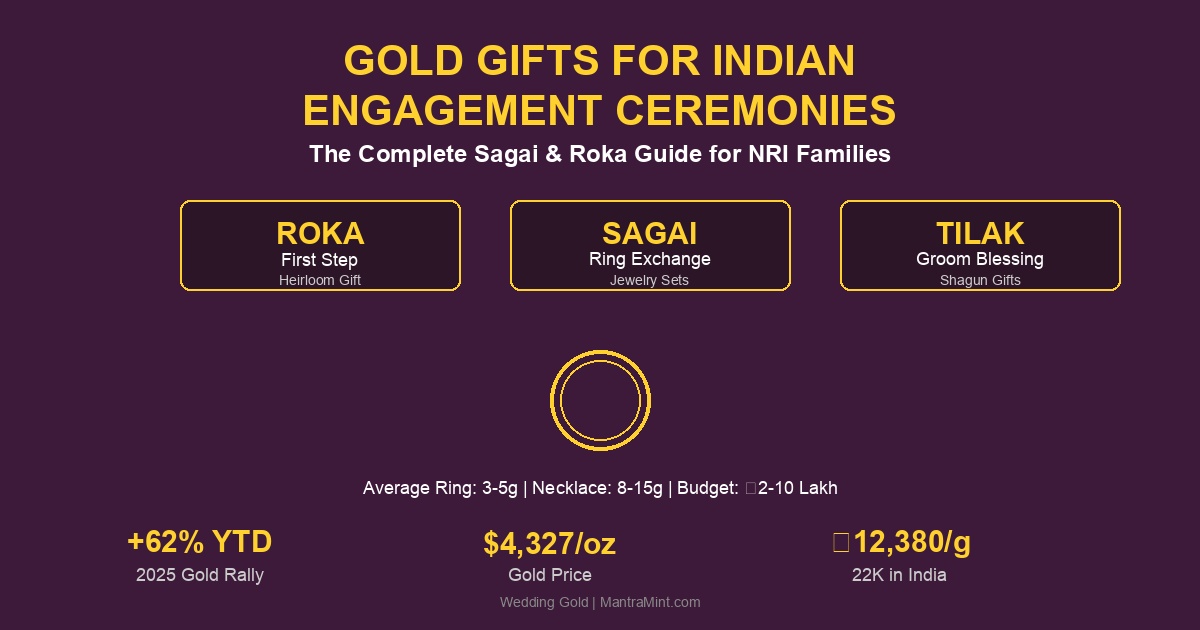
In Indian culture, the journey to marriage begins long before the wedding day. The engagement ceremonies—known variously as Roka, Sagai, Mangni, or Tilak—mark the formal beginning of two families becoming one. And at the heart of these ceremonies lies gold: the eternal symbol of prosperity, commitment, and auspicious beginnings.
With gold delivering a stunning 62% return in 2025 and currently trading at $4,327 per ounce according to Yahoo Finance, understanding the gold traditions of engagement ceremonies has never been more important—both culturally and financially.
This comprehensive guide covers every aspect of gold in Indian engagement ceremonies, from the difference between Roka and Sagai to regional variations, NRI considerations, and smart buying strategies.
Understanding Indian Engagement Ceremonies
The Pre-Wedding Journey
According to Cultural India, “There are various terms associated with the engagement ceremony like Mangni, Sagai, Roka Ceremony, Ashirbaad, Nischayam, etc. These are the closest events to a Western engagement party.”
Unlike Western engagements, Indian ceremonies involve multiple events, each with specific gold traditions:
| Ceremony | Purpose | Gold Tradition | Typical Timing |
|---|---|---|---|
| Roka | First formal acceptance | Nose ring, heirloom piece | 3-12 months before wedding |
| Sagai/Mangni | Official engagement | Ring exchange, jewelry gifts | 2-6 months before wedding |
| Tilak | Groom’s formal acceptance | Shagun gifts, gold items | Same day as Sagai or separate |
| Ashirbaad (Bengali) | Blessing ceremony | Gold coins, jewelry | Pre-wedding |
| Nischayam (South Indian) | Betrothal | Silk sarees, gold | Pre-wedding |
Roka vs. Sagai: Understanding the Difference
According to Bali Happy Events, “The Roka Ceremony is considered the first formal step in the wedding process. It is a pre-engagement ritual where both families consent to the union and give their blessings to the couple. It signifies the ‘booking’ of the bride and groom for one another.”
Roka Ceremony:
- First formal step
- Families announce intent to marry
- Typically intimate gathering
- Groom’s family gifts bride a significant piece (often heirloom)
- Bride’s family gifts groom tilak and shagun
Sagai Ceremony:
- Official engagement
- Larger celebration
- Ring exchange (modern addition)
- Extensive gift exchange between families
- Often combined with Tilak ceremony
Gold Gifts in Engagement Ceremonies
From the Groom’s Family to the Bride
According to Wedamor, “In the ancient days, the bride’s family provided Shagun to the groom and his family during an unplanned ceremony called Roka. During Roka, the groom’s family gives the bride a nose ring or any other heirloom in the family.”
| Gift Type | Significance | Typical Weight | 2025 Value (approx) |
|---|---|---|---|
| Gold Ring | Commitment | 3-5 grams | ₹40,000-65,000 |
| Gold Necklace/Pendant | Family acceptance | 8-15 grams | ₹1-2 lakh |
| Gold Bangles | Blessing | 10-20 grams (pair) | ₹1.3-2.6 lakh |
| Nose Ring (Nath) | Traditional heirloom | 2-5 grams | ₹26,000-65,000 |
| Gold Earrings | Adornment | 3-8 grams | ₹40,000-1 lakh |
Based on 22K gold price of ~₹13,000/gram as of December 2025
From the Bride’s Family to the Groom
According to Manyavar, “The groom is presented with a shagun (auspicious gift) of money, clothes, and sweets. The bride’s family also ties a safa (turban) on the groom’s head, symbolising respect and honour.”
| Gift Type | Significance | Details |
|---|---|---|
| Gold Ring | Commitment | Typically heavier than bride’s (5-8 grams) |
| Gold Chain | Blessing | 10-20 grams |
| Gold Kada (Sikh/Punjabi) | Traditional bangle | 15-30 grams |
| Gold Coins | Prosperity | 5-10 grams |
| Shagun Envelope | Auspicious amount | Cash ending in 1 (₹1,001, ₹51,001, etc.) |
The Significance of “One Rupee”
According to Puja Yagna, “Indians, mostly Hindus, add a one rupee coin along with notes… One is a number that is indivisible or cannot be divided by any other number. When we add one rupee along with our Shagun, it is a way of representing permanence.”
This is why cash gifts at engagements are always amounts like ₹51, ₹101, ₹501, ₹1,001, ₹51,001—never round numbers.
Engagement Rings: Traditional and Modern
Average Ring Weights
According to BlueStone, “There is no singular ‘average weight of a gold ring’—it can range from anywhere between 1.5 to 8 grams.”
| Ring Type | Women’s Weight | Men’s Weight |
|---|---|---|
| Simple band | 2-3 grams | 4-6 grams |
| Solitaire engagement | 3-5 grams | 5-8 grams |
| Traditional/antique | 5-10 grams | 8-12 grams |
| Cocktail/statement | 10-15 grams | N/A |
Purity Recommendations
According to Attica Gold Company, “22K gold is the most preferred choice for gold rings in India because it is more valuable and still durable.”
| Purity | Gold Content | Best For |
|---|---|---|
| 24K | 99.9% pure | Investment coins (too soft for rings) |
| 22K | 91.6% pure | Traditional Indian jewelry |
| 18K | 75% pure | Daily wear, diamond settings |
| 14K | 58.3% pure | Budget-friendly, very durable |
Engagement Ring Costs (2025)
According to Good Returns, as of January 2026, 22K gold in India is approximately ₹12,380 per gram.
| Component | Cost Range | Notes |
|---|---|---|
| Gold (4g ring) | ₹50,000-55,000 | Based on 22K |
| Making Charges | ₹4,000-11,000 | 8-20% of gold value |
| GST (3%) | ₹1,600-2,000 | On total value |
| Total | ₹55,000-68,000 | For simple 4g ring |
For comparison, With Joy reports that “the average cost of an engagement ring in the United States is approximately $5,200”—though this often includes diamonds.
Regional Engagement Traditions
Punjabi/North Indian Traditions
According to InstaAstro, “In Sikh practices, the bride’s father presents the boy with a Kada (traditional Sikh bangles), a gold ring, and gold coins.”
Key Gold Items:
- Gold Kada for groom
- Saffron-covered coconut in gold leaf
- Gold ring exchange
- Shagun in gold and silver items
South Indian Traditions
According to BriteCo, “In South India, the groom’s family often gifts the bride a silk saree or a gold necklace.”
| Region | Ceremony Name | Special Gold Traditions |
|---|---|---|
| Tamil Nadu | Nischayam | Gold jewelry, silk sarees |
| Kerala | Nischayam | Gold set (thali chain base) |
| Andhra/Telangana | Pellikuthuru | Heavy gold necklaces |
| Karnataka | Nischitartha | Gold coins, jewelry |
Bengali Traditions
According to Cultural India, the Bengali Ashirbaad ceremony involves elaborate blessing rituals with gold coins and jewelry exchanges.
Key Gold Items:
- Gold coins for blessing
- Gold jewelry set for bride
- Sweet boxes with gold covers
Gujarati Traditions
According to Gujarati Wedding Traditions, “In sagai, the bride is given jewelry (chain or necklace, bangles, earrings and silver anklets), clothes by the mother of the groom.”
Groom’s Family Gives:
- Gold chain/necklace
- Gold bangles
- Gold earrings
- Silk sarees
Bride’s Family Gives:
- Tilak and coconut
- Gold ring
- Clothes and sweets
Marwari Traditions
According to Utsavpedia, “The ‘Sagai’ ceremony is a pre-wedding ritual in Marwadi culture. It is the engagement ceremony where the bride and groom’s families formally agree to the marriage.”
Traditional Items:
- Gold nose ring (Nath)
- Heavy gold jewelry set
- Gold coins wrapped in red cloth
The Tilak Ceremony: A Deep Dive
What Happens at Tilak
According to Manyavar, “The central ritual of the ceremony involves the application of the tilak, a red vermillion mark, on the groom’s forehead. This mark is traditionally made by the bride’s father or an elder male member of her family.”
Ceremony Elements:
- Bride’s male relatives visit groom’s home
- Tilak applied on groom’s forehead
- Shagun gifts presented
- Sweets and dried fruits exchanged
- Date for wedding finalized
Gold Gifts at Tilak
According to I Love India, the bride’s family brings specific items:
| Item | Significance |
|---|---|
| Silver platter | Presentation base |
| Saffron in silver bowl | Purity and prosperity |
| 14 dried dates in silver foil | Blessing for progeny |
| Coconut in gold leaf | Auspicious offering |
| Cash shagun (odd amount) | Prosperity gift |
| Gold ring or chain | Personal gift to groom |
Who Attends
Traditionally, the bride and her mother do NOT attend the Tilak ceremony. It’s primarily a male-dominated ritual from the bride’s side visiting the groom’s family.
NRI Considerations: Gold Across Borders
Customs Rules for Bringing Gold to India
According to GoInri, NRIs have specific allowances:
| Category | Duty-Free Limit | Value Limit | Condition |
|---|---|---|---|
| Male Passenger | 20 grams jewelry | ₹50,000 | Abroad 6+ months |
| Female Passenger | 40 grams jewelry | ₹1,00,000 | Abroad 6+ months |
| Gold Bars/Coins | No duty-free | ~16.25% duty | Full duty applies |
| Maximum Allowed | 1 kg | Market value | With duty payment |
Source: SaveTaxs
Residency Requirements
According to Indian Community:
| Time Abroad | Duty-Free Limit | Duty Rate (if over limit) |
|---|---|---|
| Less than 6 months | None | 38.5% on all gold |
| 6 months to 1 year | Per limits above | 13.75% on additional |
| More than 1 year | Per limits above | 13.75% on additional |
Smart Strategies for NRI Families
| Strategy | Benefit | Consideration |
|---|---|---|
| Buy in India | No customs hassle | May pay higher making charges |
| Buy in USA, declare properly | Possibly better quality | Customs process required |
| Digital gold in India | No physical transport | Needs conversion for ceremony |
| Family purchases in India | Local expertise | Transfer funds via proper channels |
| Split purchases | Both family members use allowance | 60g total duty-free (couple) |
Documentation Required
According to My Tickets to India:
- Purchase invoice or valuation certificate
- Customs declaration form
- Passport with travel history
- Export certificate (for returning with same jewelry)
2025 Auspicious Dates for Engagement
According to Ganesha Speaks and Indian Astrology, the most auspicious days for engagement in 2026 include:
| Month | Auspicious Dates | Notes |
|---|---|---|
| January 2026 | 12, 15, 19, 26 | Post-Makar Sankranti |
| February 2026 | 2, 9, 16, 23 | Before Holi |
| March 2026 | TBD | Pending calendar confirmation |
| April-May 2026 | Around Akshaya Tritiya | Most auspicious for gold |
| November 2026 | Post-Diwali dates | Wedding season begins |
Note: Exact dates depend on Hindu calendar and should be confirmed with family priest.
Budgeting for Engagement Gold
Typical Engagement Gold Budget
| Family | Budget Range | Allocation |
|---|---|---|
| Groom’s Family | ₹2-10 lakh | Ring (₹50-70K), Necklace (₹1-2L), Bangles (₹1-2L), Earrings (₹50K-1L) |
| Bride’s Family | ₹1-5 lakh | Ring (₹60-80K), Chain (₹1-2L), Shagun (₹51K-1L), Clothes |
Cost Comparison: 2020 vs. 2025
| Year | Gold Price (22K/gram) | 4g Ring Cost | 10g Necklace Cost |
|---|---|---|---|
| 2020 | ₹4,800 | ₹22,000 | ₹55,000 |
| 2023 | ₹5,800 | ₹27,000 | ₹67,000 |
| 2025 | ₹12,380 | ₹57,000 | ₹1,43,000 |
| Change | +158% | +159% | +160% |
Source: Good Returns historical data
Smart Buying Tips
- Buy during dips: Gold prices fluctuate daily
- Compare making charges: Range from 8-20%
- Check hallmark: BIS hallmark ensures purity
- Keep receipts: Important for resale and insurance
- Consider timing: Akshaya Tritiya, Dhanteras often have promotions
Modern Adaptations for NRI Families
Virtual Engagement Ceremonies
With families spread across continents, many NRIs are adapting traditions:
| Traditional | Modern Adaptation |
|---|---|
| In-person ring exchange | Video call ceremony with couriered rings |
| Family gathering | Hybrid event (some in-person, some virtual) |
| Gold gifted in person | Digital gold transfer + physical delivery later |
| Multiple ceremonies | Combined Roka-Sagai event |
Digital Gold Options
Instead of carrying physical gold internationally:
| Option | Platform | Benefit |
|---|---|---|
| Digital Gold | Mantra Mint | Buy, gift, accumulate easily |
| Gold ETFs | Indian brokerages | Investment focus |
| Sovereign Gold Bonds | RBI via banks | Government-backed, interest |
Creating an Engagement Gold Registry
Modern families are creating gold registries where:
- Extended family can contribute
- Contributions pool toward significant pieces
- No duplicate gifts
- Transparent tracking
Investment Perspective: Engagement Gold as Asset
2025 Gold Performance
With gold up 62% in 2025 according to Yahoo Finance, engagement jewelry purchased becomes a significant asset:
| Purchase Year | Original Investment | 2025 Value | Return |
|---|---|---|---|
| 2020 | ₹2,00,000 | ₹5,16,000 | +158% |
| 2022 | ₹3,00,000 | ₹4,68,000 | +56% |
| 2024 | ₹4,00,000 | ₹6,48,000 | +62% |
Gold vs. Other Engagement Investments
| Investment | 5-Year Return | 10-Year Return | Liquidity |
|---|---|---|---|
| 22K Gold Jewelry | +158% | +250%+ | High (with making charge loss) |
| Diamond Ring | Variable | Variable | Lower |
| Bank FD | ~35% | ~80% | High |
| Stock Market | ~75% | ~150% | High |
Note: Gold jewelry resale typically recovers gold value minus making charges (8-20%)
Conclusion: Honoring Tradition, Building Wealth
Indian engagement ceremonies—whether called Roka, Sagai, Mangni, or Tilak—represent far more than social rituals. They’re the beginning of a financial partnership between families, with gold serving as both blessing and investment.
After gold’s 62% rally in 2025, the engagement jewelry exchanged today carries both emotional and financial weight. A ₹2 lakh gold set gifted at a Sagai ceremony isn’t just a symbol of commitment—it’s an asset that has historically appreciated faster than most investments.
For NRI families navigating these ceremonies across borders, the key is planning: understanding customs rules, choosing the right timing, and balancing tradition with practicality.
The rings exchanged at Sagai, the necklace gifted at Roka, the gold coins blessed at Tilak—these aren’t just jewelry. They’re the first chapter of a family’s gold legacy, beginning even before the wedding day.
Planning an engagement ceremony from the USA? Mantra Mint makes it easy to buy, gift, and accumulate digital gold for life’s most precious milestones—from Roka to wedding and beyond.
Sources
- Yahoo Finance - Gold Futures (GC=F)
- Cultural India - Engagement Ceremony
- InstaAstro - Engagement Ceremony
- BlueStone - Ring Ceremony Guide
- Utsavpedia - Sagai
- Manyavar - Tilak Ceremony
- BriteCo - Indian Wedding Traditions
- Wedamor - Hindu Engagement Guide
- Puja Yagna - What is Shagun
- BlueStone - Gold Ring Weight Guide
- Good Returns - Gold Rates India
- GoInri - NRI Gold Import Rules
- SaveTaxs - NRI Gold Allowance
- Bali Happy Events - Sagai and Tilak
- Ganesha Speaks - Ring Ceremony Muhurat 2025
Ready to start investing in gold?
Join thousands of Indian families building wealth with Mantra Mint.
Get Started Free