
Gold vs US Dollar: Understanding the Inverse Correlation That Drives Gold Prices
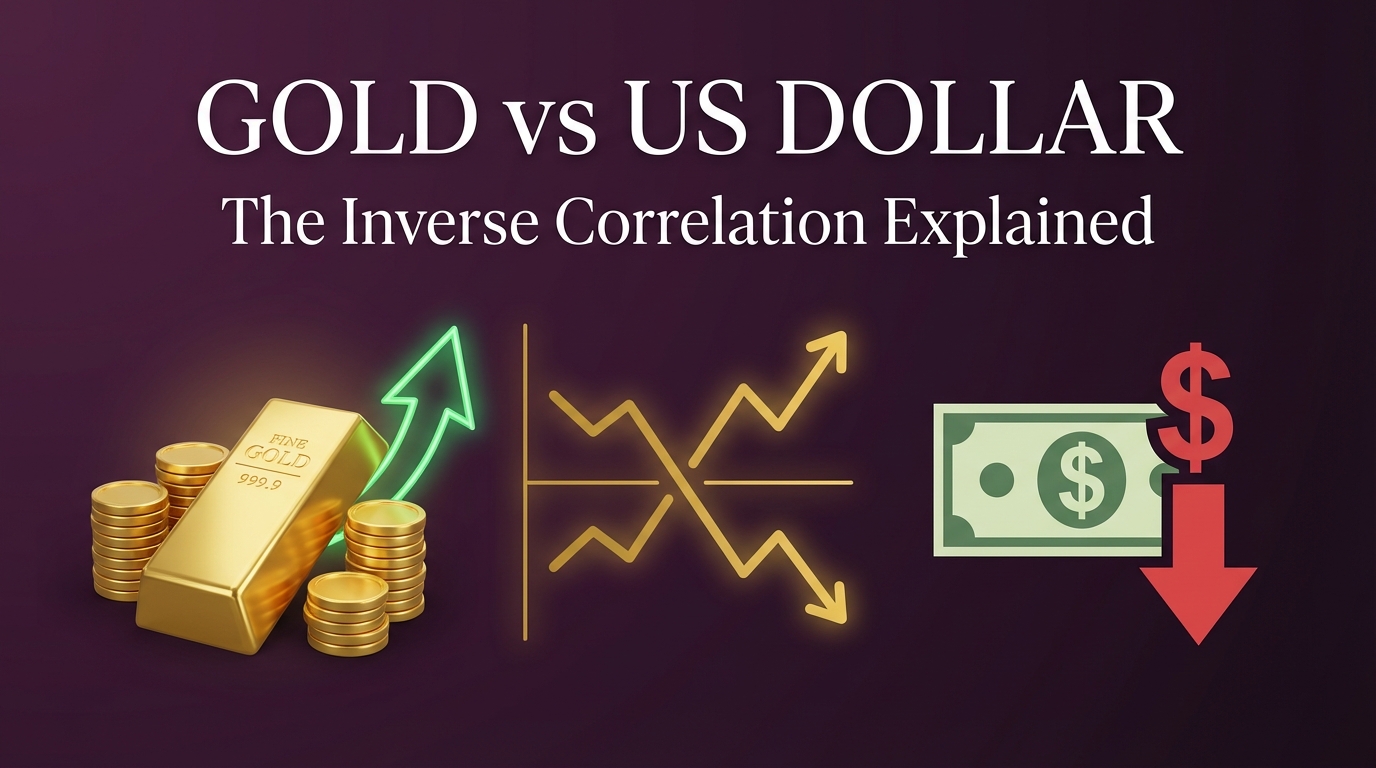
If you’ve ever wondered why gold prices surge when headlines scream about a “weakening dollar,” you’re witnessing one of the most reliable relationships in financial markets. The inverse correlation between gold and the US dollar has held for decades—and understanding it can transform how you think about gold investment.
As of December 23, 2025, gold trades at $4,516 per ounce (+4.5% this week), while the US Dollar Index (DXY) has fallen to 97.91—its lowest level since October 2025. This isn’t coincidence. It’s the inverse correlation in action.
The Numbers Don’t Lie: How Strong Is This Correlation?
According to research compiled by Bloomberg and Federal Reserve data, the inverse correlation between gold and the dollar is one of the most persistent relationships in financial markets:
| Time Frame | Negative Correlation Frequency | Source |
|---|---|---|
| 3-Month Rolling | 73% of periods | IMI Working Paper |
| 10-Year Rolling | 95% of periods | IMI Working Paper |
| Historical Average | -0.40 to -0.80 correlation coefficient | CME Group |
| Current (60-day rolling) | -0.45 | Interactive Brokers |
A correlation coefficient of -0.45 means gold still moves opposite to the dollar, though not in perfect lockstep.
Current Market Snapshot
| Metric | Current | Change | Source |
|---|---|---|---|
| Gold Spot Price | $4,516/oz | +4.5% (week) | Yahoo Finance |
| Silver Spot Price | $70.55/oz | +11.6% (week) | Yahoo Finance |
| US Dollar Index (DXY) | 97.91 | -0.2% (week) | TradingEconomics |
| DXY YTD Change | -9.54% | Worst since 2017 | TradingView |
| Gold YTD Return | +67% | Best since 1980 | Yahoo Finance |
| Fed Funds Rate | 3.50%-3.75% | -175 bps in 2025 | Federal Reserve |
| Gold in INR | ₹1,38,550/10g | +₹2,400 (day) | Good Returns |
Why Gold and the Dollar Move Inversely
The relationship isn’t arbitrary—it’s driven by fundamental economic mechanics.
1. Gold Is Priced in Dollars Globally
According to CBS News:
“Gold is globally priced and traded in US dollars. When the dollar weakens, it takes more dollars to buy the same amount of gold—mechanically pushing the gold price higher.”
This is the most direct driver. A 10% drop in the dollar’s value mathematically requires approximately 10% more dollars to purchase the same ounce of gold.
2. Opportunity Cost Dynamics
When the dollar strengthens, US Treasury bonds and other dollar-denominated assets become more attractive. Gold, which pays no yield, becomes relatively less appealing.
According to Phillip Nova:
| Dollar Strength | Impact on Gold |
|---|---|
| Dollar rises + rates rise | Gold becomes less attractive (no yield) |
| Dollar falls + rates fall | Gold becomes more attractive (lower opportunity cost) |
3. Safe-Haven Competition
Both gold and the US dollar are considered safe-haven assets. When investors flee risk:
- Dollar strength scenario: Investors buy US Treasuries → Dollar rises → Gold falls
- Dollar weakness scenario: Investors buy gold directly → Gold rises → Dollar falls
However, during extreme crises (like 2008 or 2020), both can rise simultaneously as different investor cohorts seek safety in different assets.
2025: A Case Study in Inverse Correlation
This year has provided a textbook example of the gold-dollar relationship in action.
The Dollar’s Decline
According to Trading Economics, the US Dollar Index (DXY) has experienced its worst year since 2017:
| Period | DXY Performance | Key Driver |
|---|---|---|
| H1 2025 | -10.7% | Worst first-half in 50+ years |
| Full Year 2025 | -9.54% YTD | Fed rate cuts, fiscal concerns |
| December 2025 | Testing 97-98 | Lowest since October 2025 |
Source: Cambridge Currencies
Gold’s Historic Rally
As the dollar weakened, gold delivered its best performance in over four decades:
| Metric | 2025 Performance | Source |
|---|---|---|
| Gold Price Gain | +67% YTD | Yahoo Finance |
| All-Time High | $4,516/oz | Current |
| Record Peak | $3,149/oz (April 10) | Discovery Alert |
| Central Bank Buying | Record 244 tonnes (Q1) | World Gold Council |
The Correlation in Real-Time
According to CME Group OpenMarkets:
“In early 2025, the dollar index fell dramatically—down about 10.8% in the first half of the year—as investors sold USD amid global policy concerns. At the same time, gold hit new record highs on sustained buying by central banks worried about dollar devaluation.”
This is the inverse correlation in action at scale.
When the Correlation Breaks Down
While the inverse relationship holds most of the time, there are notable exceptions.
2023-2024: The Anomaly
According to Interactive Brokers Campus:
“In 2023 and 2024, we witnessed an unusual phenomenon: both gold and the dollar demonstrated significant strength simultaneously. Gold prices surged past $2,000 per ounce and set new all-time highs, while the U.S. Dollar Index also showed remarkable resilience.”
What caused this breakdown?
| Factor | Impact |
|---|---|
| Central Bank Buying | Record purchases regardless of dollar strength |
| Geopolitical Risk | Safe-haven demand for both assets |
| De-dollarization | Emerging markets diversifying reserves |
| Inflation Hedging | Gold demand despite dollar stability |
Why the DXY Isn’t the Whole Story
According to GoldBroker:
“DXY is not the US Dollar; rather, it is a ratio of the US Dollar against a basket of foreign currencies. If the US Dollar is losing value, but the basket of currencies are losing value even faster, then DXY will rise.”
This explains why gold and DXY can occasionally move in the same direction—the relationship is more nuanced than a simple seesaw.
Central Banks Are Changing the Game
One of the biggest disruptors to the traditional gold-dollar correlation is unprecedented central bank buying.
Record Accumulation in 2025
According to the World Gold Council:
| Quarter | Central Bank Purchases | Notable Buyers |
|---|---|---|
| Q1 2025 | 244 tonnes (record) | China, Russia, Turkey |
| Q2 2025 | Strong continuation | Emerging markets |
| Full Year Pace | 800+ tonnes projected | Diversification trend |
“43% of central banks are planning further gold accumulation, driven by concerns about dollar devaluation and geopolitical risks.”
De-Dollarization Driver
Central banks are increasingly viewing gold as a strategic reserve asset to reduce dollar dependency:
| Country | Gold Reserve Strategy | Source |
|---|---|---|
| China | Aggressive accumulation since 2022 | World Gold Council |
| Russia | Sanctions avoidance, dollar alternatives | World Gold Council |
| India | Steady diversification | RBI |
| Turkey | High inflation hedge | World Gold Council |
The Fed Factor: Interest Rates and the Dollar
The Federal Reserve’s monetary policy directly impacts both the dollar and gold.
2025 Rate Cuts
According to the Federal Reserve:
| Meeting | Action | New Rate | Dollar Impact |
|---|---|---|---|
| September 2025 | -50 bps | 4.50%-4.75% | Dollar weakened |
| November 2025 | -25 bps | 4.00%-4.25% | Dollar weakened |
| December 2025 | -25 bps | 3.50%-3.75% | Dollar at 3-year low |
Total cuts in 2025: 175 basis points
According to CNBC, the market now expects:
- January 2026: 75.6% probability of rates on hold
- 2026 outlook: Just one additional cut projected
- Dollar outlook: Continued weakness expected
Why Rate Cuts Boost Gold
| Mechanism | Effect |
|---|---|
| Lower yields | Reduces opportunity cost of holding gold |
| Dollar weakness | Mechanically pushes gold price higher |
| Inflation concerns | Gold becomes more attractive as hedge |
| Risk appetite | Can shift flows between assets |
How to Use This Relationship in Your Strategy
Understanding the gold-dollar inverse correlation can help optimize your investment approach.
For Indian Americans and NRIs
The dollar-gold relationship creates unique dynamics for NRIs:
| Scenario | Impact on NRI Gold Investment |
|---|---|
| Dollar falls, gold rises | USD gold gains, INR conversion less favorable |
| Dollar rises, gold falls | USD gold weaker, INR conversion more favorable |
| Both fall (rare) | Gold weaker, INR gains from forex |
Practical Strategies
| Strategy | Implementation |
|---|---|
| Dollar-Cost Average | Regular purchases smooth out currency volatility |
| Monitor DXY | Major DXY moves (>3%) often signal gold direction |
| Diversify Currency | Hold gold in multiple currencies if possible |
| Long-Term Focus | Short-term correlation breaks normalize over time |
Warning Signs to Watch
| Indicator | What It Means |
|---|---|
| DXY breaking 95 | Major dollar weakness → potential gold surge |
| DXY above 105 | Dollar strength → gold headwinds |
| Correlation > 0 | Unusual period—investigate the cause |
| Fed pivot signals | Early indicator of dollar direction |
India Gold Price Impact
For Indian investors, the rupee-dollar exchange rate adds another layer:
Current India Prices
| Karat | Price (₹/10g) | Daily Change | Source |
|---|---|---|---|
| 24K | ₹1,38,550 | +₹2,400 | Good Returns |
| 22K | ₹1,27,000 | +₹2,200 | Good Returns |
| 18K | ₹1,03,910 | +₹1,800 | Good Returns |
City-Wise Prices (24K per gram)
| City | Price | Source |
|---|---|---|
| Chennai | ₹13,931 | Good Returns |
| Delhi | ₹13,870 | Good Returns |
| Mumbai | ₹13,855 | Good Returns |
| Bangalore | ₹13,855 | Good Returns |
According to Good Returns, gold prices in India have surged ₹43,700 in just two days—reflecting both international gold strength and rupee dynamics.
Looking Ahead: What’s Next for the Correlation?
Dollar Outlook for 2026
According to Cambridge Currencies:
“As we close out 2025, the dollar’s era of strength appears to be ending. With global central banks narrowing the policy gap and U.S. data softening, the trend favors a weaker USD into early 2026.”
| Forecast | DXY Range | Implication for Gold |
|---|---|---|
| Near-term | 96-99 | Supportive |
| Q1 2026 | 95-100 | Neutral to supportive |
| Full 2026 | Dependent on Fed | Data-driven |
Gold Price Implications
If the inverse correlation holds:
| DXY Scenario | Gold Implication |
|---|---|
| DXY falls to 95 | Gold could test $4,800+ |
| DXY stabilizes 97-100 | Gold consolidates $4,400-4,600 |
| DXY rebounds to 105 | Gold faces headwinds |
The Bottom Line
The inverse correlation between gold and the US dollar is one of the most reliable relationships in financial markets—holding 73-95% of the time depending on the timeframe. In 2025, this relationship has been on full display:
Key Takeaways:
- The correlation is real: Historical data shows -0.40 to -0.80 correlation coefficient
- 2025 is a textbook example: DXY down 9.5%, gold up 67%
- Central banks are amplifying it: Record buying regardless of dollar strength
- Exceptions happen: 2023-2024 saw both rise together during extreme uncertainty
- The DXY isn’t perfect: It measures dollar vs. other currencies, not absolute dollar value
For Indian families building generational wealth, understanding this relationship provides an edge. When you see headlines about dollar weakness, you can anticipate gold strength—and position accordingly.
Whether you’re buying digital gold through Mantra Mint, physical jewelry for a wedding, or gold ETFs for your portfolio, the dollar-gold relationship is a fundamental force that will continue shaping prices for decades to come.
Sources
- MacroTrends - Gold Prices and U.S. Dollar Correlation (10 Year Chart)
- CME Group OpenMarkets - Gold and the U.S. Dollar: An Evolving Relationship
- Interactive Brokers Campus - Gold and the U.S. Dollar Correlation
- CBS News - The Relationship Between Gold Prices and the Dollar
- Phillip Nova - Why Gold Moves When the Dollar Moves
- World Gold Council - Are Fiscal Concerns Driving Gold?
- Federal Reserve - December 2025 FOMC Statement
- Trading Economics - US Dollar Index
- TradingView - DXY Chart
- Cambridge Currencies - USD Forecast 2025
- Good Returns - Gold Rate India
- Yahoo Finance - Gold Futures
- CNBC - Fed Interest Rate Decision December 2025
- IMI Working Paper - Nonlinear Dynamics of Gold and the Dollar
- Discovery Alert - Gold US Dollar Inverse Correlation 2025
Ready to start investing in gold?
Join thousands of Indian families building wealth with Mantra Mint.
Get Started Free