
Executive Order 6102: When America Confiscated Gold in 1933
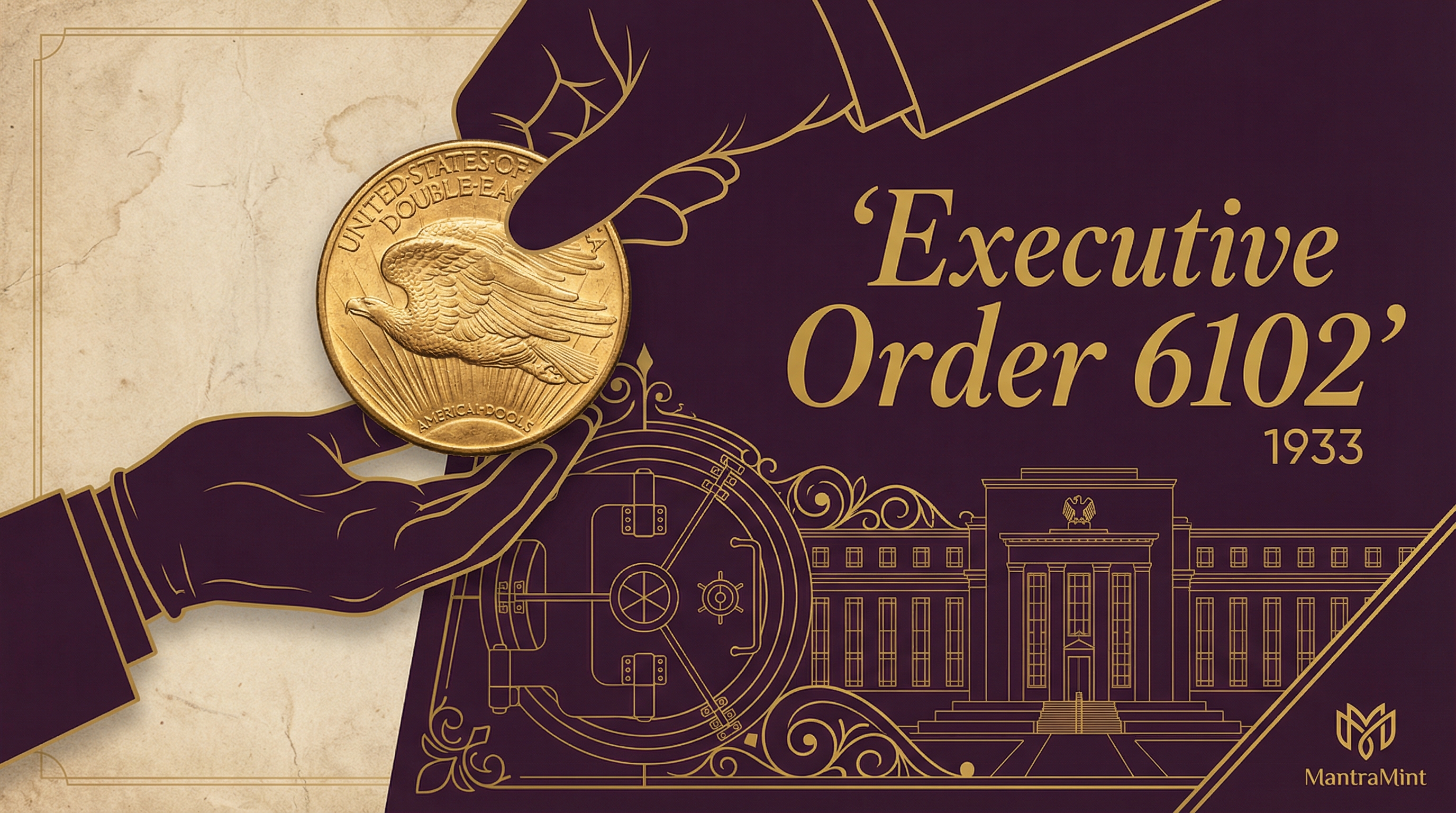
Ninety-three years ago, on April 5, 1933, President Franklin D. Roosevelt signed one of the most controversial executive orders in American history. Executive Order 6102 made it illegal for American citizens to “hoard” gold coins, gold bullion, and gold certificates—effectively forcing millions of Americans to surrender their gold to the Federal Reserve.
With gold now at $4,663/oz (down 6.7% this week following January’s flash crash) and renewed interest in precious metals as inflation hedges, understanding this pivotal moment in gold history has never been more relevant for investors.
The Crisis That Sparked Confiscation
The Great Depression and the Gold Standard
By early 1933, America was in the depths of the Great Depression. According to the Federal Reserve History archive, the country faced a convergence of economic disasters:
| Crisis Factor | 1933 Situation | Impact |
|---|---|---|
| Bank Failures | Over 4,000 banks closed | Wiped out savings |
| Unemployment | 25% of workforce | Mass poverty |
| Deflation | Prices falling | Economic stagnation |
| Gold Outflows | $300M+ drained monthly | Threatened currency |
The U.S. operated on the gold standard, meaning every dollar in circulation had to be backed by gold. According to the Federal Reserve, the Federal Reserve Act of 1913 required 40% gold backing of all Federal Reserve notes issued.
The Bank Panic of 1933
According to The Conversation, as banks failed across the country, Americans began withdrawing their gold—both from bank accounts and by exchanging paper dollars for gold coins at Federal Reserve banks.
“During the financial crisis of 1933 that culminated in the banking holiday in March 1933, large quantities of gold flowed out from the Federal Reserve. Some of this outflow went to individuals and firms in the United States who preferred holding metallic gold to bank deposits or paper currency.”
By March 1933, the Federal Reserve was running dangerously low on gold reserves. The system was about to break.
Executive Order 6102: The Details
What the Order Required
On April 5, 1933, Roosevelt issued Executive Order 6102, according to Wikipedia, which:
| Requirement | Details |
|---|---|
| Surrender deadline | May 1, 1933 (less than one month) |
| Compensation rate | $20.67 per troy ounce |
| Permitted holdings | Up to $100 in gold coins (~5 oz) |
| Exemptions | Rare coins, jewelry, industrial use |
| Legal authority | Trading with the Enemy Act of 1917 |
The Penalties for Non-Compliance
According to JM Bullion, the penalties for violating the order were severe:
- Fine: Up to $10,000 (equivalent to $243,000 in 2024)
- Prison: Up to 10 years
- Confiscation: All gold seized without compensation
The government wasn’t bluffing about enforcement.
The First Prosecution: Frederick Barber Campbell
According to TIME Magazine, the first person prosecuted was Frederick Barber Campbell, a Manhattan attorney who had deposited 27 gold bars (worth $135,000) at Chase National Bank before the order.
When Campbell tried to withdraw his gold after the order, Chase refused. Campbell sued the bank—which brought him to the attention of federal prosecutors. He was indicted for “hoarding” gold, facing up to 20 years in prison and a $20,000 fine.
The outcome: According to the US Gold Bureau, Federal Judge John M. Woolsey threw out the case on a technicality—the order had been signed by the President instead of the Secretary of the Treasury as required. But the government still confiscated Campbell’s gold, and Roosevelt quickly issued new orders under the proper authority.
The Gold Reserve Act of 1934
Making Confiscation Permanent
A few months after Executive Order 6102, according to the Federal Reserve, Congress passed the Gold Reserve Act of 1934, which:
| Provision | Effect |
|---|---|
| Made gold ownership illegal | Codified the confiscation into law |
| Transferred all gold to Treasury | Federal Reserve lost its gold |
| Raised gold price to $35/oz | 69% devaluation of the dollar |
| Created Fort Knox | Centralized gold storage |
The Devaluation Windfall
Here’s where the math gets interesting. According to Wikipedia, the government:
- Confiscated gold at $20.67/oz from citizens
- Raised the official price to $35/oz the next year
- Kept the $14.33/oz difference for the Treasury
This represented an instant 69% profit for the government on every ounce confiscated—at the expense of American citizens who were forced to sell at the lower price.
Fort Knox: Born from Confiscation
The Need for Secure Storage
According to the U.S. Mint, the massive influx of confiscated gold required new storage facilities:
| Fort Knox Timeline | Event |
|---|---|
| 1936 | Construction begins on Fort Knox depository |
| December 1936 | Construction completed ($560,000 cost) |
| January 13, 1937 | First gold shipment arrives |
| December 31, 1941 | Peak holdings: 649.6 million ounces |
| Today | 147.3 million ounces (~$686 billion at current prices) |
Current U.S. Gold Reserves
According to BullionByPost, today’s U.S. gold holdings include:
| Location | Holdings | Percentage |
|---|---|---|
| Fort Knox | 147.3M oz | 56.35% |
| Denver Mint | ~43M oz | 16.5% |
| West Point | ~54M oz | 20.7% |
| New York Fed | ~6.7M oz | 2.6% |
| Total | ~261M oz | 100% |
At today’s price of $4,663/oz, the total U.S. gold reserve is worth approximately $1.2 trillion.
The 1933 Double Eagle: Most Valuable Coin in History
A $20 Coin Worth $18.9 Million
One of the most fascinating consequences of Executive Order 6102 was the creation of numismatic history. According to the Smithsonian, when Roosevelt ordered all gold coins destroyed, the 1933 Double Eagle became extraordinarily rare.
| 1933 Double Eagle Facts | Details |
|---|---|
| Coins minted | 445,500 |
| Coins surviving | ~13 known (most illegal) |
| Legal to own | Only 1 specimen |
| 2002 auction price | $7.59 million |
| 2021 auction price | $18.9 million |
The sole legally-owned 1933 Double Eagle sold in June 2021 for $18,872,250—making it the most valuable coin ever sold, according to PCGS.
Why Only One Is Legal
According to Wikipedia, most 1933 Double Eagles were melted down, but approximately 20 were illegally removed from the Philadelphia Mint by Mint Cashier George McCann. The government spent decades tracking them down, seizing and destroying them.
The one legal coin survived because it was mistakenly exported to King Farouk of Egypt in 1944 with a valid export license. After decades of legal battles, the government agreed to split auction proceeds with the last private owner—creating the world’s only legal-to-own 1933 Double Eagle.
India’s Parallel Gold Confiscation
The Gold Control Act of 1968
Remarkably, India implemented similar restrictions decades later. According to Wikipedia, India’s Gold Control Act of 1968 prohibited citizens from owning gold bars and coins:
| India Gold Control | Details |
|---|---|
| Year enacted | 1968 |
| Trigger | Foreign exchange crisis after 1962 China war |
| Restrictions | No gold bars/coins; jewelry limited |
| Goldsmith limits | Maximum 100 grams |
| Dealer limits | Maximum 2 kg |
| Year repealed | 1990 |
Unintended Consequences
According to My Gold Guide, the Indian gold ban backfired spectacularly:
- Massive smuggling networks developed
- Black market premiums soared
- Foreign exchange continued draining through unofficial channels
- Government lost potential tax revenue
- Sunar goldsmith caste suffered economic devastation
When India repealed the Gold Control Act in 1990, official gold imports jumped from nearly zero to 110 tonnes in 1992—proving demand never disappeared, just went underground.
Could Gold Confiscation Happen Again?
Legal Changes Since 1933
According to First National Bullion, several legal changes make confiscation less likely today:
| Protection | Details |
|---|---|
| 1974 | President Ford restored gold ownership rights |
| 1977 | Congress removed presidential authority to regulate gold except during war |
| No gold standard | Government doesn’t need gold to back currency |
| Global markets | Confiscation would be impossible to enforce internationally |
Expert Consensus
According to the US Gold Bureau:
“Gold confiscation in the U.S. is not a myth—it is a documented historical event. While the likelihood of it happening again is low, being informed and prepared is essential for serious investors.”
Why It’s Less Likely Today
According to Provident Metals:
- No gold standard: The U.S. went off gold in 1971 (Nixon Shock)
- Fiat currency: Government can print money without gold backing
- Global ownership: Gold is held worldwide, beyond U.S. jurisdiction
- Property rights: Stronger legal protections exist today
- Political cost: Confiscation would be politically catastrophic
Current Market Context (February 2026)
Today’s Gold Prices
| Metric | Value | Change | Source |
|---|---|---|---|
| Gold Spot | $4,663/oz | -6.7% (week) | Yahoo Finance |
| Silver Spot | $78.82/oz | -22.0% (week) | Yahoo Finance |
| Gold/Silver Ratio | 59.2 | — | Calculated |
| Gold Futures (GC=F) | $4,848.80 | — | Yahoo Finance |
The January 2026 Flash Crash
Just as 1933 saw a gold crisis, January 2026 witnessed a historic precious metals crash. According to CNBC, on January 30:
- Gold dropped 11% from its all-time high
- Silver crashed 30% in a single day
- Largest single-day precious metals decline in 13 years
The catalyst? Uncertainty around Federal Reserve policy and the Warsh nomination. History rhymes.
Lessons for Modern Gold Investors
What 1933 Teaches Us
| Lesson | Application Today |
|---|---|
| Government can act decisively | In crises, expect the unexpected |
| Legal protections matter | Know your rights and the law |
| Diversification is key | Don’t concentrate all assets in one jurisdiction |
| Paper claims vs. physical | Consider how you hold your gold |
| History repeats | Study the past to prepare for the future |
NRI-Specific Considerations
For Indians in the USA, gold ownership carries both investment and cultural significance. Understanding the legal framework in both countries is essential:
| Country | Current Gold Rules |
|---|---|
| USA | No restrictions on ownership; capital gains taxes apply |
| India | No restrictions; import duties of 6% (reduced from 15% in 2025) |
| DTAA | Double taxation avoidance agreement protects NRIs |
Key Takeaways
-
Executive Order 6102 was real: The U.S. government confiscated gold from citizens in 1933, with criminal penalties for non-compliance
-
The government profited: By raising gold’s price from $20.67 to $35/oz after confiscation, the Treasury gained 69% on every ounce seized
-
Fort Knox was built for confiscated gold: The famous depository was constructed to store the massive influx of citizen gold
-
India tried similar restrictions: The Gold Control Act of 1968 failed spectacularly, fueling black markets until its 1990 repeal
-
Confiscation is unlikely today: Legal changes since 1977 and the end of the gold standard make similar action improbable
-
History provides perspective: Understanding 1933 helps investors appreciate both gold’s enduring value and the importance of property rights
Build Your Gold Portfolio with MantraMint
The 1933 confiscation targeted physical gold bars and coins—but it also showed why gold remains valuable enough for governments to covet. Today, building gold wealth is simpler and safer than ever.
Why MantraMint?
- Start with just $10 — Build your gold position at any budget
- Real gold backing — Every dollar invested represents actual gold
- Instant gifting — Send gold to family for any occasion
- Auto-invest — Dollar-cost average into gold systematically
- Legal and secure — Full ownership rights protected by U.S. law
Your great-grandparents may have had their gold confiscated in 1933. Today, you can build gold wealth freely—and MantraMint makes it easy for Indians in the USA to connect cultural tradition with modern investment.
Current Price: Gold $4,663/oz | Silver $78.82/oz
Start Your Gold Journey Today — Where 5,000 years of tradition meets modern investing.
Sources
- The American Presidency Project - Executive Order 6102
- Federal Reserve History - Roosevelt’s Gold Program
- Federal Reserve History - Gold Reserve Act
- Wikipedia - Executive Order 6102
- The Conversation - How the US Government Seized All Citizens’ Gold
- JM Bullion - Executive Order 6102 Explained
- US Gold Bureau - Gold Confiscation History
- TIME Magazine - Gold Indictment No. 1
- U.S. Mint - Fort Knox Bullion Depository
- BullionByPost - Fort Knox Gold History
- Smithsonian - 1933 Double Eagle Sells for $18.9 Million
- Wikipedia - 1933 Double Eagle
- PCGS CoinFacts - 1933 $20
- Wikipedia - Gold Control Act, 1968 (India)
- My Gold Guide - Gold Control Period in India
- First National Bullion - Could Gold Confiscation Happen Again?
- Provident Metals - Gold Confiscation Myth
- Yahoo Finance - Gold Futures
- Yahoo Finance - Silver Futures
- CNBC - Silver Gold Fall January 2026
Ready to start investing in gold?
Join thousands of Indian families building wealth with Mantra Mint.
Get Started Free