
Why Central Banks Are Buying Record Amounts of Gold in 2025
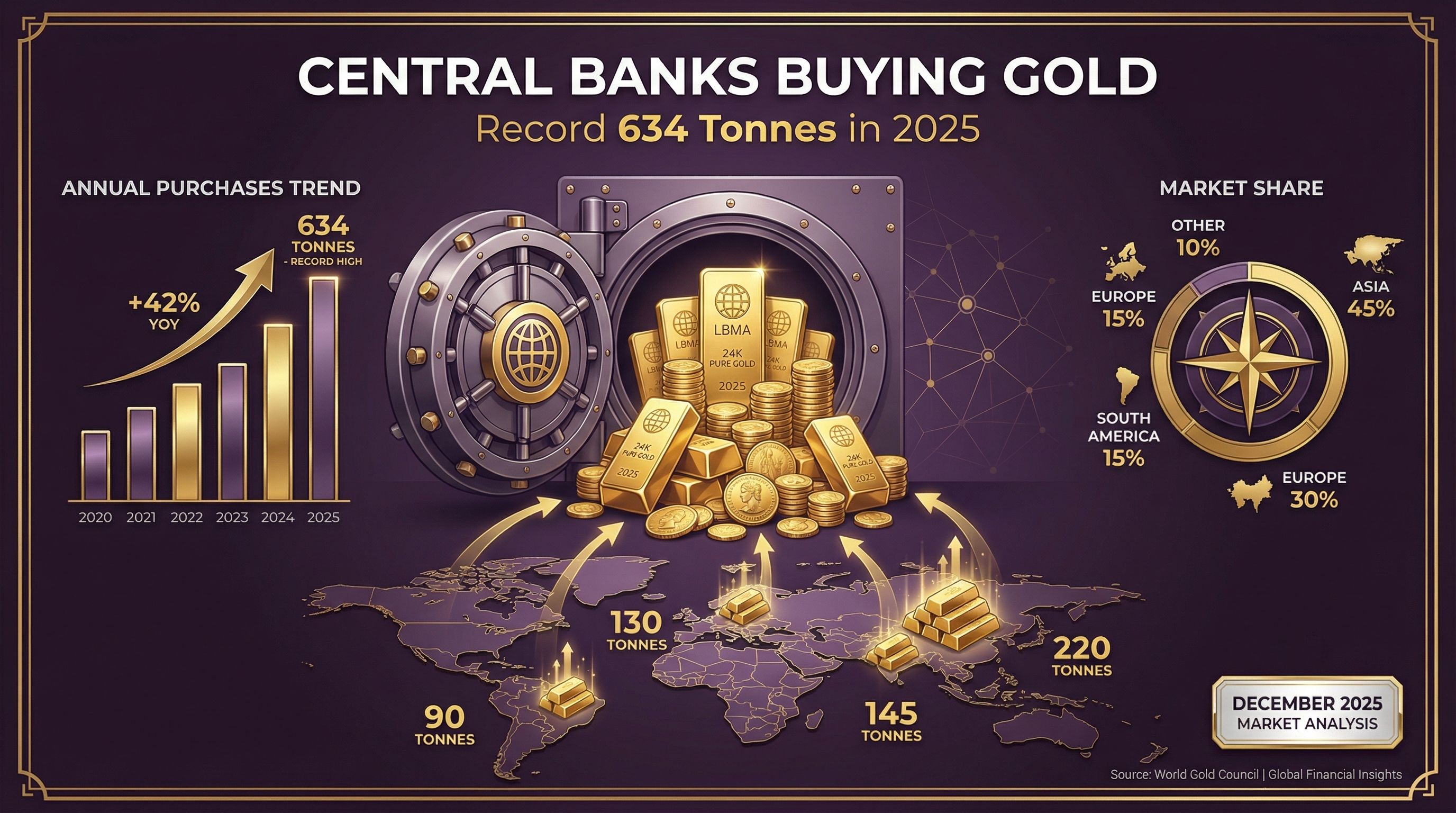
Central banks around the world have purchased 634 tonnes of gold through the first three quarters of 2025, according to the World Gold Council. This sustained buying spree—the fifth consecutive year of significant accumulation—represents a fundamental shift in how nations view their monetary reserves.
With gold trading at $4,317 per ounce as of December 2025, up 61.1% year-to-date per Yahoo Finance, understanding why central banks are aggressively accumulating gold is essential for any precious metals investor.
Current Market Snapshot
| Metric | Value | Change | Source |
|---|---|---|---|
| Gold Price | $4,317/oz | +61.1% YTD | Yahoo Finance |
| Silver Price | $61.04/oz | +8.4% weekly | Yahoo Finance |
| Central Bank Purchases (2025 YTD) | 634 tonnes | Q1-Q3 | World Gold Council |
| Central Bank Purchases (2024) | 1,045 tonnes | Full year | World Gold Council |
| USD Share of Global Reserves | 56.32% | Lowest in 30 years | IMF COFER |
The Scale of Central Bank Gold Buying
According to the World Gold Council’s Q3 2025 Gold Demand Trends report, central bank gold buying has fundamentally transformed the precious metals market:
Historical Context
| Year | Central Bank Net Purchases | Notable Events |
|---|---|---|
| 2022 | 1,082 tonnes | Record year, post-Russia sanctions |
| 2023 | 1,037 tonnes | Second-highest on record |
| 2024 | 1,045 tonnes | Third consecutive year over 1,000 tonnes |
| 2025 (Q1-Q3) | 634 tonnes | On pace for another strong year |
Prior to 2022, central banks hadn’t purchased more than 650 tonnes in a single year since 1967. The paradigm shift is unmistakable.
Top Central Bank Buyers in 2025
According to World Gold Council data, the leading accumulators are:
| Central Bank | Gold Holdings | 2025 Additions | % of Reserves |
|---|---|---|---|
| People’s Bank of China | 2,303 tonnes | 13 consecutive months | ~6% |
| Reserve Bank of India | 880+ tonnes | ~70 tonnes YTD | 14.7% |
| National Bank of Poland | 448 tonnes | Aggressive buyer | ~20% |
| Central Bank of Brazil | 153 tonnes | 11 tonnes recent | Growing |
| Central Bank of Turkey | 615 tonnes | Steady accumulation | ~35% |
Why Are Central Banks Buying Gold?
1. De-Dollarization: A Global Trend
The US dollar’s share of global foreign exchange reserves has fallen to 56.32%—the lowest level in 30 years, according to IMF COFER data. Central banks are actively diversifying away from dollar-denominated assets.
According to Reuters, several factors drive this trend:
Geopolitical Concerns
- Freezing of Russia’s $300+ billion in foreign reserves after 2022
- Demonstrated weaponization of the dollar-based financial system
- Sanctions risk for countries with strained US relations
Economic Factors
- US fiscal deficit concerns
- Inflation eroding dollar purchasing power
- Rising US debt-to-GDP ratios
2. BRICS+ and the New Monetary Order
The expanded BRICS bloc (Brazil, Russia, India, China, South Africa, plus new members) has been at the forefront of de-dollarization efforts. According to Bloomberg, BRICS nations purchased 663 tonnes of gold in the first nine months of 2025.
Key BRICS developments:
China’s Strategy
- 13 consecutive months of gold purchases through November 2025
- Total holdings now exceed 2,300 tonnes
- Gold represents approximately 6% of total reserves (vs. 70%+ for developed economies)
India’s Acceleration According to Livemint, the Reserve Bank of India added 10.2 tonnes in October 2025 alone, bringing total holdings to approximately 880 tonnes. Gold now represents 14.7% of India’s foreign exchange reserves—up from just 6% a few years ago.
3. Sanctions-Proof Asset
Gold’s appeal as a sanctions-proof asset has intensified since 2022. Unlike dollar-denominated bonds or bank deposits, physical gold stored domestically cannot be frozen or seized by foreign governments.
According to Financial Times analysis, central banks view gold as:
- Counterparty-free: No default risk
- Sanction-resistant: Physical possession equals control
- Universally accepted: Monetary metal for 5,000+ years
- Inflation hedge: Maintains purchasing power over time
4. Portfolio Diversification
The World Gold Council’s 2026 Outlook notes that central banks are increasingly viewing gold as essential portfolio diversification:
“After setting more than 50 all-time highs in 2025, gold is on track for its fourth strongest annual return since 1971. Central bank demand remains a structural support.”
Country Deep Dives
China: The Quiet Accumulator
China’s gold strategy has been methodical and persistent. According to CNBC:
- Official holdings: 2,303 tonnes (as reported)
- Suspected actual holdings: Potentially much higher (unreported purchases)
- Strategic goal: Reduce dollar exposure, prepare for potential currency internationalization
The People’s Bank of China resumed reporting gold purchases in November 2024 after a six-month pause, adding gold for 13 consecutive months through November 2025.
India: Record Pace
The Reserve Bank of India has emerged as one of the most aggressive gold buyers. Per Livemint:
| Period | RBI Gold Purchases |
|---|---|
| 2024 Full Year | ~73 tonnes |
| 2025 YTD | ~70 tonnes (through October) |
| October 2025 | 10.2 tonnes |
| Total Holdings | ~880 tonnes |
| % of Reserves | 14.7% |
India’s gold buying has multiple motivations:
- Cultural affinity: World’s largest gold consumer
- Rupee stabilization: Gold backing for currency credibility
- Geopolitical hedging: Reducing dollar dependence
Poland: Europe’s Biggest Buyer
Poland has been Europe’s most aggressive gold accumulator. According to the World Gold Council:
- Holdings increased from 229 tonnes (2018) to 448 tonnes (2025)
- Target: 20% of reserves in gold (nearly achieved)
- Motivation: Security concerns given proximity to Ukraine conflict
Other Notable Buyers
Turkey: 615 tonnes, approximately 35% of reserves Singapore: Quietly accumulating since 2021 Czech Republic: Following Polish lead in Europe Brazil: 153 tonnes, accelerating purchases
Impact on Gold Prices
Supply-Demand Dynamics
Central bank purchases of 1,000+ tonnes annually represent approximately 25-30% of total annual gold mine production (roughly 3,500 tonnes per year). This structural demand creates a floor under gold prices.
According to Trading Economics, gold reached an all-time high of $4,379.22 on October 17, 2025—with central bank buying cited as a key driver.
Price Support Levels
The sustained central bank bid has shifted market dynamics:
| Factor | Impact on Gold |
|---|---|
| Central bank buying | Removes ~1,000+ tonnes/year from market |
| ETF flows | Variable, recently positive |
| Jewelry demand | Price-sensitive, moderates on rallies |
| Investment demand | Rises with geopolitical uncertainty |
Analyst Perspectives
Goldman Sachs (per Yahoo Finance):
“Central bank demand has structurally shifted the equilibrium price of gold higher.”
World Gold Council (per 2026 Outlook):
“We expect central bank buying to remain elevated, though potentially moderating from record 2024 levels.”
What This Means for Investors
Following Central Bank Behavior
When the world’s most sophisticated monetary institutions allocate significant resources to gold, individual investors should take note. Consider:
-
Validation of gold’s role: Central banks buy gold for the same reasons individuals should—wealth preservation and diversification
-
Price support: Structural demand creates a higher floor for gold prices
-
De-dollarization implications: As dollar hegemony wanes, gold’s monetary role may expand
Allocation Considerations
According to Ray Dalio of Bridgewater Associates, individual investors should consider allocating around 15% to gold as a hedge against credit-dependent assets.
The emerging 60/20/20 portfolio strategy (60% equities, 20% bonds, 20% gold) recommended by Morgan Stanley’s CIO, per Advisor Perspectives, aligns with central bank thinking.
For NRI Investors
With gold at ₹1,33,910 per 10 grams in India according to GoodReturns, and the RBI itself aggressively accumulating, gold holds particular significance for Indian investors:
- RBI validation: India’s central bank buying at record pace
- Currency hedge: Gold protects against rupee depreciation
- Cultural alignment: Traditional store of value in Indian households
Looking Ahead: 2026 and Beyond
Continued Central Bank Demand
The World Gold Council’s 2026 Outlook projects:
- Central bank buying to remain elevated
- Continued de-dollarization trends
- Gold maintaining role as reserve diversifier
Potential Catalysts
Bullish factors for gold:
- Further central bank accumulation
- Geopolitical escalation
- Dollar weakness
- Inflation concerns
Bearish risks:
- Strong dollar
- Rising real interest rates
- Profit-taking after 60%+ rally
- Economic normalization
Price Targets
| Institution | 2026 Target | Rationale |
|---|---|---|
| Goldman Sachs | $4,500+ | Structural central bank demand |
| Bank of America | $4,800 | De-dollarization continues |
| UBS | $4,200-4,600 | Fed policy dependent |
Conclusion
Central bank gold buying has transformed from a curiosity to a structural market force. With 634 tonnes purchased through Q3 2025 and the dollar’s share of global reserves at a 30-year low, the message is clear: the world’s monetary authorities are betting on gold.
For individual investors, following central bank behavior offers valuable insight. Gold at $4,317 per ounce reflects not just speculation, but a fundamental reassessment of gold’s role in the global monetary system.
Whether you’re looking to hedge against geopolitical uncertainty, diversify away from dollar-denominated assets, or simply follow the “smart money,” gold deserves consideration in any well-balanced portfolio.
For NRIs looking to participate in this trend, Mantra Mint offers an easy way to buy, gift, and save digital gold—aligning your portfolio with the same asset class that central banks are aggressively accumulating.
Sources
- World Gold Council - Gold Demand Trends Q3 2025
- World Gold Council - Gold Outlook 2026
- World Gold Council - Gold Reserves by Country
- Yahoo Finance - Gold Futures (GC=F)
- Yahoo Finance - Silver Futures (SI=F)
- IMF COFER - Currency Composition of Official Foreign Exchange Reserves
- Reuters - Central Banks Keep Buying Gold
- Bloomberg - BRICS Nations Grab Record Gold Reserves
- Livemint - RBI Gold Reserves Surge
- CNBC - China PBOC Gold Reserves
- Trading Economics - Gold Price Data
- Fortune - Ray Dalio Gold Allocation
- Advisor Perspectives - 60/20/20 Portfolio Strategy
- GoodReturns - Gold Rate Today India
Ready to start investing in gold?
Join thousands of Indian families building wealth with Mantra Mint.
Get Started Free