
Buy the Dip: How Smart Investors Capitalize on Gold Price Corrections
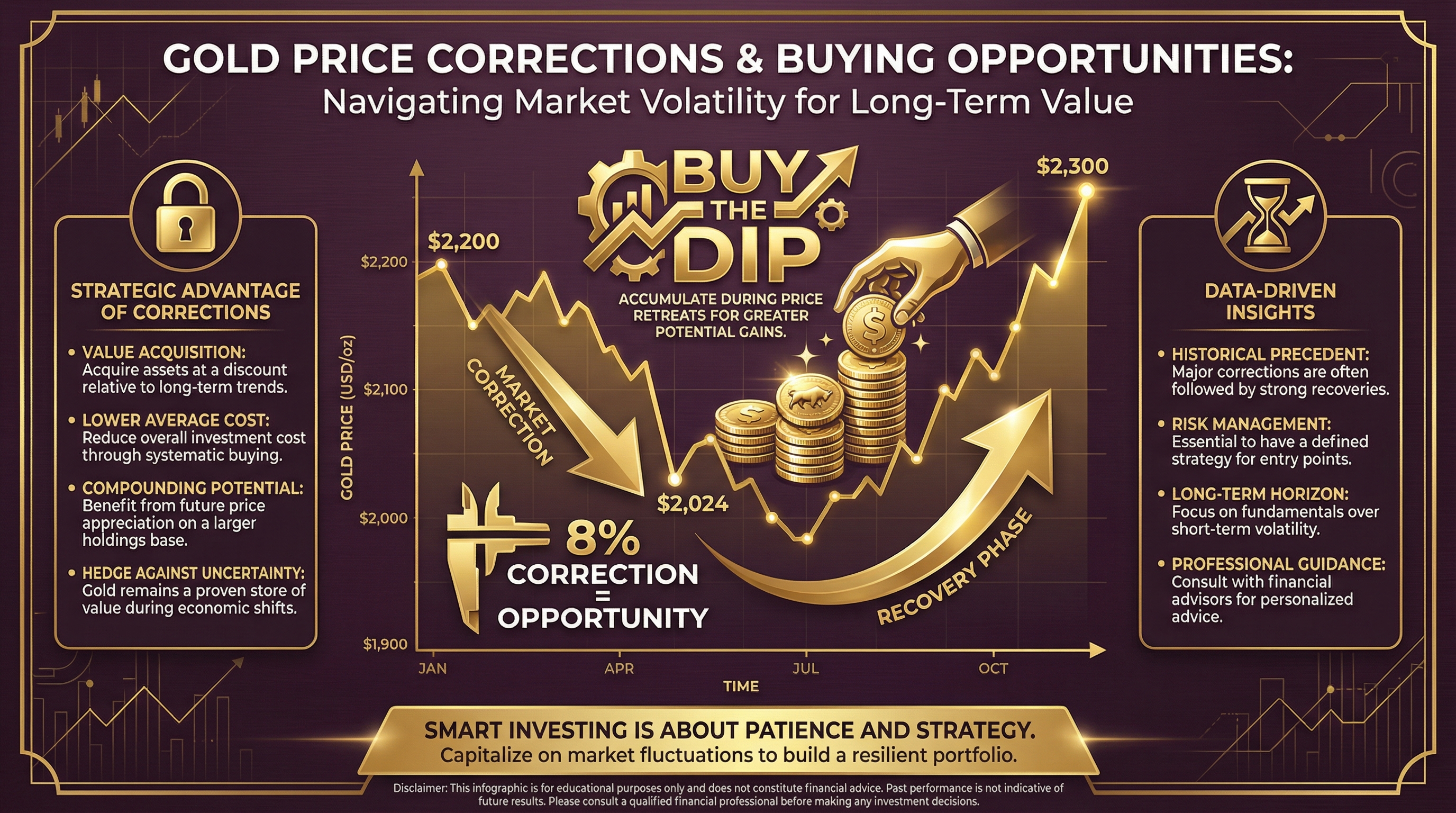
In October 2025, gold experienced its largest correction in over a decade—dropping 8% from its record high of $4,355 to approximately $4,000 per ounce. For many investors, this decline triggered panic. For smart money, it was an opportunity.
As of December 24, 2025, gold trades at $4,502.80 per ounce (+3.6% this week), having fully recovered and pushed higher. Those who bought the dip are now sitting on substantial gains. But how do you identify these opportunities—and what’s the best strategy for capitalizing on them?
Current Market Snapshot
| Metric | Current | Change | Source |
|---|---|---|---|
| Gold Spot Price | $4,502.80/oz | +3.6% (week) | Yahoo Finance |
| Silver Spot Price | $71.69/oz | +8.2% (week) | Yahoo Finance |
| Gold YTD Return | +67% | Best year since 1980 | Calculated |
| Gold-Silver Ratio | 62.8:1 | Compressing | Calculated |
| October Correction | -8% | Largest in decade | Market data |
The October 2025 Correction: A Case Study
What Happened
According to Reuters and market data:
| Timeline | Price | Event |
|---|---|---|
| Late October 2025 | $4,355 | All-time record high |
| Following weeks | $4,000 | ~8% correction |
| December 2025 | $4,503 | Full recovery + new highs |
This represented the largest single correction in over a decade, yet gold still finished the year up 67%.
Earlier 2025 Corrections
Gold experienced multiple buying opportunities throughout 2025:
| Period | Peak | Trough | Correction |
|---|---|---|---|
| Mid-April to August | $2,450 | ~$2,180 | ~11% over 2.5 months |
| October | $4,355 | ~$4,000 | ~8% in weeks |
| Various pullbacks | — | — | 3-5% regularly |
Historical Gold Corrections: What’s Normal?
Early Bull Market Corrections (2000-2011)
According to Gold Survival Guide and historical analysis:
| Year | Peak | Trough | Correction | Recovery Time |
|---|---|---|---|---|
| 2006 | $730 | $560 | -23% | 8 months |
| 2008 | $1,030 | $680 | -34% | 12 months |
| 2011 | $1,920 | $1,540 | -20% | Never (secular top) |
Late Bull Market Pattern
| Phase | Typical Correction | Frequency |
|---|---|---|
| Early bull | 10-15% | 1-2 per year |
| Mid bull | 15-25% | Annually |
| Late bull | 20-30% | Major events only |
| Secular peak | 30-50% | Once per cycle |
How Central Banks Buy the Dip
The smart money doesn’t panic during corrections—they accumulate. According to the World Gold Council:
Q3 2025 Central Bank Buying
| Metric | Value | Change |
|---|---|---|
| Q3 2025 Purchases | 219.9 tonnes | +28% QoQ |
| October Alone | 60 tonnes | During correction |
| YTD 2025 | 694 tonnes | On pace for record |
Central banks accelerated purchases during the October correction, demonstrating how institutional investors view dips as buying opportunities rather than warning signs.
Top Buyers During Corrections
| Country | Q3 2025 Purchases | Strategy |
|---|---|---|
| Poland | 42 tonnes | Aggressive accumulation |
| Uzbekistan | 25 tonnes | Steady buying |
| India | 18 tonnes | Reserve building |
| China | 15 tonnes (reported) | Strategic reserves |
DCA vs. Lump Sum: What Works for Gold?
The Academic Evidence
According to Vanguard research covering 1926-2011:
| Strategy | Outperformance Rate | Average Advantage |
|---|---|---|
| Lump Sum | 68% of time (stocks) | +2.3% |
| Lump Sum | 75% of time (bonds) | +1.8% |
| Conclusion | Lump sum wins | Most periods |
But Gold Is Different
Gold’s volatility characteristics make DCA more compelling than for equities:
| Factor | Stocks | Gold |
|---|---|---|
| Long-term trend | Upward with dividends | Upward, no yield |
| Volatility | 15-20% annually | 15-25% annually |
| Corrections | 10% common, 20% bear | 10-20% common |
| Recovery pattern | Usually within 1-2 years | Varies widely |
The Psychological Reality
According to Investopedia:
“DCA provides psychological benefits that pure mathematics cannot capture. Investors who dollar-cost average are more likely to stay invested through volatility.”
| DCA Benefits | Lump Sum Benefits |
|---|---|
| Reduces timing risk | Maximizes time in market |
| Lower average cost in downtrends | Higher returns in uptrends |
| Psychological comfort | Simpler execution |
| Disciplined approach | No cash drag |
Optimal Gold Buying Strategy
The Hybrid Approach
Based on historical data and behavioral finance:
| Market Condition | Recommended Strategy |
|---|---|
| Normal conditions | Monthly DCA |
| 5-10% correction | Accelerate purchases |
| 10-15% correction | Deploy 25-50% of reserves |
| 15%+ correction | Consider lump sum |
Practical Implementation
| Scenario | Action |
|---|---|
| Regular investing | Monthly purchase (e.g., 1 gram) |
| Correction detected | Double or triple monthly amount |
| Major pullback | Deploy cash reserves |
| New highs | Maintain regular DCA |
Identifying Buying Opportunities
Technical Indicators
| Signal | What It Means | Action |
|---|---|---|
| 50-day moving average touch | Normal pullback | Buy normal |
| 100-day moving average touch | Meaningful correction | Buy more |
| 200-day moving average touch | Major opportunity | Significant buy |
| RSI below 30 | Oversold | Strong buy signal |
Fundamental Triggers
| Event | Typical Gold Impact | Opportunity? |
|---|---|---|
| Fed rate hike fears | Short-term drop | Often yes |
| Dollar strength | Temporary weakness | Usually yes |
| Risk-on sentiment | Rotation away | Accumulate |
| Liquidation events | Sharp drops | Best opportunities |
What Wall Street Expects
2026 Price Targets
According to major investment banks:
| Institution | 2026 Target | Implied Upside |
|---|---|---|
| Goldman Sachs | $4,900/oz | +9% |
| JP Morgan | $4,200/oz (conservative) | -7% |
| Bank of America | $4,500/oz | ~flat |
| UBS | $4,600/oz | +2% |
The Bull Case
According to Goldman Sachs:
“Central bank buying, de-dollarization trends, and geopolitical uncertainty support continued gold accumulation. Any correction should be viewed as a buying opportunity within a structural bull market.”
Common Mistakes When Buying Dips
What to Avoid
| Mistake | Why It’s Problematic |
|---|---|
| Catching falling knives | Wait for stabilization |
| All-in at first dip | Corrections can deepen |
| Ignoring fundamentals | Not all dips are opportunities |
| Leveraging on dips | Risk of margin calls |
| Selling the recovery | Missing the full rebound |
The Right Mindset
| Wrong Approach | Right Approach |
|---|---|
| ”Gold is crashing!" | "Gold is on sale" |
| "I should have sold" | "I should buy more" |
| "The bull market is over" | "This is a healthy correction" |
| "Timing is everything" | "Time in market matters” |
Gold Corrections in Context
2025’s 67% Gain Despite Corrections
| Quarter | Return | Major Events |
|---|---|---|
| Q1 2025 | +18% | Rate cut expectations |
| Q2 2025 | +12% | Central bank buying |
| Q3 2025 | +15% | Geopolitical tensions |
| Q4 2025 | +10% | Despite October correction |
The October correction was a speed bump, not a trend reversal.
Historical Perspective
| Year | Annual Return | Largest Correction |
|---|---|---|
| 2020 | +25% | -15% (March) |
| 2024 | +27% | -8% |
| 2025 | +67% | -8% (October) |
Even in strong years, corrections happen. The key is using them.
For Indian Families: Cultural Wisdom Meets Strategy
The Akshaya Tritiya Effect
Indian families have practiced “buy the dip” for generations:
| Occasion | Traditional Action | Investment Parallel |
|---|---|---|
| Akshaya Tritiya | Buy gold for auspiciousness | Systematic accumulation |
| Dhanteras | Major gold purchases | Annual lump sum |
| Price drops | ”Gold is blessed to buy now” | Buy the dip |
Modern Implementation
| Traditional | Modern |
|---|---|
| Physical jewelry | Digital gold + jewelry |
| Festival buying | DCA + dip buying |
| Family savings | Portfolio allocation |
| Generational transfer | Tax-efficient gifting |
Action Plan: Your Dip-Buying Strategy
Step 1: Establish Base Allocation
| Portfolio Size | Gold Target | Monthly DCA |
|---|---|---|
| Under $50K | 10% | $200-500 |
| $50K-200K | 10-15% | $500-1,000 |
| $200K+ | 15-20% | $1,000+ |
Step 2: Set Correction Triggers
| Correction Level | Action | Example at $4,500 |
|---|---|---|
| -5% ($4,275) | Increase DCA 2x | $400 → $800 |
| -10% ($4,050) | Deploy 25% reserves | Add $2,500 |
| -15% ($3,825) | Deploy 50% reserves | Add $5,000 |
Step 3: Maintain Discipline
| Rule | Rationale |
|---|---|
| Never sell on dips | Corrections are temporary |
| Keep cash reserves | Dry powder for opportunities |
| Rebalance annually | Lock in gains, buy weakness |
| Document purchases | Track cost basis |
The Bottom Line
Gold’s October 2025 correction—the largest in over a decade—has already been erased, with prices now above $4,500. Those who panicked missed the recovery. Those who bought are ahead.
Key takeaways:
- Corrections are normal: Even in a +67% year, 8-10% pullbacks happen
- Central banks buy dips: They added 60 tonnes during October’s correction
- DCA works for gold: Reduces timing risk and psychological stress
- Hybrid approach is optimal: Regular DCA plus accelerated buying on dips
- Fundamentals matter: Buy dips in bull markets, not reversals
For Indian families who understand gold’s generational value, modern “buy the dip” strategy simply formalizes what your grandparents always knew: when gold goes on sale, you buy more.
Whether through Mantra Mint’s digital gold platform or physical purchases, the next correction isn’t something to fear—it’s something to prepare for.
Sources
- Reuters - Gold Prices Head for Largest Drop in Decade
- World Gold Council - Central Bank Gold Statistics October 2025
- Vanguard - Dollar-Cost Averaging vs. Lump Sum Investing
- Goldman Sachs - Gold Still Has Shine at Record Prices
- Gold Survival Guide - Historical Gold Corrections
- Investopedia - Dollar-Cost Averaging
- Yahoo Finance - Gold Futures
- Yahoo Finance - Silver Futures
- JP Morgan - Gold Outlook 2026
- World Gold Council - Gold Demand Trends
Ready to start investing in gold?
Join thousands of Indian families building wealth with Mantra Mint.
Get Started Free