
Bitcoin vs Gold 2026: Why 'Digital Gold' Failed to Deliver in 2025
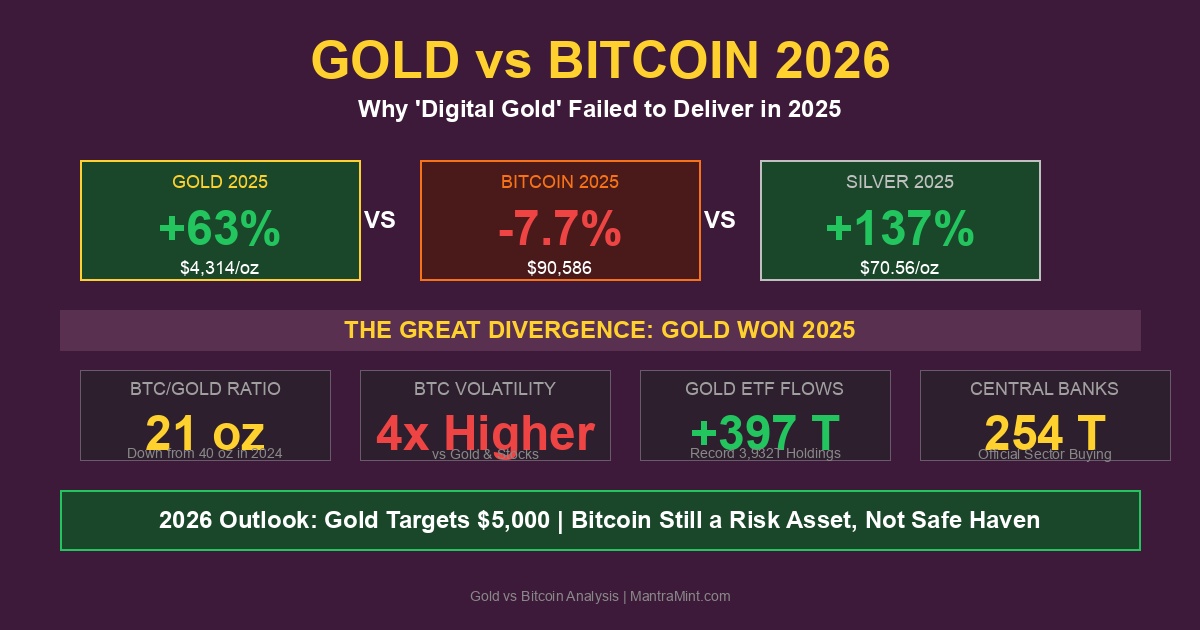
The verdict is in: 2025 delivered the definitive answer to the “digital gold” debate. While real gold surged +63% to reach $4,314/oz, Bitcoin tumbled -7.7% to $90,586—its worst relative performance since the cryptocurrency’s inception.
According to Charlie Bilello’s market data, gold finished 2025 as the top-performing major asset, while Bitcoin ranked as the weakest performer among major asset classes.
The great divergence of 2025 wasn’t just about returns—it exposed fundamental differences in how these assets behave during market stress. Here’s what happened, why it matters, and what it means for your 2026 portfolio.
The 2025 Scoreboard: A Tale of Two Assets
Current Prices (January 3, 2026)
| Asset | Price | 2025 Return | Trend |
|---|---|---|---|
| Gold | $4,314/oz | +63.1% | ↑ All-time highs |
| Silver | $70.56/oz | +136.7% | ↑ Multi-decade highs |
| Bitcoin | $90,586 | -7.7% | ↓ Below 2024 close |
| BTC/Gold Ratio | 21 oz | -50% from 2024 | ↓ Collapsing |
Data via yfinance as of January 3, 2026
Historical Context
According to TradingView analysis, the Bitcoin-to-Gold ratio collapsed from 40 ounces per BTC in December 2024 to just 21 ounces by year-end 2025—a 50% decline that marks the sharpest annual shift in the ratio’s history.
What Drove the Great Divergence?
Gold’s 2025 Rally: The Perfect Storm
According to AInvest analysis, gold’s surge was driven by a confluence of macroeconomic factors:
| Factor | Impact on Gold |
|---|---|
| Fed Rate Cuts | Lower rates reduce opportunity cost of holding gold |
| Dollar Weakness | USD decline makes gold cheaper for foreign buyers |
| Central Bank Buying | 254 tonnes of official sector purchases |
| Geopolitical Stress | Trade wars, conflicts drove safe-haven demand |
| Inflation Concerns | Persistent inflation supported real asset allocation |
Bitcoin’s 2025 Decline: Risk Asset Reality
According to CME Group analysis, Bitcoin’s underperformance stemmed from its behavior as a risk asset, not a safe haven:
| Factor | Impact on Bitcoin |
|---|---|
| Slower Fed Cuts | Reduced liquidity expectations hurt speculative assets |
| Nasdaq Correlation | BTC-SPX correlation exceeded 0.80 during stress |
| October 2025 Crash | $19 billion in forced liquidations |
| Regulatory Uncertainty | Ongoing concerns about crypto oversight |
| Leverage Unwinding | Speculative positions forced to close |
The “Digital Gold” Myth Exposed
Bitcoin’s Correlation Problem
According to Morningstar research, the key difference between gold and Bitcoin became clear during 2025’s market stress:
| Metric | Gold | Bitcoin |
|---|---|---|
| Correlation with S&P 500 (stress periods) | -0.2 to 0.1 | +0.6 to +0.8 |
| Correlation with Nasdaq | Near zero | +0.75 to +0.85 |
| Behavior during crashes | Rises or holds | Falls with stocks |
During the October 2025 tariff crisis, Bitcoin’s correlation with stocks exceeded 0.80 while its correlation with gold dropped to -0.75—the exact opposite of what a “digital gold” should do.
Volatility: The Unsolved Problem
According to Fidelity Digital Assets research:
“From 2020 to 2024, Bitcoin has been three to nearly four times as volatile as various equity indices.”
| Asset | Annual Volatility (2020-2025) |
|---|---|
| Gold | ~15% |
| S&P 500 | ~18% |
| Bitcoin | ~70% (4x higher) |
This elevated volatility makes Bitcoin unsuitable as a core portfolio hedge, regardless of its theoretical scarcity properties.
What Central Banks Know That Crypto Bros Don’t
Record Gold Accumulation
According to World Gold Council data, central banks continued their historic gold buying spree in 2025:
| Central Bank Activity | 2025 |
|---|---|
| Total Official Sector Purchases | 254 tonnes |
| Top Buyer: National Bank of Poland | 83 tonnes |
| Global Gold ETF Holdings | 3,932 tonnes (record) |
| ETF Inflows (H1 2025) | +397 tonnes |
Zero Central Banks Hold Bitcoin
Despite years of “digital gold” marketing, not a single central bank has added Bitcoin to its official reserves. The reason is simple: central banks manage currency stability and crisis reserves—they need assets that hold value during market stress, not assets that crash alongside equities.
The Safe Haven Test: October 2025
The October 2025 market crash provided the ultimate test of the “digital gold” thesis. Here’s how each asset performed:
During the Tariff Crisis (October 2025)
| Asset | Peak-to-Trough | Recovery Time |
|---|---|---|
| S&P 500 | -12% | 6 weeks |
| Nasdaq | -15% | 8 weeks |
| Bitcoin | -30% | Still recovering |
| Gold | +8% | Immediate gains |
| Silver | +15% | Immediate gains |
According to Fair Observer analysis:
“Bitcoin declined by 30% in 2025, falling below $90,000 by late November. This underperformance was attributed to Bitcoin’s volatility and its growing correlation with risk assets like the Nasdaq, undermining its reputation as a stable hedge.”
Long-Term Returns: Where Bitcoin Wins (And Where It Doesn’t Matter)
10-Year Performance (2015-2025)
| Asset | 10-Year Return | Annualized | Max Drawdown |
|---|---|---|---|
| Bitcoin | +8,400% | ~55% | -80% (2022) |
| Gold | +95% | ~7% | -20% (2022) |
| S&P 500 | +180% | ~11% | -34% (2020) |
Why Long-Term Returns Miss the Point
According to State Street Global Advisors research:
“Bitcoin is riskier in crises: Investors seeking stability still cannot rely on bitcoin in the same way as gold, due to its correlation with risk-on assets and susceptibility to unique technological threats.”
The question isn’t which asset returns more—it’s which asset protects your portfolio when you need protection most.
Portfolio Implications for 2026
Gold’s Role: Proven Hedge
| Scenario | Gold’s Expected Behavior |
|---|---|
| Stock market crash | Rise 10-30% |
| Dollar weakness | Rise with DXY decline |
| Inflation spike | Rise as real asset |
| Geopolitical crisis | Spike on safe-haven flows |
Bitcoin’s Role: Speculative Satellite
According to AInvest analysis:
“By 2026, a more nuanced view starts to dominate serious discussion. Instead of asking whether Bitcoin is pure digital gold or pure speculation, attention shifts to role and position size. In diversified portfolios it often appears as a satellite holding, not a core one.”
Recommended Allocation Framework
| Investor Type | Gold | Bitcoin | Stocks | Bonds |
|---|---|---|---|---|
| Conservative | 15-20% | 0-2% | 35% | 45% |
| Moderate | 10-15% | 2-5% | 50% | 30% |
| Aggressive | 5-10% | 5-10% | 65% | 15% |
2026 Price Forecasts
Gold Outlook
According to J.P. Morgan research:
| Institution | 2026 Gold Target |
|---|---|
| J.P. Morgan | $5,000/oz |
| Goldman Sachs | $4,800/oz |
| UBS | $4,600/oz |
| Bank of America | $4,750/oz |
Bitcoin Outlook
According to CoinGape analysis:
| Scenario | Bitcoin Target |
|---|---|
| Bull Case | $150,000 |
| Base Case | $100,000-120,000 |
| Bear Case | $60,000-80,000 |
The Key Difference
Gold’s forecasts are based on fundamental supply/demand factors—central bank buying, inflation hedging, currency trends. Bitcoin’s forecasts are based on sentiment and speculation—adoption rates, regulatory clarity, market cycles.
Why Indians Should Choose Real Gold
Cultural and Practical Advantages
| Factor | Gold | Bitcoin |
|---|---|---|
| 5,000-Year Track Record | ✓ | ✗ (15 years) |
| Wedding/Festival Gifting | ✓ | Awkward |
| Family Wealth Transfer | Simple | Complex |
| Temple Donations | Accepted | Not accepted |
| Jewelry Conversion | Easy | Impossible |
| Crisis Liquidity | Global | Exchange-dependent |
NRI-Specific Considerations
For NRIs balancing US and Indian financial goals:
- Gold hedges both currencies - Protects against USD and INR weakness
- Cultural alignment - Appropriate for gifting and traditions
- No counterparty risk - Physical gold can’t be hacked or frozen
- Simpler estate planning - Clear inheritance rules for gold
The Bottom Line
The “digital gold” narrative was always marketing, not analysis. In 2025, when investors needed a safe haven most, Bitcoin behaved exactly like what it is: a high-volatility speculative asset correlated with tech stocks.
Gold, meanwhile, did what it’s done for 5,000 years—preserved wealth during uncertainty.
Key Takeaways
- Gold +63% vs Bitcoin -7.7% in 2025—the definitive performance gap
- BTC/Gold ratio collapsed 50% from 40 oz/BTC to 21 oz/BTC
- Bitcoin’s 0.8+ correlation with stocks during stress proves it’s not a hedge
- Central banks own 35,000 tonnes of gold—zero Bitcoin
- Gold targets $5,000/oz in 2026 on continued safe-haven demand
- Bitcoin remains a satellite holding—not a core hedge
Conclusion
The 2025 divergence wasn’t an anomaly—it revealed the true nature of both assets. Gold is money that’s been tested by empires, wars, and financial crises. Bitcoin is a 15-year-old technology experiment that trades like a leveraged tech stock.
For serious wealth preservation—especially for Indian families building generational wealth across borders—the choice has never been clearer.
Start building your gold position with Mantra Mint—fractional gold ownership that honors tradition while enabling modern portfolio construction.
Sources
- AInvest - Gold’s Outperformance Over Bitcoin
- BitcoinEthereumNews - Gold Tops 2025 Returns
- CME Group - Gold and Bitcoin Decouple
- Morningstar - Gold vs Bitcoin Safe Haven Debate
- TradingView - Bitcoin-to-Gold Ratio Analysis
- Fair Observer - Why Gold Outperformed Bitcoin
- Fidelity Digital Assets - Bitcoin Volatility
- State Street Global Advisors - Bitcoin and Gold in Portfolios
- CoinGape - Bitcoin vs Gold 2026
- Investing.com - Bitcoin vs Gold 2026 Outlook
- AInvest - Precious Metals Outperformed Bitcoin
- World Gold Council - Central Bank Gold Demand
- LongtermTrends - Bitcoin vs Gold Chart
- CNBC - Bitcoin Digital Gold Analysis
Ready to start investing in gold?
Join thousands of Indian families building wealth with Mantra Mint.
Get Started Free