
5,000 Years of Gold: Why It Remains the Ultimate Store of Value
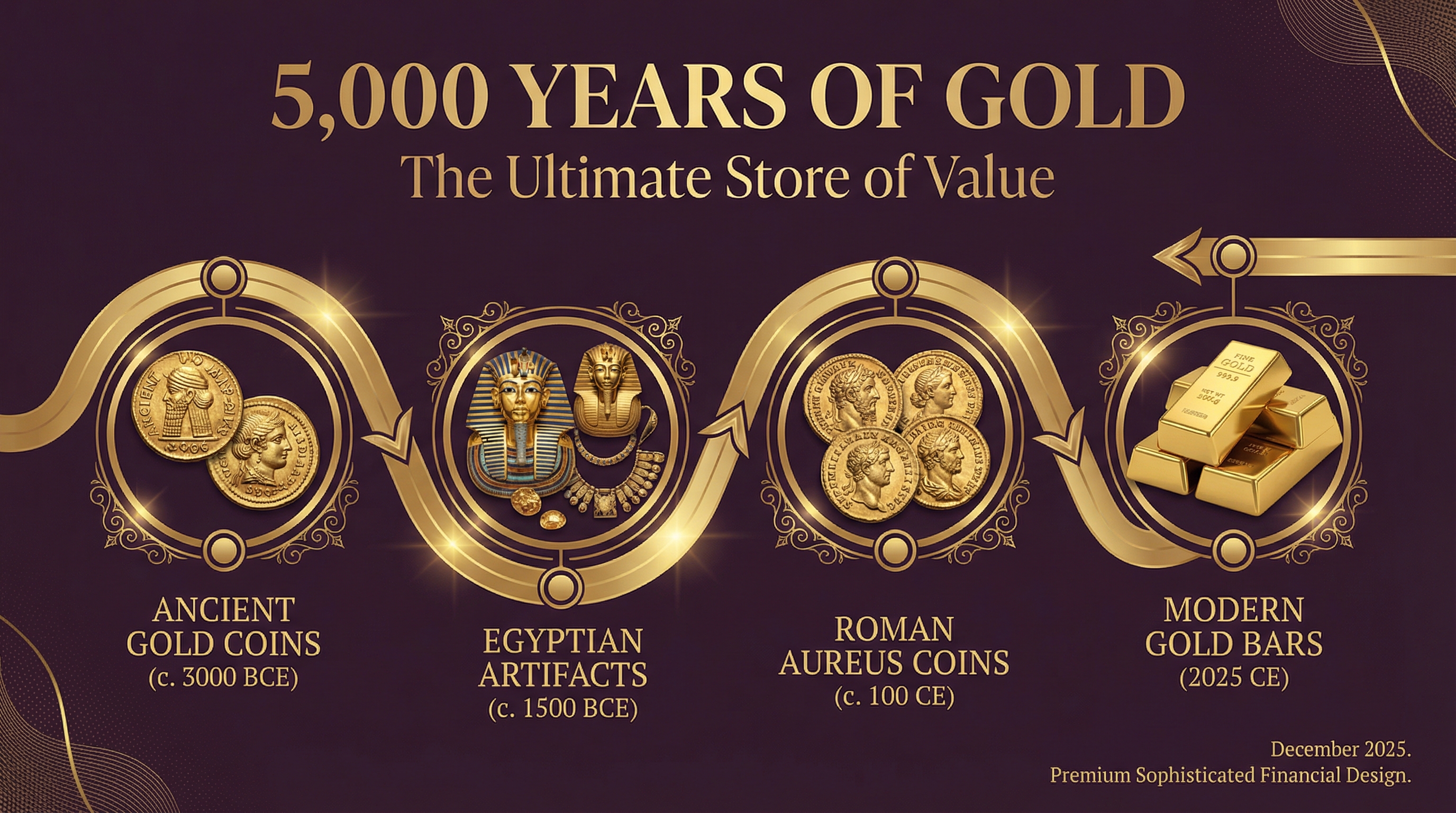
In an age of cryptocurrencies, digital payments, and complex financial instruments, one asset has stood the test of time for over 5,000 years: gold. Trading at $4,317 per ounce in December 2025 according to Yahoo Finance, gold continues to serve the same fundamental purpose it did when ancient Egyptians first crafted it into jewelry and currency—preserving wealth across generations.
This comprehensive exploration traces gold’s remarkable journey from the tombs of pharaohs to modern investment portfolios, revealing why this precious metal remains the ultimate store of value.
Current Gold Market Snapshot
| Metric | Value | Change | Source |
|---|---|---|---|
| Gold Price | $4,317/oz | +61.1% YTD | Yahoo Finance |
| Silver Price | $61.04/oz | +8.4% weekly | Yahoo Finance |
| Gold/Silver Ratio | 70.7 | — | Calculated |
| Gold in INR | ₹1,33,910/10g | Record highs | GoodReturns |
The Dawn of Gold: 5,000 Years of History
Ancient Beginnings (5000-3000 BCE)
According to the World History Encyclopedia, gold’s history with humanity stretches back nearly 6,000 years to the earliest civilizations. Archaeological evidence shows that electrum (a natural gold-silver alloy) was used in jewelry by Egyptians as early as 5000 BCE.
The first solid evidence of human interaction with gold comes from ancient Egypt around 3000 BCE, where gold was not merely a symbol of wealth but an integral part of mythology and daily life. According to Provident Metals:
“Everything from jewelry to the capstones of the Great Pyramids to King Tut’s funeral mask was crafted from gold.”
Why Ancient Civilizations Chose Gold
Gold’s unique properties made it ideal for storing value:
| Property | Significance | Ancient Application |
|---|---|---|
| Does not corrode | Immortality, permanence | Religious artifacts, royal tombs |
| Rare | Scarcity = value | Currency, trade |
| Malleable | Easy to work | Jewelry, coins |
| Distinctive color | Aesthetic appeal | Status symbols |
| Divisible | Practical for trade | Standardized weights |
According to the World History Encyclopedia:
“Gold does not corrode and so it became a symbol of immortality and power in many ancient cultures. Its rarity and aesthetic qualities made it an ideal material for ruling classes to demonstrate their power and position.”
The Birth of Gold Currency
Mesopotamia and Early Proto-Money (3000-1000 BCE)
The Mesopotamian shekel emerged nearly 5,000 years ago as one of the first known forms of currency. According to Hard Money History, gold bars of set weight were used as a medium of exchange in both Mesopotamia and Egypt during the 4th millennium BCE.
The First Gold Coins: Lydia (600 BCE)
A pivotal moment in monetary history occurred in the Kingdom of Lydia (modern-day Turkey) around 600 BCE. According to Scottsdale Bullion & Coin:
- King Alyattes minted the first standardized coins from electrum
- King Croesus refined this by issuing pure gold coins called the Croeseid or stater
- This created the world’s first bimetallic monetary system
- Coins were stamped with symbols for authenticity, facilitating trade across the Mediterranean
Greek and Roman Gold Standards
According to Provident Metals, gold was money in ancient Greece by 550 BCE. The Greeks mined gold throughout the Mediterranean and Middle East regions.
The Romans systematized gold currency:
| Coin | Period | Significance |
|---|---|---|
| Aureus | 46 BCE (Julius Caesar) | Standard Roman gold coin |
| Solidus | 312 CE | Replaced aureus, survived 700+ years |
The solidus, introduced by Constantine, was so stable it remained the dominant trade currency for seven centuries—a testament to gold’s enduring value.
Gold in Ancient India: A 5,000-Year Love Affair
Sacred Origins
India’s relationship with gold spans over 5,000 years, according to Jar App. The Rig Veda, attributed to the period before the 2nd millennium BCE, contains multiple references to gold as “Hiranya-mani”—gem-studded gold ornaments.
According to Bank Bazaar:
“In ancient Indian texts, gold is referred to as ‘swarna,’ which means ‘the best.’ The word ‘swarna’ is also used to describe the colour yellow, associated with the sun and prosperity.”
Gold has had more than 40 unique names in Sanskrit, often depending on how it was mined, the region where it was found, or its metallic properties.
Spiritual Significance
Gold holds immense spiritual significance in Indian culture:
- Goddess Lakshmi is often depicted with a pot of gold, symbolizing wealth and prosperity
- The Sri Sukta hymn describes Devi Lakshmi as “shining resplendently with a golden hue”
- Gold offerings to deities are believed to bring good fortune
- In ancient texts, gold symbolized the sky, day, and life itself
Ancient Indian Gold Mining
The sophistication of ancient Indian gold mining is remarkable. According to En Route Indian History:
“The Hatti mines in the Raichur Doab in present-day Karnataka are as deep as 640 feet (195 metres). These are possibly the deepest mines of the ancient period.”
Modern India’s Gold Holdings
India’s gold tradition continues today:
| Metric | Value | Source |
|---|---|---|
| Household gold stock | ~25,000 tonnes | World Gold Council |
| Temple holdings | ~4,000 tonnes | Coin Bazaar |
| Official reserves (RBI) | ~880 tonnes | RBI |
| Annual imports | World’s 2nd largest | World Gold Council |
According to Gold City Jewelers, gold jewelry and ornaments are passed from generation to generation, keeping family legacy alive.
Gold vs. Fiat Currency: The 100-Year Test
The Dollar’s Decline
According to the US Gold Bureau, since the creation of the Federal Reserve in 1912, the U.S. dollar has lost nearly 98% of its purchasing power.
Per Goldco:
“The dollar in 1971 was officially valued at 1/35 ounce of gold, whereas today that same dollar purchases less than 1/3300 ounce of gold. That’s a 99% loss of purchasing power in a little over 50 years.”
Gold’s Purchasing Power Stability
According to Bullion Star, gold’s purchasing power has remained remarkably stable over centuries:
| Time Period | Gold Price Start | Gold Price End | Purchasing Power |
|---|---|---|---|
| 1910 | $20.67/oz | — | Baseline |
| 1971 | $35/oz | — | Still pegged |
| 2025 | — | $4,317/oz | Maintained |
The key insight from Gold Price Forecast:
“One ounce of gold purchases approximately the same goods and services it did 100 years ago.”
Long-Term Performance Data
According to Gainesville Coins:
| Period | Gold Return | Notes |
|---|---|---|
| 1971-2024 | 10.6% average annual | Post-gold standard |
| 2004-2024 | 8.4% nominal, 5.6% real | Inflation-adjusted |
| High inflation periods | 15% average annual | When CPI exceeded 5% |
Gold as an Inflation Hedge
Historical Evidence
According to research published in PMC/NIH and ScienceDirect, gold’s effectiveness as an inflation hedge has been studied extensively since the 1970s.
Per Metals Edge:
“Between 1970 and 1980, during a period of high inflation in many countries, gold prices surged dramatically while cash savings lost significant purchasing power.”
Why Gold Works
According to Al Romaizan:
- Physical scarcity: Unlike paper currencies, governments cannot create more gold
- Mining limitations: Only limited quantities can be produced annually
- Historical precedent: 5,000 years of wealth preservation
- Universal acceptance: Recognized globally as a store of value
CPI-Adjusted Analysis
Per Julius Baer:
“The CPI-adjusted gold price shows a different pattern than nominal prices. It appears relatively stable and remains within a consistent range, indicative of effective capital preservation and wealth protection.”
Gold Across Ancient Civilizations
Global Universality
What’s remarkable about gold is how independently civilizations across the world recognized its value:
| Civilization | Period | Gold’s Role | Source |
|---|---|---|---|
| Egypt | 3000 BCE | Divine material, burial goods | World History Encyclopedia |
| Mesopotamia | 3000 BCE | Proto-currency, trade | Hard Money History |
| India | 2000 BCE | Sacred, jewelry, currency | Jar App |
| China | 1000 BCE | Trade, jewelry, Silk Road | Only Gold |
| Greece | 550 BCE | Coins, trade currency | Provident Metals |
| Rome | 46 BCE | Standardized coinage | SBC Gold |
| Inca | 1400 CE | ”Sweat of the sun god” | World History Encyclopedia |
According to Only Gold:
“There’s one common trend across all ancient civilizations: gold is a status symbol used to separate one class from another.”
The Incas and Mesoamerica
In the Inca civilization of Peru, gold was considered the “sweat of the sun god Inti” and was used to manufacture religious objects, masks, and sun disks. According to the World History Encyclopedia:
“In Mesoamerica, the Aztecs, Incas, and Mayans valued gold for religious artifacts rather than money, while in ancient China and India, it was used for jewelry and trade along the Silk Road.”
Modern Investment Implications
Expert Recommendations
Based on gold’s 5,000-year track record, modern financial experts recommend meaningful portfolio allocations:
| Expert/Institution | Recommended Allocation | Rationale |
|---|---|---|
| Ray Dalio (Bridgewater) | 15% | Hedge against credit-dependent assets |
| Morgan Stanley | 20% | 60/20/20 portfolio strategy |
| BlackRock | 2-5% | Near-term economic factors |
| World Gold Council | 5-10% | Portfolio diversification |
Why 5,000 Years Matters Today
Gold’s historical track record provides unique advantages:
- Proven durability: No other asset has maintained value across five millennia
- Crisis performance: Gold rises during economic uncertainty
- Currency independence: No government can devalue gold
- Universal acceptance: Recognized worldwide, regardless of political systems
- Generational wealth: Can be passed down without depreciation
The Holiday Gifting Angle
As we approach the holiday season, gold’s 5,000-year legacy makes it particularly meaningful for gifts:
- Generational connection: Linking to traditions spanning millennia
- Lasting value: Unlike most gifts, gold appreciates over time
- Cultural significance: Especially resonant for Indian families
- Tangible wealth: Physical representation of care and prosperity
Gold in the Digital Age
Central Bank Validation
Modern central banks continue validating gold’s store-of-value properties. According to the World Gold Council, central banks purchased 634 tonnes of gold through Q3 2025, continuing a multi-year buying spree.
Digital Gold: Ancient Value, Modern Access
While physical gold has endured for 5,000 years, digital gold platforms now offer:
- Fractional ownership: Start with any amount
- Instant liquidity: Buy or sell 24/7
- No storage concerns: Professional custody
- Gifting capability: Send gold across borders instantly
Conclusion: Why Gold Endures
Gold’s 5,000-year history as a store of value isn’t merely interesting trivia—it’s profound evidence of the metal’s unique properties. From the tombs of Egyptian pharaohs to the vaults of modern central banks, gold has preserved wealth through:
- The rise and fall of empires
- The creation and collapse of currencies
- Wars, plagues, and economic crises
- Technological revolutions
At $4,317 per ounce today, gold continues serving the same purpose it did when King Croesus minted the first gold coins in 600 BCE: protecting purchasing power across time.
For NRIs looking to participate in this timeless tradition, Mantra Mint offers a modern way to buy, gift, and save gold—connecting you to a 5,000-year legacy of wealth preservation.
Sources
- World History Encyclopedia - Gold in Antiquity
- Yahoo Finance - Gold Futures (GC=F)
- Yahoo Finance - Silver Futures (SI=F)
- Provident Metals - History of Gold
- Scottsdale Bullion & Coin - History of Gold as Currency
- Hard Money History - History of Gold
- US Gold Bureau - Gold vs Inflation
- Goldco - Gold vs The Dollar
- Bullion Star - Gold’s Purchasing Power
- Gainesville Coins - Gold Inflation Hedge Analysis 2025
- Jar App - History of Gold in India
- GIVA - Cultural Significance of Gold
- Bank Bazaar - Significance of Gold in Indian Culture
- Gold City Jewelers - History of Gold in Indian Tradition
- En Route Indian History - Gold Mining in Ancient India
- World Gold Council - Gold Demand Trends
- Metals Edge - Gold Inflation Protection
- Julius Baer - Gold as Inflation Hedge
Ready to start investing in gold?
Join thousands of Indian families building wealth with Mantra Mint.
Get Started Free